Related Research Articles
The Nikkatsu Corporation is a Japanese entertainment company known for its film and television productions. The name Nikkatsu amalgamates the words Nippon Katsudō Shashin, literally "Japan Motion Pictures".
Toshio Masuda is a Japanese composer. He has composed and synthesized scores for several Japanese television shows and animated series. Masuda is perhaps best known as the composer of the 2002 hit anime series Naruto where he combined traditional instruments like the shamisen and shakuhachi together with guitar, drums, bass, piano and other keyboard instruments along with chanting.
Toshio Masuda is a Japanese film director. He developed a reputation as a consistent box office hit-maker. Over the course of five decades, 16 of his films made the yearly top ten lists at the Japanese box office—a second place record in the industry. Between 1958 and 1968 he directed 52 films for the Nikkatsu Company. He was their top director of action films and worked with the company's top stars, including Yujiro Ishihara with whom he made 25 films. After the breakdown of the studio system, he moved on to a succession of big-budget movies including the American-Japanese co-production Tora! Tora! Tora! (1970) and the science fiction epic Catastrophe 1999: The Prophecies of Nostradamus (1974). He worked on such anime productions as the Space Battleship Yamato series. His corporate drama Company Funeral (1989) earned him a Japanese Academy Award nomination and wins at the Blue Ribbon Awards and Mainichi Film Awards. In Japan, his films are well-remembered by fans and called genre landmarks by critics. He remains little known abroad save for rare exceptions of his post-Nikkatsu work such as Tora! Tora! Tora!. However, a number of his films were screened in a 2005 Nikkatsu Action Cinema retrospective in Italy, and a few have since made their way to the United States. In 2009, he helped produce Space Battleship Yamato: Resurrection.

Joe Shishido was a Japanese actor most recognizable for his intense, eccentric yakuza film roles and his artificially enlarged cheekbones. He appeared in some 300 films but is best known in the West for his performance in the cult film Branded to Kill (1967). In Japan, he is also known by the nickname Joe the Ace for his popular role in the Western Quick Draw Joe (1961).

Be Forever Yamato is a 1980 Japanese science fiction anime film and the fourth film based on the classic anime series Space Battleship Yamato. The film is unique for switching from monaural VistaVision (1.85:1) to Quadraphonic CinemaScope (2.35:1) when the Yamato enters the Double Galaxy.

Space Battleship Yamato: The Movie is a 1977 Japanese anime film directed by Toshio Masuda and Noboru Ishiguro. The film consists of various television episodes edited from the "Iscandar" arc of the 1974 Space Battleship Yamato television series. It originally had a new ending created for the theatrical release. In English-speaking countries, it was known by the title Space Cruiser.

Toshio is a common masculine Japanese given name.
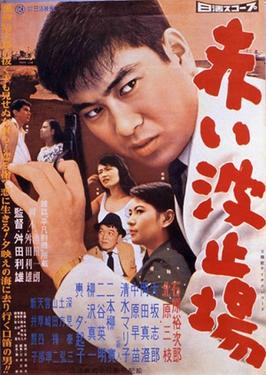
Red Quay is a 1958 black-and-white action Japanese film directed by Toshio Masuda.
Rusty Knife is a 1958 action Japanese film directed by Toshio Masuda. Rusty Knife was part of the Nikkatsu film studio's wave of Japanese noir films, made in order to compete with popular American and French films at the Japanese box office. The film became more widely available outside Japan only when Janus Films released a special set of Nikkatsu noir films on DVD, as part of the Criterion Collection. The other films in the set are A Colt Is My Passport, Take Aim at the Police Van, Cruel Gun Story, and I Am Waiting.

Suspense ~Pink Lady Again~ is the sixth studio album by Japanese idol duo Pink Lady, released through VAP on June 21, 1984. It was the duo's reunion album after having disbanded in 1981. Following the concert tour to promote the album, Mie and Keiko Masuda once again went their separate ways to focus on their solo careers until their second reformation in 1989.
Shaso (社葬) is a 1989 Japanese film directed by Toshio Masuda.
Higepiyo is a four-panel gag manga by Risa Itō about a small yellow bird with a beard, who ends up as a pet of a boy named Hiroshi. Serialized between 2004 and 2006 in Shueisha's Chorus magazine, the series was later compiled into a single volume on 12 January 2007. It was later adapted into an anime television series, which premiered on 3 April 2009, directed by Atsushi Takeyama, written by Natsuko Takahashi and with music by Toshio Masuda. The anime adaptation later inspired the creation of a spin-off manga series, published in Ribon magazine.
Masuda is a Japanese surname. Notable people with the surname include:

Toshio Saeki is a fictional character from the Ju-on franchise, created by Takashi Shimizu. He was played by several child actors, including Daiki Sawada in the short movie 4444444444, Ryōta Koyama in the original two V-Cinema movies, Yuya Ozeki in the theatrical movies and The Grudge, Ohga Tanaka in The Grudge 2, Shimba Tsuchiya in The Grudge 3, Shūsei Uto in Ju-on: White Ghost and Ju-on: Black Ghost, Kai Kobayashi in the 2014 Japanese reboot Ju-on: The Beginning of the End, and Garrett Masuda in the parody Scary Movie 4. He is characterized by his pitch-black eyes, pale skin, and the haunting meowing sounds he makes.
The Human Revolution is a roman à clef written by Daisaku Ikeda, the third and honorary president of the Soka Gakkai, chronicling the efforts of Jōsei Toda, the second president of the Soka Gakkai, to construct this Buddhist organization upon his release from Sugamo Prison at the end of World War II. The Human Revolution has sold millions of copies and served as the source of two films of the same name produced by Toho Company and directed by Toshio Masuda. The novel was printed in 30 volumes.
Toshio Masuda may refer to:

Outlaw: Gangster VIP is a 1968 Japanese crime film directed by Toshio Masuda. The film stars Tetsuya Watari who plays Goro, a gangster who was sent to prison for three years for stabbing a hitman who belonged to the rival gang called the Aokis. On his release from prison, Goro finds out his gang is in decline and learns that the hitman he stabbed is still alive.
Hissatsu!5 Ōgon no Chi is a 1991 film based on the television jidaigeki Hissatsu Shigotonin series. The film is an occasionally whimsical Japanese drama about assassins. The film was directed by Toshio Masuda.

Toshio Masuda is a Japanese politician and a former member of the House of Representatives.
References
- ↑ The Battle of Port Arthur (203 Koshi) in the Internet Movie Database