 | This article needs additional citations for verification .(December 2015) |
In some science fiction stories, total conversion may mean higher or complete conversion of matter into energy, or vice versa in some proportion of E = mc2.
| | This article needs additional citations for verification .(December 2015) |
In some science fiction stories, total conversion may mean higher or complete conversion of matter into energy, or vice versa in some proportion of E = mc2.
Positron and electron production: For photons at high-energy (MeV scale and higher), photon–photon collisions can efficiently convert the photon energy into matter in the form of a positron and an electron: [1]
Proton and antiproton production: Conventional matter consists of protons and electrons, with electrons having insignificant mass compared to protons. One conventional model for producing protons from energy is extremely high-energy cosmic ray protons colliding with nuclei in the interstellar medium, via the reaction:
p
+ A →
p
+
p
+
p
+ A. (A represents an atom, p a proton, and
p
an antiproton.) A portion of the kinetic energy of the initial proton is used to create two additional nuclei: another proton plus an antiproton.
Conventional nuclear reactions such as nuclear fission and nuclear fusion convert relatively small amounts of matter only indirectly into useful energy, such as electricity or rocket thrust. For electricity production released nuclear energy in the form of heat is typically used to boil water to turn a turbine-generator.
Possibly matter is almost completely converted into energy in the cores of neutron stars and black holes by a process of nuclei collapse resulting in: proton → positron + 938 MeV, resulting in a >450 MeV positron-electron jet. Trace nuclei swept up in such a beam would achieve an approximate energy of (nucleus mass/electron mass) × 450 MeV, for example an iron atom could achieve about 45 TeV. An up to 45 TeV atom impacting a proton in the interstellar medium should result in the p + A process described above.
Ion-electron or positron-electron plasma with magnetic confinement theoretically allows direct conversion of particle energy to electricity by the separation of the positive particles from the negative particles with magnetic deflection. Direct conversion of particle energy to thrust is theoretically simpler, merely requiring magnetically directing a neutral plasma beam. Present lab production of relativistic 5 MeV positron-electron beams mimic on a small scale the relativistic jets from compact stars, and allow small scale studies how different elements interact with 5 MeV positron-electron beams, how energy is transferred to particles, the shock effect of gamma-ray bursts, and possible direct thrust and electricity generation from neutral plasmas. Lab positron-electron plasmas could be useful for studying compact star jets and other phenomena. However thrust generation or magnetically separating neutral beams for electrical generation will probably only be useful if there is a practical continuous process for generating neutral plasma by nuclear reactions. [2]

An atom is the smallest unit of ordinary matter that forms a chemical element. Every solid, liquid, gas, and plasma is composed of neutral or ionized atoms. Atoms are extremely small, typically around 100 picometers across. They are so small that accurately predicting their behavior using classical physics—as if they were tennis balls, for example—is not possible due to quantum effects.

In modern physics, antimatter is defined as matter composed of the antiparticles of the corresponding particles in "ordinary" matter. Minuscule numbers of antiparticles are generated daily at particle accelerators—total production has been only a few nanograms—and in natural processes like cosmic ray collisions and some types of radioactive decay, but only a tiny fraction of these have successfully been bound together in experiments to form anti-atoms. No macroscopic amount of antimatter has ever been assembled due to the extreme cost and difficulty of production and handling.

The electron is a subatomic particle,, whose electric charge is negative one elementary charge. Electrons belong to the first generation of the lepton particle family, and are generally thought to be elementary particles because they have no known components or substructure. The electron has a mass that is approximately 1/1836 that of the proton. Quantum mechanical properties of the electron include an intrinsic angular momentum (spin) of a half-integer value, expressed in units of the reduced Planck constant, ħ. Being fermions, no two electrons can occupy the same quantum state, in accordance with the Pauli exclusion principle. Like all elementary particles, electrons exhibit properties of both particles and waves: they can collide with other particles and can be diffracted like light. The wave properties of electrons are easier to observe with experiments than those of other particles like neutrons and protons because electrons have a lower mass and hence a longer de Broglie wavelength for a given energy.
Particle radiation is the radiation of energy by means of fast-moving subatomic particles. Particle radiation is referred to as a particle beam if the particles are all moving in the same direction, similar to a light beam.

The positron or antielectron is the antiparticle or the antimatter counterpart of the electron. The positron has an electric charge of +1 e, a spin of 1/2, and has the same mass as an electron. When a positron collides with an electron, annihilation occurs. If this collision occurs at low energies, it results in the production of two or more photons.

An antimatter rocket is a proposed class of rockets that use antimatter as their power source. There are several designs that attempt to accomplish this goal. The advantage to this class of rocket is that a large fraction of the rest mass of a matter/antimatter mixture may be converted to energy, allowing antimatter rockets to have a far higher energy density and specific impulse than any other proposed class of rocket.

Antihydrogen is the antimatter counterpart of hydrogen. Whereas the common hydrogen atom is composed of an electron and proton, the antihydrogen atom is made up of a positron and antiproton. Scientists hope that studying antihydrogen may shed light on the question of why there is more matter than antimatter in the observable universe, known as the baryon asymmetry problem. Antihydrogen is produced artificially in particle accelerators.

Pair production is the creation of a subatomic particle and its antiparticle from a neutral boson. Examples include creating an electron and a positron, a muon and an antimuon, or a proton and an antiproton. Pair production often refers specifically to a photon creating an electron–positron pair near a nucleus. As energy must be conserved, for pair production to occur, the incoming energy of the photon must be above a threshold of at least the total rest mass energy of the two particles created. Conservation of energy and momentum are the principal constraints on the process. All other conserved quantum numbers of the produced particles must sum to zero – thus the created particles shall have opposite values of each other. For instance, if one particle has electric charge of +1 the other must have electric charge of −1, or if one particle has strangeness of +1 then another one must have strangeness of −1.
Ionizing radiation consists of subatomic particles or electromagnetic waves that have sufficient energy to ionize atoms or molecules by detaching electrons from them. The particles generally travel at a speed that is greater than 1% of that of light, and the electromagnetic waves are on the high-energy portion of the electromagnetic spectrum.

In particle physics, annihilation is the process that occurs when a subatomic particle collides with its respective antiparticle to produce other particles, such as an electron colliding with a positron to produce two photons. The total energy and momentum of the initial pair are conserved in the process and distributed among a set of other particles in the final state. Antiparticles have exactly opposite additive quantum numbers from particles, so the sums of all quantum numbers of such an original pair are zero. Hence, any set of particles may be produced whose total quantum numbers are also zero as long as conservation of energy and conservation of momentum are obeyed.
In physics, a charged particle is a particle with an electric charge. It may be an ion, such as a molecule or atom with a surplus or deficit of electrons relative to protons. It can also be an electron or a proton, or another elementary particle, which are all believed to have the same charge. Another charged particle may be an atomic nucleus devoid of electrons, such as an alpha particle.
ATHENA, AD-1 experiment, was an antimatter research project at the Antiproton Decelerator at CERN, Geneva. In August 2002, it was the first experiment to produce 50,000 low-energy antihydrogen atoms, as reported in Nature. In 2005, ATHENA was disbanded and many of the former members worked on the subsequent ALPHA experiment.
Elastic scattering is a form of particle scattering in scattering theory, nuclear physics and particle physics. In this process, the kinetic energy of a particle is conserved in the center-of-mass frame, but its direction of propagation is modified. Furthermore, while the particle's kinetic energy in the center-of-mass frame is constant, its energy in the lab frame is not. Generally, elastic scattering describes a process in which the total kinetic energy of the system is conserved. During elastic scattering of high-energy subatomic particles, linear energy transfer (LET) takes place until the incident particle's energy and speed has been reduced to the same as its surroundings, at which point the particle is "stopped".
Protonium, also known as antiprotonic hydrogen, is a type of exotic atom in which a proton and an antiproton orbit each other. Since protonium is a bound system of a particle and its corresponding antiparticle, it is an example of a type of exotic atom called an onium.
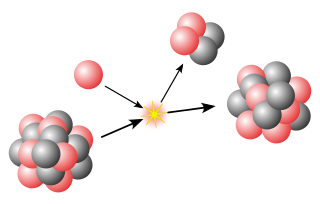
High-energy nuclear physics studies the behavior of nuclear matter in energy regimes typical of high-energy physics. The primary focus of this field is the study of heavy-ion collisions, as compared to lighter atoms in other particle accelerators. At sufficient collision energies, these types of collisions are theorized to produce the quark–gluon plasma. In peripheral nuclear collisions at high energies one expects to obtain information on the electromagnetic production of leptons and mesons that are not accessible in electron–positron colliders due to their much smaller luminosities.
Even restricting the discussion to physics, scientists do not have a unique definition of what matter is. In the currently known particle physics, summarised by the standard model of elementary particles and interactions, it is possible to distinguish in an absolute sense particles of matter and particles of antimatter. This is particularly easy for those particles that carry electric charge, such as electrons or protons or quarks, while the distinction is more subtle in the case of neutrinos, fundamental elementary particles that do not carry electric charge. In the standard model, it is not possible to create a net amount of matter particles—or more precisely, it is not possible to change the net number of leptons or of quarks in any perturbative reaction among particles. This remark is consistent with all existing observations.

The Bevatron was a particle accelerator — specifically, a weak-focusing proton synchrotron — at Lawrence Berkeley National Laboratory, U.S., which began operating in 1954. The antiproton was discovered there in 1955, resulting in the 1959 Nobel Prize in physics for Emilio Segrè and Owen Chamberlain. It accelerated protons into a fixed target, and was named for its ability to impart energies of billions of eV.

The Antiproton Decelerator (AD) is a storage ring at the CERN laboratory near Geneva. It was built from the Antiproton Collector (AC) to be a successor to the Low Energy Antiproton Ring (LEAR) and started operation in the year 2000. Antiprotons are created by impinging a proton beam from the Proton Synchrotron on a metal target. The AD decelerates the resultant antiprotons to an energy of 5.3 MeV, which are then ejected to one of several connected experiments.

A particle accelerator is a machine that uses electromagnetic fields to propel charged particles to very high speeds and energies, and to contain them in well-defined beams.
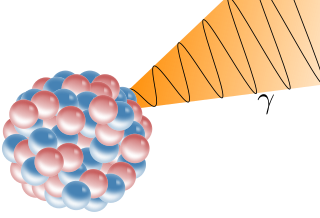
A gamma ray, also known as gamma radiation, is a penetrating form of electromagnetic radiation arising from the radioactive decay of atomic nuclei. It consists of the shortest wavelength electromagnetic waves and so imparts the highest photon energy. Paul Villard, a French chemist and physicist, discovered gamma radiation in 1900 while studying radiation emitted by radium. In 1903, Ernest Rutherford named this radiation gamma rays based on their relatively strong penetration of matter; in 1900 he had already named two less penetrating types of decay radiation alpha rays and beta rays in ascending order of penetrating power.
 | This science fiction–related article is a stub. You can help Wikipedia by expanding it. |