This article is being considered for deletion in accordance with Wikipedia's deletion policy.
Please share your thoughts on the matter at this article's entry on the Articles for deletion page. Feel free to improve the article, but the article must not be blanked, and this notice must not be removed, until the discussion is closed. For more information, particularly on merging or moving the article during the discussion, read the guide to deletion. Find sources:"Tournament shield"–news·newspapers·books·scholar·JSTOR%5B%5BWikipedia%3AArticles+for+deletion%2FTournament+shield%5D%5DAFD
The shield banderese, also known as a tournament shield or square shield, is a shield is of wide rectangular shape 7 modules and high 8.
A shield is a piece of personal armour held in the hand or mounted on the wrist or forearm. Shields are used to intercept specific attacks, whether from close-ranged weaponry or projectiles such as arrows, by means of active blocks, as well as to provide passive protection by closing one or more lines of engagement during combat.
It was the shield of the gentlemen who had the right to take up arms to their vassals, and to lead them to war under their flag. These gentlemen were called knights banderesi (chevaliers bannerets).
A vassal is a person regarded as having a mutual obligation to a lord or monarch, in the context of the feudal system in medieval Europe. The obligations often included military support by knights in exchange for certain privileges, usually including land held as a tenant or fief. The term is applied to similar arrangements in other feudal societies.
A knight is a man granted an honorary title of knighthood by a monarch, bishop or other political or religious leader for service to the monarch or a Christian church, especially in a military capacity. Historically, in all Europe, knighthood was conferred upon mounted warriors. During the High Middle Ages, knighthood was considered a class of lower nobility. By the Late Middle Ages, the rank had become associated with the ideals of chivalry, a code of conduct for the perfect courtly Christian warrior. Often, a knight was a vassal who served as an elite fighter, a bodyguard or a mercenary for a lord, with payment in the form of land holdings. The lords trusted the knights, who were skilled in battle on horseback.
The shield banderese, replicated fabric and attached to a vertical rod, is the direct ancestor of the flags, in their original square form.
Tournament shields were first recorded when Philip II the Bold, Duke of Burgundy, used one in a tournament in 1399. The French used it after Charles VI formed a company of 500 knights.
Duke of Burgundy was a title borne by the rulers of the Duchy of Burgundy, a small portion of traditional lands of Burgundians west of river Saône which in 843 was allotted to Charles the Bald's kingdom of West Franks. Under the Ancien Régime, the Duke of Burgundy was the premier lay peer of the kingdom of France.
France, officially the French Republic, is a country whose territory consists of metropolitan France in Western Europe and several overseas regions and territories. The metropolitan area of France extends from the Mediterranean Sea to the English Channel and the North Sea, and from the Rhine to the Atlantic Ocean. It is bordered by Belgium, Luxembourg and Germany to the northeast, Switzerland and Italy to the east, and Andorra and Spain to the south. The overseas territories include French Guiana in South America and several islands in the Atlantic, Pacific and Indian oceans. The country's 18 integral regions span a combined area of 643,801 square kilometres (248,573 sq mi) and a total population of 67.3 million. France, a sovereign state, is a unitary semi-presidential republic with its capital in Paris, the country's largest city and main cultural and commercial centre. Other major urban areas include Lyon, Marseille, Toulouse, Bordeaux, Lille and Nice.
Charles VI, called the Beloved and the Mad, was King of France for 42 years from 1380 to his death in 1422, the fourth from the House of Valois.
This page explains commonly used terms in chess in alphabetical order. Some of these have their own pages, like fork and pin. For a list of unorthodox chess pieces, see Fairy chess piece; for a list of terms specific to chess problems, see Glossary of chess problems; for a list of chess-related games, see List of chess variants.
In heraldry, supporters, sometimes referred to as attendants, are figures or objects usually placed on either side of the shield and depicted holding it up.
Jousting is a martial game or hastilude between two horsemen wielding lances with blunted tips, often as part of a tournament. The primary aim was to replicate a clash of heavy cavalry, with each participant trying hard to strike the opponent while riding towards him at high speed, breaking the lance on the opponent's shield or jousting armour if possible, or unhorsing him. The joust became an iconic characteristic of the knight in Romantic medievalism. The participants experience close to three and a quarter times their body weight in G-forces when the lances collide with their armour.
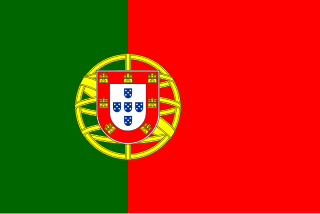
The Flag of Portugal is a rectangular bicolour with a field unevenly divided into green on the hoist, and red on the fly. The lesser version of the national coat of arms is centered over the colour boundary at equal distance from the upper and lower edges. On 30 June 1911, less than a year after the downfall of the constitutional monarchy, this design was officially adopted for the new national flag of the First Portuguese Republic, after selection by a special commission whose members included Columbano Bordalo Pinheiro, João Chagas and Abel Botelho.
Starting in the Middle Ages, a squire was the shield- or armour-bearer of a knight. At times, a squire acted as a knight's errand runner.
A crest is a component of a heraldic display, consisting of the device borne on top of the helm. Originating in the decorative sculptures worn by knights in tournaments and, to a lesser extent, battles, crests became solely pictorial after the 16th century.
In Scotland, a Baron is the head of a "feudal" barony. This used to be attached to a particular piece of land on which was the "caput", or the essence of the barony, normally a building, such as a castle or manor house. Accordingly, the owner of the piece of land containing the "caput" was the Baron or Baroness. The Court of the Lord Lyon issued a new ruling April 2015 that recognises a person possessing the dignity of baron and other feudal titles (Lordship/Earl/Marquis). Lord Lyon now prefers the approach of recognizing the particular feudal noble dignity as expressed in the Crown Charter that the petitioner presents. These titles are recognised as the status of a minor baron but not a peer. Scottish feudal baronies may be passed to any person, of either sex, by inheritance or conveyance. Scotland has a distinct legal system within the United Kingdom. Historically, in the Kingdom of Scotland, the Lord Lyon King of Arms, as the Sovereign’s Minister in matters armorial, is at once Herald and Judge.
A pale is a term used in heraldic blazon and vexillology to describe a charge on a coat of arms, that takes the form of a band running vertically down the centre of the shield. Writers broadly agree that the width of the pale ranges from about one-fifth to about one-third of the width of the shield, but this width is not fixed. A narrow pale is more likely if it is uncharged, that is, if it does not have other objects placed on it. If charged, the pale is typically wider to allow room for the objects drawn there.
The coat of arms of Portugal is the main heraldic insignia of Portugal. The present model was officially adopted on 30 June 1911, along with the present model of the Flag of Portugal. It is based on the coat of arms used by the Portuguese Kingdom since the Middle Ages. The coat of arms of Portugal is popularly referred as the Quinas.
In classical heraldry, vert is the name of the tincture equivalent to the colour "green". It is one of the five dark tinctures (colours). The word vert is simply the French for "green". It is used in English in the sense of a heraldic tincture since the early 16th century. In Modern French, vert is not used as a heraldic term. Instead, the French heraldic term for green tincture is sinople. This has been the case since c. the 16th century. In medieval French heraldry, vert also meant "green" while sinople was a shade of red. Vert is portrayed by the conventions of heraldic "hatching" by lines at a 45-degree angle from upper left to lower right, or indicated by the abbreviation vt. when a coat of arms is tricked.
This article is a vexillological summary of all flags and symbols in current use by the island nation of Malta. More information on the history of the various flags and emblems, as well as on their equivalents which are no longer in use, is found on the specific articles, linked to in the subtitle headings.
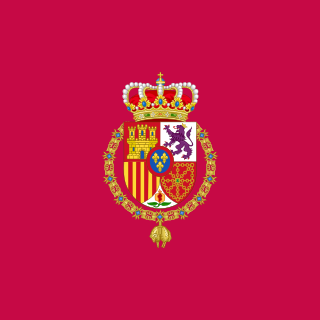
The Royal Standard of Spain is the official flag of the King of Spain. It comprises a crimson square, traditional colour of both Castilian and Spanish monarchs, with the coat of arms of the King in the center. It is raised over the official royal residence in Madrid, the Palacio de la Zarzuela and other Spanish royal sites, when the monarch is in residence and displayed on his official car as small flag. The current flag was adopted when Felipe VI acceded the throne as King of Spain on 19 June 2014. The Royal Standard is regulated by Rule 2 of Royal Decree 527/2014, 20 June, an amendment to Title II of Spanish Royal Decree 1511/1977 adopting Flags, Standards, Guidons, Insignia and Emblems Regulation.
LEGO Castle was a Lego medieval and fantasy theme featuring knights and castles. It was introduced in 1978 until 1997. The medieval theme was then carried on in the LEGO Knights Kingdoms and later LEGO Kingdoms themes. Lego Castle sets were marketed under the LEGOLAND banner until 1991. LEGO decided to change and add LEGO System in 1992, but was dropped after 1999.
The heater shield or heater-shaped shield is a form of European medieval shield, developing from the early medieval kite shield in the late 12th century as depicted in the great seal of Richard I and John. The term is a neologism, created by Victorian antiquarians due to the shape's resemblance to a clothes iron.
In heraldry and vexillology, a heraldic flag is a flag containing coats of arms, heraldic badges, or other devices used for personal identification.
Attributed arms are Western European coats of arms given retrospectively to persons real or fictitious who died before the start of the age of heraldry in the latter half of the 12th century. Arms were assigned to the knights of the Round Table, and then to biblical figures, to Roman and Greek heroes, and to kings and popes who had not historically borne arms. Each author could attribute different arms for the same person, but the arms for major figures soon became fixed.
The royal standards of England were narrow, tapering swallow-tailed heraldic flags, of considerable length, used mainly for mustering troops in battle, in pageants and at funerals, by the monarchs of England. In high favour during the Tudor period, the Royal English Standard was a flag that was of a separate design and purpose to the Royal Banner. It featured St George's Cross at its head, followed by a number of heraldic devices, a supporter, badges or crests, with a motto—but it did not bear a coat of arms. The Royal Standard changed its composition frequently from reign to reign, but retained the motto Dieu et mon droit, meaning God and my right; which was divided into two bands: Dieu et mon and Droyt.
In heraldic achievements, the helmet or helm is situated above the shield and bears the torse and crest. The style of helmet displayed varies according to rank and social status, and these styles developed over time, in step with the development of actual military helmets. In some traditions, especially German and Nordic heraldry, two or three helmets may be used in a single achievement of arms, each representing a fief to which the bearer has a right. For this reason, the helmets and crests in German and Nordic arms are considered to be essential to the coat of arms and are never separated from it.
A number of cross symbols were developed for the purpose of the emerging system of heraldry, which appeared in western Europe in about 1200. This tradition is partly in the use of the Christian cross an emblem from the 11th century, and increasingly during the age of the Crusades. A large number of cross variants were developed in the classical tradition of heraldry during the late medieval and early modern periods. Heraldic crosses are inherited in modern iconographic traditions and are used in numerous national flags.
This page is based on this Wikipedia article Text is available under the CC BY-SA 4.0 license; additional terms may apply. Images, videos and audio are available under their respective licenses.