Related Research Articles

Chinese is a group of languages spoken natively by the ethnic Han Chinese majority and many minority ethnic groups in China, as well as by various communities of the Chinese diaspora. Approximately 1.35 billion people, or 17% of the global population, speak a variety of Chinese as their first language.
Myriad is technically the number 10,000 ; in that sense, the term is used in English almost exclusively for literal translations from Greek, Latin or Sinospheric languages, or when talking about ancient Greek numerals.

Standard Chinese is a modern standard form of Mandarin Chinese that was first codified during the republican era (1912–1949). It is designated as the official language of mainland China and a major language in the United Nations, Singapore, and Taiwan. It is largely based on the Beijing dialect. Standard Chinese is a pluricentric language with local standards in mainland China, Taiwan and Singapore that mainly differ in their lexicon. Hong Kong written Chinese, used for formal written communication in Hong Kong and Macau, is a form of Standard Chinese that is read aloud with the Cantonese reading of characters.

Kanji are the logographic Chinese characters adapted from the Chinese script used in the writing of Japanese. They were made a major part of the Japanese writing system during the time of Old Japanese and are still used, along with the subsequently-derived syllabic scripts of hiragana and katakana. The characters have Japanese pronunciations; most have two, with one based on the Chinese sound. A few characters were invented in Japan by constructing character components derived from other Chinese characters. After the Meiji Restoration, Japan made its own efforts to simplify the characters, now known as shinjitai, by a process similar to China's simplification efforts, with the intention to increase literacy among the general public. Since the 1920s, the Japanese government has published character lists periodically to help direct the education of its citizenry through the myriad Chinese characters that exist. There are nearly 3,000 kanji used in Japanese names and in common communication.
Written Chinese is a writing system that uses Chinese characters and other symbols to represent the Chinese languages. Chinese characters do not directly represent pronunciation, unlike letters in an alphabet or syllabograms in a syllabary. Rather, the writing system is morphosyllabic: characters are one spoken syllable in length, but generally correspond to morphemes in the language, which may either be independent words, or part of a polysyllabic word. Most characters are constructed from smaller components that may reflect the character's meaning or pronunciation. Literacy requires the memorization of thousands of characters; college-educated Chinese speakers know approximately 4,000. This has led in part to the adoption of complementary transliteration systems as a means of representing the pronunciation of Chinese.
Classical Chinese is the language in which the classics of Chinese literature were written, from c. the 5th century BCE. For millennia thereafter, the written Chinese used in these works was imitated and iterated upon by scholars in a form now called Literary Chinese, which was used for almost all formal writing in China until the early 20th century. Each written character corresponds to a single spoken syllable, and almost always to a single independent word. As a result, the characteristic style of the language is comparatively terse.
Written vernacular Chinese, also known as baihua, comprises forms of written Chinese based on the vernacular varieties of the language spoken throughout China. It is contrasted with Literary Chinese, which was the predominant written form of the language in imperial China until the early 20th century.

Chengyu are a type of traditional Chinese idiomatic expressions, most of which consist of four Chinese characters. Chengyu were widely used in Literary Chinese and are still common in written vernacular Chinese writing and in the spoken language today. According to the most stringent definition, there are about 5,000 chengyu in the Chinese language, though some dictionaries list over 20,000. Chengyu are considered the collected wisdom of the Chinese culture, and contain the experiences, moral concepts, and admonishments from previous generations of Chinese speakers. Chengyu still play an important role in Chinese conversation and education. Chinese idioms are one of four types of formulaic expressions, which also include collocations, two-part allegorical sayings called xiehouyu, and proverbs.

Gwoyeu Romatzyh is a system for writing Standard Chinese using the Latin alphabet. It was primarily conceived by Yuen Ren Chao (1892–1982), who led a group of linguists on the National Languages Committee in refining the system between 1925 and 1926. In September 1928, it was adopted by the Republic of China as the national romanization system for Standard Chinese. GR indicates the four tones of Standard Chinese by varying the spelling of syllables, a method originally proposed by team member Lin Yutang (1895–1976). Distinct sets of spellings are assigned to syllables in GR according to particular rules. This differs from approaches used by other systems to denote tones, like the numerals used by the earlier Wade–Giles system, or the diacritics used by the later Hanyu Pinyin system.
Sino-Japanese vocabulary, also known as kango, is a subset of Japanese vocabulary that originated in Chinese or was created from elements borrowed from Chinese. Some grammatical structures and sentence patterns can also be identified as Sino-Japanese.
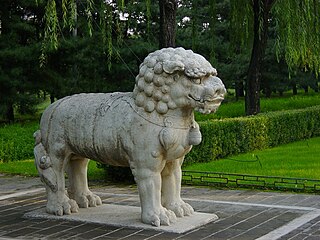
"Lion-Eating Poet in the Stone Den" is a short narrative poem written in Literary Chinese, composed of around 92 to 94 characters in which every word is pronounced shi when read in modern Standard Chinese, with only the tones differing.

Written Cantonese is the most complete written form of a Chinese language after that for Mandarin Chinese and Classical Chinese. Written Chinese was the main literary language of China until the 19th century. Written vernacular Chinese first appeared in the 17th century, and a written form of Mandarin became standard throughout China in the early 20th century. Cantonese is a common language in places like Hong Kong and Macau. While the Mandarin form can to some extent be read and spoken word for word in other Chinese varieties, its intelligibility to non-Mandarin speakers is poor to incomprehensible because of differences in idioms, grammar and usage. Modern Cantonese speakers have therefore developed new characters for words that do not exist and have retained others that have been lost in standard Chinese.
General Chinese is a diaphonemic orthography invented by Yuen Ren Chao to represent the pronunciations of all major varieties of Chinese simultaneously. It is "the most complete genuine Chinese diasystem yet published". It can also be used for the Korean, Japanese, and Vietnamese pronunciations of Chinese characters, and challenges the claim that Chinese characters are required for interdialectal communication in written Chinese.

Taiwanese Mandarin, frequently referred to as Guoyu or Huayu, is the variety of Mandarin Chinese spoken in Taiwan. A large majority of the Taiwanese population is fluent in Mandarin, though many also speak a variety of Min Chinese known as Taiwanese Hokkien, which has had a significant influence on the Mandarin spoken on the island.

There are two types of dictionaries regularly used in the Chinese language: 'character dictionaries' list individual Chinese characters, and 'word dictionaries' list words and phrases. Because tens of thousands of characters have been used in written Chinese, Chinese lexicographers have developed a number of methods to order and sort characters to facilitate more convenient reference.

The debate on traditional Chinese characters and simplified Chinese characters is an ongoing dispute concerning Chinese orthography among users of Chinese characters. It has stirred up heated responses from supporters of both sides in mainland China, Hong Kong, Macau, Taiwan, and among overseas Chinese communities with its implications of political ideology and cultural identity. Simplified characters here exclusively refer to those characters simplified by the People's Republic of China (PRC), instead of the concept of character simplification as a whole. The effect of simplified characters on the language remains controversial, decades after their introduction.
Singaporean Mandarin is a variety of Mandarin Chinese spoken natively in Singapore. Mandarin is one of the four official languages of Singapore along with English, Malay and Tamil.
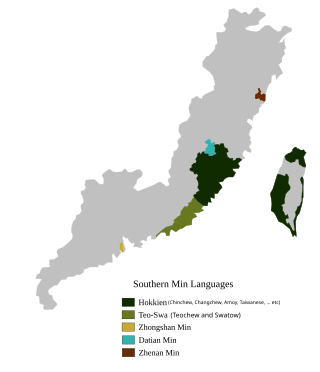
Hokkien is a variety of the Southern Min languages, native to and originating from the Minnan region, in the southeastern part of Fujian in southeastern mainland China. It is also referred to as Quanzhang, from the first characters of the urban centers of Quanzhou and Zhangzhou.
Differing literary and colloquial readings for certain Chinese characters are a common feature of many Chinese varieties, and the reading distinctions for these linguistic doublets often typify a dialect group. Literary readings are usually used in loanwords, geographic and personal names, literary works such as poetry, and in formal contexts, while colloquial readings are used in everyday vernacular speech.
Hokkien, a variety of Chinese that forms part of the Southern Min family and is spoken in Southeastern China, Taiwan and Southeast Asia, does not have a unitary standardized writing system, in comparison with the well-developed written forms of Cantonese and Standard Chinese (Mandarin). In Taiwan, a standard for Written Hokkien has been developed by the Ministry of Education including its Dictionary of Frequently-Used Taiwan Minnan, but there are a wide variety of different methods of writing in Vernacular Hokkien. Nevertheless, vernacular works written in Hokkien are still commonly seen in literature, film, performing arts and music.