Related Research Articles
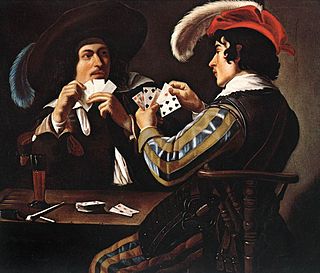
A card game is any game using playing cards as the primary device with which the game is played, be they traditional or game-specific.
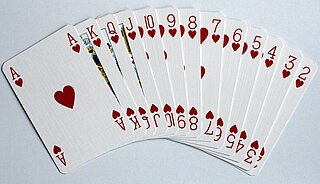
Hearts is an "evasion-type" trick-taking playing card game for four players, although most variations can accommodate between three and six players. It was first recorded in America in the 1880s and has many variants, some of which are also referred to as "Hearts"; especially the games of Black Lady and Black Maria. The game is a member of the Whist group of trick-taking games, but is unusual among Whist variants in that it is a trick-avoidance game; players avoid winning certain penalty cards in tricks, usually by avoiding winning tricks altogether. The original game of Hearts is still current, but has been overtaken in popularity by Black Lady in the United States and Black Maria in Great Britain.
Oh Hell, Oh Pshaw or Nomination Whist is a trick-taking card game of British origin in which the object is to take exactly the number of tricks bid. Unlike contract bridge and spades, taking more tricks than bid is a fail. It was first described by B. C. Westall around 1930 and originally called Oh! Well. It was said to have been introduced into America via the New York clubs in 1931. It has been described as "one of the best round games."
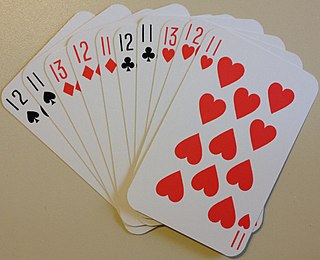
500 or Five Hundred, also called Bid Euchre is a trick-taking game that is an extension of Euchre with some ideas from bridge. It can be played by two to six players, is most commonly played by four, in partnerships, and has also been recommended as a good three-player game. It arose in America before 1900 and was promoted by the US Playing Card Company, who copyrighted and marketed the rules in 1904. 500 is a social card game and was highly popular in the United States until around 1920 when first auction bridge and then contract bridge drove it from favour. It continues be popular in Ohio and Pennsylvania, where it has been taught through six generations community-wide, and in other countries: Australia, New Zealand, Canada and Shetland. Despite its American origin, 500 is the national card game of Australia.
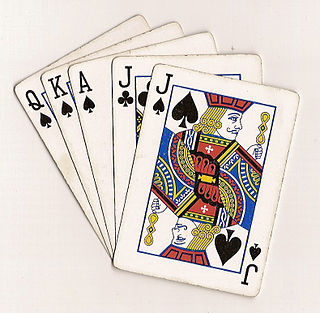
Euchre or eucre is a trick-taking card game commonly played in Australia, Canada, New Zealand, Great Britain, and the United States. It is played with a deck of 24, 28, or 32 standard playing cards. Normally there are four players, two on each team, although there are variations that range from two to nine players.
Card players are those participating in a card game. Various names are given to card players based on their role or position.

Brag is an 18th century British card game, and the British national representative of the vying or "bluffing" family of gambling games. It is a descendant of the Elizabethan game of Primero and one of the several ancestors to poker, the modern version just varying in betting style and hand rankings. It has been described as the "longest-standing British representative of the Poker family."

Jacob Leonard Replogle, usually known as J. L. Replogle, was a wealthy American industrialist.
Rubber bridge is a form of contract bridge played by two competing pairs using a particular method of scoring. A rubber is completed when one pair becomes first to win two games, each game presenting a score of 100 or more contract points; a new game ensues until one pair has won two games to conclude the rubber. Owing to the availability of various additional bonus and penalty points in the scoring, it is possible, though less common, to win the rubber by amassing more total points despite losing two games out of three. Rubber bridge involves a high degree of skill but there is also a fair amount of luck involved in who gets the best cards.
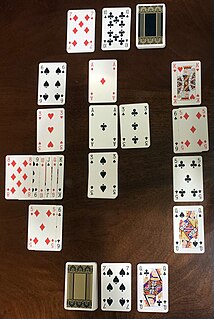
Russian Bank, Crapette or Tunj, historically also called Wrangle, is a card game for two players from the solitaire family. It is played with two decks of 52 standard playing cards. The U.S. Playing Card Company called it "probably the best game for two players ever invented".

Twenty-five or Spoil-Five, is the Irish national card game, which also underlies the Canadian game of Forty-fives. Charles Cotton describes it in 1674 as "Five Fingers", a nickname applied to the Five of Trumps extracted from the fact that the Irish word cúig means both 'five' and 'trick'. It is supposed to be of great antiquity, and widely believed to have originated in Ireland, although "its venerable ancestor", Maw, of which James I of England was very fond, is a Scottish game.

Nerts (US), Pounce (US) or Racing Demon (UK) is a fast-paced, multiplayer card game involving multiple decks of playing cards. It is often described as a combination of the card games Speed and Solitaire.
Cinch, also known as Double Pedro or High Five, is an American trick-taking card game derived from Pitch via Pedro. Developed in Denver, Colorado in the 1880s, it was soon regarded as the most important member of the All Fours family but went out of fashion with the rise of Auction Bridge. The game is primarily played by 4 players in fixed partnerships, but can also be played by 2–6 individual players.

Catch the Ten is a point trick-taking card game which first appeared in The American Hoyle of 1868 and is alternatively called Scotch Whist, although evidence shows that it is in fact of German origin. Unlike standard whist, it is played with a deck of only 36 cards, with Six (low) up to the Ace (high) of each suit. The order of trumps has the Jack high.

Robert Frederick Foster of New York City, known as R. F. Foster, was a memory training promoter and the prolific writer of more than 50 nonfiction books. He wrote primarily on the rules of play and methods for successful play of card, dice, and board games. Alan Truscott wrote 20 years after his death that Foster "had been one of the great figures in whist and bridge" for 60 years.
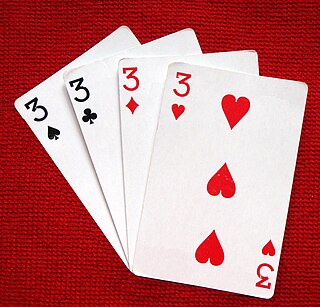
Put is an English tavern trick-taking card game first recorded in the 16th century and later castigated by 17th century moralists as one of ill repute. It belongs to a very ancient family of card games and clearly relates to a group known as Trut, Truque, also Tru, and the South American game Truco. Its more elaborate version is the Spanish game of Truc, which is still much played in many parts of Southern France and Spain.

Quinze, Quince, also known as Ace-low, is a 17th-century French card game of Spanish origin that was much patronized in some parts of Europe. It is considered a forerunner of the French Vingt-et-un, a game very popular at the court of Louis XV, and also a two-player simplification of the modern game of Blackjack.
Commerce is an 18th-century gambling French card game akin to Thirty-one and perhaps ancestral to Whisky Poker and Bastard Brag. It aggregates a variety of games with the same game mechanics. Trade and Barter, the English equivalent, has the same combinations, but a different way of acquiring them. Trentuno, Trent-et-Uno, applies basically to the same method of play, but also has slightly different combinations. Its rules are recorded as early as 1769.

Newmarket is an English card game of the matching type for any number of players. It is a domestic gambling game, involving more chance than skill, and emerged in the 1880s as an improvement of the older game of Pope Joan. It became known in America as Stops or Boodle before developing into Michigan. In 1981, Newmarket was still the sixth most popular card game in Britain.
Ramscheln, also called Ramsch, is a German card game for three to five players, which is usually played for small stakes. It is a variant of Mönch and a member of the Rams group of card games characterised by allowing players to drop out of the current game if they think they will be unable to win any tricks or a minimum number of tricks. It should not be confused with Ramsch, an unofficial contract in Skat, played when everyone passes, in which the aim is not to score the most card points.
References
- ↑ Peter Chambers Chambers Card Games 0550106863 2012 "The game which has survived longest is Towie, invented around 1931. The description here assumes that the reader can play Bridge. Aim Each player attempts to win two games and thus the rubber. Cards: The standard pack of 52 cards is ..."
- ↑ Albert Hodges Morehead, Edmond Hoyle The New Complete Hoyle 0385249624 - 1991 Page 223 "Essentially a three-hand game, Towie may be played by four, five, or more players, only three of whom are active at any one ..."
- ↑ William J Huske; J. Leonard Replogle Towie, including the complete official laws and a discussion of the strategy of bidding and the tactics of play New York, Lewis Copeland Company, 1934
- ↑ Vanity Fair - Volumes 43-45 - Page 40 1935 "It is the fifth article on Towie to appear in Vanity Fair. The others have been by Christopher Dunphy, W. J. Huske and Lelia Hattersley. Mr. Dunphy's piece, in the October issue, was the first article to be published on this new game. A book on ."
 | This card game–related article is a stub. You can help Wikipedia by expanding it. |