
Sphaerius is a genus of beetles, comprising 23 species, which are the only members of the family Sphaeriusidae. They are typically found along the edges of streams and rivers, where they feed on algae; they occur on all continents except Antarctica. Three species occur in the United States.

Passalidae is a family of beetles known variously as "bessbugs", "bess beetles", "betsy beetles" or "horned passalus beetles". Nearly all of the 500-odd species are tropical; species found in North America are notable for their size, ranging from 20–43 mm, for having a single "horn" on the head, and for a form of social behavior unusual among beetles.

The rove beetles are a family (Staphylinidae) of beetles, primarily distinguished by their short elytra that typically leave more than half of their abdominal segments exposed. With roughly 63,000 species in thousands of genera, the group is currently recognized as the largest extant family of organisms. It is an ancient group, with fossilized rove beetles known from the Triassic, 200 million years ago, and possibly even earlier if the genus Leehermania proves to be a member of this family. They are an ecologically and morphologically diverse group of beetles, and commonly encountered in terrestrial ecosystems.
Lutrochidae is a family of water beetles sometimes known as "travertine beetles", since in North America they are common in springs and streams depositing travertine.
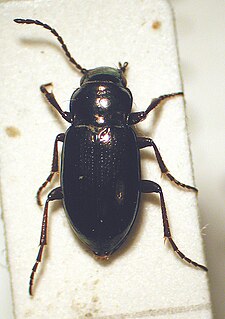
The Trachypachidae are a family of beetles that generally resemble small ground beetles, but that are distinguished by the large coxae of their rearmost legs. There are only six known extant species in the family, with four species of Trachypachus found in northern Eurasia and northern North America, and two species of Systolosoma in Chile. They were much more diverse in the past, with many members belonging to the extinct subfamily Eodromeinae, the first fossils known of this family are of the genera Petrodromeus and Permunda from the Permian-Triassic boundary of Russia.

Sphaerites is a genus of beetles, the only genus in the family Sphaeritidae, sometimes called the false clown beetles. It is closely related to the clown beetles but with distinct characteristics. There are five known species, widespread in temperate area but not commonly seen.

Derodontidae is a family of beetles, in its own superfamily, Derodontoidea, sometimes known as the tooth-necked fungus beetles. Beetles of this family are small, between 2 and 6 mm in length, with spiny margins on their pronotum that give them their name. The genus, Laricobius, lacks these spines. They have two ocelli on the top of their heads.

The Boridae are a small family of beetles with no vernacular common name, though recent authors have coined the name conifer bark beetles.
Syntelia is a genus of middle-sized beetles, the only genus in the family Synteliidae.

Georissus, also called minute mud-loving beetles, is the only genus in the beetle family Georissidae. They are tiny insects living in wet soil, often near water. Found on every continent except Antarctica.

Jacobsoniidae is a family of beetles. The larvae and adults live under bark, in plant litter, fungi, bat guano and rotten wood. It is a small family with 23 described species in three genera:
Meruidae is a recently described family of aquatic beetles in the suborder Adephaga, with only one genus and species, Meru phyllisae. This beetle species was first found in the early 1980s. At 0.8 mm, it is one of the smallest adephagan beetles in the world. A recent survey of aquatic beetles of Venezuela prove that Meru is most common during the wet season, when larger areas of granitic rock surface are covered with water film, which the adult beetles as well as the larvae inhabit.

Silvanidae, "silvan flat bark beetles", is a family of beetles in the superfamily Cucujoidea, consisting of 58 described genera and about 500 described species. The family is represented on all continents except Antarctica, and is most diverse at both the generic and species levels in the Old World tropics.

Byturidae, also known as Fruitworms, is a very small family of beetles, in the suborder Polyphaga, comprising fewer than 20 species worldwide. The larvae of some species develop in fruits. Byturus unicolor affects species of Rubus and Geum.
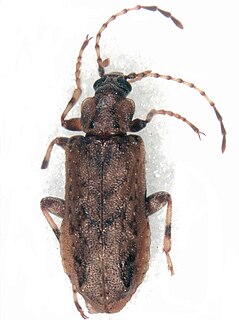
The Chalcodryidae are a family of beetles in the large suborder Polyphaga.

Trachypteris picta is a species of beetles in the family Buprestidae, the only species in the genus Trachypteris.
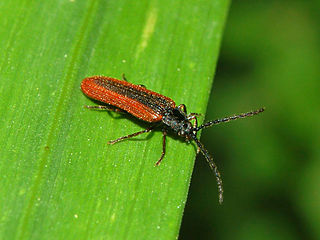
Omalisidae are a very small family of beetles within the superfamily Elateroidea. Members of this beetle family have bioluminescent organs on the larvae. The most recent evidence indicates they are the sister group to a clade comprising the families Rhagophthalmidae and Phengodidae.

Clambidae is a family of beetles. They are known commonly as the minute beetles or the fringe-winged beetles. They are found worldwide on every continent except Antarctica.

Cyclaxyra is a genus of cucujoid beetles in the family Cyclaxyridae, and the sole extant genus in the family, others being known only from fossils. There are two described species in Cyclaxyra, found on the North Island, South Island, and Stewart Island of New Zealand.
Trachypteris is a small genus of ferns in the subfamily Cheilanthoideae of the family Pteridaceae. Three species are native to the tropical South America, one to Madagascar.
