
James Burke is a British broadcaster, science historian, author, and television producer, who is known, among other things, for the BBC1 science series Tomorrow's World, his documentary television series Connections (1978), and for its more philosophically oriented companion series, The Day the Universe Changed (1985), which is about the history of science and technology. The Washington Post has called him "one of the most intriguing minds in the Western world".

Sociology of sport, alternately referred to as sports sociology, is a sub-discipline of sociology which focuses on sports as social phenomena. It is an area of study concerned with the relationship between sociology and sports, and also various socio-cultural structures, patterns, and organizations or groups involved with sport. This area of study discusses the positive impact sports have on individual people and society as a whole economically, financially, and socially. Sociology of sport attempts to view the actions and behavior of sports teams and their players through the eyes of a sociologist.

Conspicuous consumption is the spending of money on and the acquiring of luxury goods and services to publicly display economic power—of the income or of the accumulated wealth of the buyer. To the conspicuous consumer, such a public display of discretionary economic power is a means of either attaining or maintaining a given social status.

Veblen goods are types of luxury goods for which the quantity demanded increases as the price increases, an apparent contradiction of the law of demand, resulting in an upward-sloping demand curve. Some goods become more desirable because of their high prices. For example, in the 1990s when "fashion" jeans became popular, one retailer was able to sell more after raising the price. A higher price may make a product desirable as a status symbol in the practices of conspicuous consumption and conspicuous leisure. A product may be a Veblen good because it is a positional good, something few others can own.
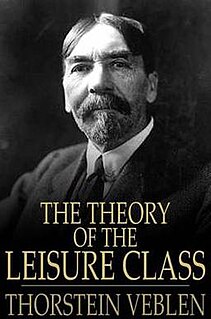
The Theory of the Leisure Class: An Economic Study of Institutions (1899), by Thorstein Veblen, is a treatise on economics and a detailed, social critique of conspicuous consumption, as a function of social class and of consumerism, derived from the social stratification of people and the division of labour, which are the social institutions of the feudal period that have continued to the modern era.
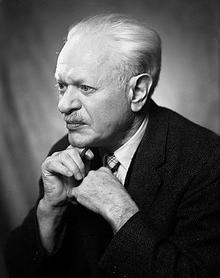
Kenneth Duva Burke was an American literary theorist, as well as poet, essayist, and novelist, who wrote on 20th-century philosophy, aesthetics, criticism, and rhetorical theory. As a literary theorist, Burke was best known for his analyses based on the nature of knowledge. Furthermore, he was one of the first individuals to stray away from more traditional rhetoric and view literature as "symbolic action."
Institutional economics focuses on understanding the role of the evolutionary process and the role of institutions in shaping economic behaviour. Its original focus lay in Thorstein Veblen's instinct-oriented dichotomy between technology on the one side and the "ceremonial" sphere of society on the other. Its name and core elements trace back to a 1919 American Economic Review article by Walton H. Hamilton. Institutional economics emphasizes a broader study of institutions and views markets as a result of the complex interaction of these various institutions. The earlier tradition continues today as a leading heterodox approach to economics.

The technocracy movement is a social movement which arose in the early 20th century. Technocracy was popular in the United States and Canada for a brief period in the early 1930s, before it was overshadowed by other proposals for dealing with the crisis of the Great Depression. The technocracy movement proposed replacing politicians and businesspeople with scientists and engineers who had the technical expertise to manage the economy.
Technocracy is a proposed system of governance in which decision-makers are selected on the basis of their expertise in a given area of responsibility, particularly with regard to scientific or technical knowledge. This system explicitly contrasts with the notion that elected representatives should be the primary decision-makers in government, though it does not necessarily imply eliminating elected representatives. Leadership skills for decision-makers are selected on the basis of specialized knowledge and performance, rather than political affiliations or parliamentary skills.

Geoffrey Martin Hodgson is a Professor in Management at Loughborough University London, and also the editor-in-chief of the Journal of Institutional Economics.
Occupational psychosis is the concept that one's occupation or career makes that person so biased that they could be described as psychotic. Especially common in tight occupational circles, individuals can normalize ideas or behaviours that seem absurd or irrational to the external public.
Douglas Fitzgerald Dowd was an American political economist, economic historian and political activist.
The Theory of Business Enterprise is an economics book by Thorstein Veblen published in 1904 that looks at the growing corporate domination of culture and the economy.

The Thorstein Veblen Farmstead is a National Historic Landmark near Nerstrand in rural Rice County, Minnesota, United States. The property is nationally significant as the childhood home of Thorstein B. Veblen (1857-1929), an economist, social scientist, and critic of American culture probably best known for The Theory of the Leisure Class, published in 1899.
Sociology of leisure or leisure sociology is the study of how humans organize their free time. Leisure includes a broad array of activities, such as sport, tourism, and the playing of games. The sociology of leisure is closely tied to the sociology of work, as each explores a different side of the work-leisure relationship. More recent studies in the field move away from the work-leisure relationship and focus on the relation between leisure and culture.

Workmanship is a human attribute relating to knowledge and skill at performing a task. Workmanship is also a quality imparted to a product. The type of work may include the creation of handcrafts, art, writing, machinery and other products.
This bibliography of sociology is a list of works, organized by subdiscipline, on the subject of sociology. Some of the works are selected from general anthologies of sociology; other works are selected because they are notable enough to be mentioned in a general history of sociology or one of its subdisciplines.
Theories of consumption have been a part of the field of sociology since its earliest days, dating back, at least implicitly, to the work of Karl Marx in the mid-to-late nineteenth century. Sociologists view consumption as central to everyday life, identity and social order. Many sociologists associate it with social class, identity, group membership, age and stratification as it plays a huge part in modernity. Thorstein Veblen's (1899) The Theory of the Leisure Class is generally seen as the first major theoretical work to take consumption as its primary focus. Despite these early roots, research on consumption began in earnest in the second half of the twentieth century in Europe, especially Great Britain. Interest in the topic among mainstream US sociologists was much slower to develop and it is still not a focal concern of many American sociologists. Efforts are currently underway to form a section in the American Sociological Association devoted to the study of consumption.
The Engineers and the Price System, by Thorstein Veblen, is a compilation of a series of papers originally published in The Dial in 1919, each of which mainly analyzes and criticizes the price system, planned obsolescence, and artificial scarcity. The final chapter outlined a plan for a "soviet of technicians".
