
A tram is a type of urban rail transit consisting of a rail vehicle, either individual railcars or self-propelled trains coupled by a multiple unit, that runs on tramway tracks on urban public streets; some include segments on segregated right-of-way. The tramlines or networks operated as public transport are called tramways or simply trams/streetcars. Many recently built tramways use the contemporary term light rail.

The Buenos Aires Underground, locally known as Subte, is a rapid transit system that serves the area of the city of Buenos Aires, Argentina. The first section of this network opened in 1913, making it the 13th earliest subway network in the world and the first underground railway in Latin America, the Southern Hemisphere, and the Spanish-speaking world, with the Madrid Metro opening five years later, in 1919. As of 2023, Buenos Aires is the only Argentine city with a metro system.

Trams in Saint Petersburg are a major mode of public transit in the city of Saint Petersburg, Russia. Saint Petersburg once had the second-largest tram network in the world, consisting of about 340 kilometres (210 mi) of unduplicated track in the late 1980s. However, since 1995 the tramway network has declined sharply in size as major portions of track were removed, particularly in the city centre. Saint Petersburg lost its record to Melbourne, Australia. While it still had 285 kilometres (177 mi) of length in 2002, by early 2007 the tram network's had declined to just over 220 kilometres (140 mi), and by the 2010s operated on just 205.5 kilometres (127.7 mi) of network.
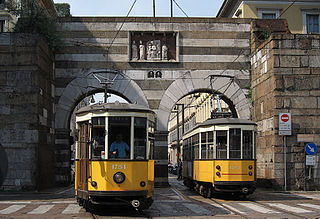
Europe has an extensive number of tramway networks. Some of these networks have been upgraded to light rail standards, called Stadtbahn in Germany, premetros in Belgium, sneltram in the Netherlands, trem ligeiro in Portugal and fast trams in some other countries.

Le Havre tramway is a modern two-line tram system in the city of Le Havre in Normandy, France. The modern tramway opened on 12 December 2012.
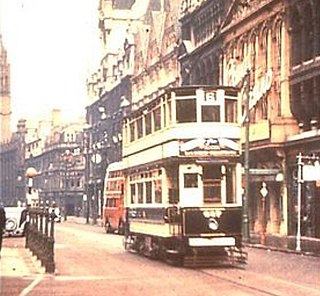
Birmingham Corporation Tramways operated a network of tramways in Birmingham from 1904 until 1953. It was the largest narrow-gauge tramway network in the UK, and was built to a gauge of 3 ft 6 in. It was the fourth largest tramway network in the UK behind London, Glasgow and Manchester.

The Marseille tramway is a tramway system in Marseille, France. The city's modern tram network now consists of three lines, serving 32 stations and operating over 15.8 kilometres (9.8 mi) of route. The current, modern Marseille tram network opened on 7 July 2007.

Until 1958, trams formed a network spanning most of Adelaide, South Australia, with a history dating back to 1878. Adelaide ran horse trams from 1878 to 1914 and electric trams from 1909, but has primarily relied on buses for public transport since the mid-20th century. Electric trams, and later trolleybuses, were Adelaide's main method of public transport throughout the life of the electric tram network. The tram network was progressively closed down through the 1950s with the last lines closing in 1958; the Glenelg tram line was the only line to survive these closures and has remained in operation ever since and has been progressively upgraded and extended since 2005.

The Strasbourg tramway, run by the CTS, is a network of six tramlines, A, B, C, D, E and F that operate in the cities of Strasbourg in Alsace, France, and Kehl in Baden-Württemberg, Germany. It is one of the few tram networks to cross an international border, along with the trams of Basel and Geneva. The first tramline in Strasbourg, which was originally horse-drawn, opened in 1878. After 1894, when an electric-powered tram system was introduced, a widespread network of tramways was built, including several longer-distance lines on both sides of the Rhine.

Rail transport in Belarus is owned by the national rail company BŽD / BČ. The railway network consists of 5,512 km, its gauge is 1,520 mm and 874 km are electrified.

The tram system in Ljubljana, the capital of Slovenia, was originally built in 1901 and was operated until 1958. Slovenia was then part of Austria-Hungary and Yugoslavia, respectively. Work started in 1900 and the tram was put in use after postponements and without a special ceremony on 6 September 1901. The tram system's end came on 20 December 1958, when it was replaced in a ceremony by 12 buses.

The Antwerp tramway network is a network of tramways forming part of the public transport system in Antwerp, a city in the Flemish Region of Belgium. The network is operated by the Flemish region's transportation company De Lijn. As of April 2017, it featured fourteen lines, eight of which pass partially underground.

The Rabat–Salé tramway is a tram system in the Moroccan agglomeration of Rabat and Salé cities which opened on 23 May 2011.

The Turin tramway network is an important part, along with the Turin Metro, of the public transport network of the city and comune of Turin, in the Piedmont region, northwest Italy.

Trams in Spain go back to an animal-drawn Madrid tramway network, which opened in 1871. Steam tramway traction started in Spain in 1879, and electric trams first operated in 1899.
Edinburgh Street Tramways operated a horse-drawn tramway service in Edinburgh between 1871 and 1896, and Leith between 1871 and 1904.

Leeds Tramways Company operated a tramway service in Leeds between 1871 and 1894.

Most narrow-gauge railways in Italy were built with Italian metre gauge, which is actually 950 mm because historically the Italian track gauge was defined from the centres of the rail instead of the internationally accepted method of measuring the gauge from the inside edges of the rails. Several metre-gauge lines were built in northern Italy.

The Bonn tramway network forms part of the public transport system in the city Bonn, North Rhine-Westphalia, Germany, along with the Bonn Stadtbahn with which the tramlines are heavily integrated. The tram network consists of three tram lines which makes Bonn's tramway relatively small, as it comprises only 29.52 kilometres (18.34 mi) of route. The tramway is operated by 24 low-floor tramcars.

Pinar de Chamartín is a station on the Madrid Metro, opened to the public on 4 November, 2007. It is located in fare Zone A and serves the area of Pinar de Chamartín.
