
Transcranial magnetic stimulation (TMS) is a noninvasive form of brain stimulation in which a changing magnetic field is used to induce an electric current at a specific area of the brain through electromagnetic induction. An electric pulse generator, or stimulator, is connected to a magnetic coil connected to the scalp. The stimulator generates a changing electric current within the coil which creates a varying magnetic field, inducing a current within a region in the brain itself.

Cranial electrotherapy stimulation (CES) is a form of neurostimulation that delivers a small, pulsed, alternating current via electrodes on the head. CES is used with the intention of treating a variety of conditions such as anxiety, depression and insomnia. CES has been suggested as a possible treatment for headaches, fibromyalgia, smoking cessation, and opiate withdrawal, but there is little evidence of effectiveness for many of these conditions and the evidence for use in acute depression is not sufficient to justify it.

A phosphene is the phenomenon of seeing light without light entering the eye. The word phosphene comes from the Greek words phos (light) and phainein. Phosphenes that are induced by movement or sound may be associated with optic neuritis.
Electro-stimulation is stimulation using electricity.
Neurotechnology encompasses any method or electronic device which interfaces with the nervous system to monitor or modulate neural activity.
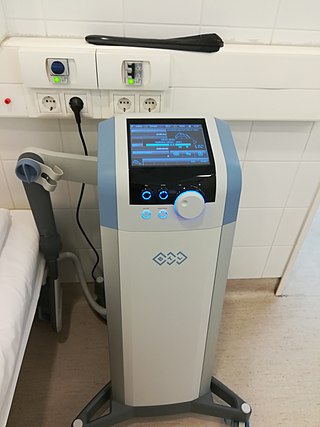
Electrotherapy is the use of electrical energy as a medical treatment. In medicine, the term electrotherapy can apply to a variety of treatments, including the use of electrical devices such as deep brain stimulators for neurological disease. The term has also been applied specifically to the use of electric current to speed wound healing. The use of EMS is also very wide for managing muscular pain. Additionally, the term "electrotherapy" or "electromagnetic therapy" has also been applied to a range of alternative medical devices and treatments. Evidence supporting the effectiveness of electrotherapy is limited.
Bioelectromagnetics, also known as bioelectromagnetism, is the study of the interaction between electromagnetic fields and biological entities. Areas of study include electromagnetic fields produced by living cells, tissues or organisms, the effects of man-made sources of electromagnetic fields like mobile phones, and the application of electromagnetic radiation toward therapies for the treatment of various conditions.

Transcranial direct current stimulation (tDCS) is a form of neuromodulation that uses constant, low direct current delivered via electrodes on the head. It was originally developed to help patients with brain injuries or neuropsychiatric conditions such as major depressive disorder. It can be contrasted with cranial electrotherapy stimulation, which generally uses alternating current the same way, as well as transcranial magnetic stimulation.
Neuronetics is a Malvern, PA based, publicly traded company incorporated in Delaware in April 2003, that develops non-invasive treatments for psychiatric disorders that have shown resistance or lack of improvement using traditional medicine. The treatments are based upon neuromodulation technology.

Electrical brain stimulation (EBS), also referred to as focal brain stimulation (FBS), is a form of electrotherapy used as a technique in research and clinical neurobiology to stimulate a neuron or neural network in the brain through the direct or indirect excitation of its cell membrane by using an electric current. EBS is used for research or for therapeutic purposes.
Brain stimulation may refer to:
Neurostimulation is the purposeful modulation of the nervous system's activity using invasive or non-invasive means. Neurostimulation usually refers to the electromagnetic approaches to neuromodulation.

BrainsWay Ltd. is an international company that is engaged in the development of a medical device that uses H-coil for deep transcranial magnetic stimulation as a non-invasive treatment for depression, OCD, and smoking addiction. The company was founded in 2003 and has offices in the US and Jerusalem.
Transcranial pulsed ultrasound (TPU) uses low intensity, low frequency ultrasound (LILFU) to stimulate the brain. In 2002, Dr. Alexander Bystritsky first proposed the idea that this methodology contained therapeutic benefits. Beginning in 2008, Dr. William Tyler and his research team from Arizona State University began an investigation and development of this alternative neuromodulation without the harmful effects and risks of invasive surgery. They discovered that this low-power ultrasound is able to stimulate high neuron activity which allows for the manipulation of the brain waves through an external source. Unlike deep brain stimulation or Vagus nerve stimulation, which use implants and electrical impulses, TPU is a noninvasive and focused procedure that does not require the implantation of electrodes that could damage the nervous tissue. Its use is applicable in the various fields including but not limited to medical and military science. Although this technology holds great potential to introducing new and beneficial alternatives to conventional brain manipulation, it is a relatively young science and has certain obstructions to its full development such as a lack of complete understanding and control of every safety measure.
Transcranial random noise stimulation (tRNS) is a non-invasive brain stimulation technique and a form of transcranial electrical stimulation (tES). Terney et al from Göttingen University was the first group to apply tRNS in humans in 2008. They showed that by using an alternate current along with random amplitude and frequency in healthy subjects, the motor cortex excitability increased for up to 60 minutes after 10 minutes of stimulation. The study included all the frequencies up to half of the sampling rate i.e. 640 Hz, however the positive effect was limited only to higher frequencies. Although tRNS has shown positive effects in various studies the optimal parameters, as well as the potential clinical effects of this technique, remain unclear.
Gait variability seen in Parkinson's Disorders arise due to cortical changes induced by pathophysiology of the disease process. Gait rehabilitation is focused to harness the adapted connections involved actively to control these variations during the disease progression. Gait variabilities seen are attributed to the defective inputs from the Basal Ganglia. However, there is altered activation of other cortical areas that support the deficient control to bring about a movement and maintain some functional mobility.
Non-invasive cerebellar stimulation is the application of non-invasive neurostimulation techniques on the cerebellum to modify its electrical activity. Techniques such as transcranial magnetic stimulation (TMS) or transcranial direct current stimulation (tDCS) can be used. The cerebellum is a high potential target for neuromodulation of neurological and psychiatric disorders due to the high density of neurons in its superficial layer, its electrical properties, and its participation in numerous closed-loop circuits involved in motor, cognitive, and emotional functions.
Todd M. Hutton is an American psychiatrist specializing in transcranial magnetic stimulation (TMS). He is Associate Clinical Professor of Psychiatry at the Keck School of Medicine of the University of Southern California. Hutton is also currently President of the Clinical TMS Society, as well as the founder and medical director of the Southern California TMS Center.
Valeria Gazzola is an Italian neuroscientist, associate professor at the Faculty of Social and Behavioral Sciences at the University of Amsterdam (UvA) and member of the Young Academy of Europe. She is also a tenured department head at the Netherlands Institute for Neuroscience (NIN) in Amsterdam, where she leads her own research group and the Social Brain Lab together with neuroscientist Christian Keysers. She is a specialist in the neural basis of empathy and embodied cognition: Her research focusses on how the brain makes individuals sensitive to the actions and emotions of others and how this affects decision-making.
