
In mathematics, cardinal numbers, or cardinals for short, are a generalization of the natural numbers used to measure the cardinality (size) of sets. The cardinality of a finite set is a natural number: the number of elements in the set. The transfinite cardinal numbers, often denoted using the Hebrew symbol (aleph) followed by a subscript, describe the sizes of infinite sets.

Mathematical induction is a method for proving that a statement is true for every natural number , that is, that the infinitely many cases all hold. Informal metaphors help to explain this technique, such as falling dominoes or climbing a ladder:
Mathematical induction proves that we can climb as high as we like on a ladder, by proving that we can climb onto the bottom rung and that from each rung we can climb up to the next one.
In mathematical logic, the Peano axioms, also known as the Dedekind–Peano axioms or the Peano postulates, are axioms for the natural numbers presented by the 19th century Italian mathematician Giuseppe Peano. These axioms have been used nearly unchanged in a number of metamathematical investigations, including research into fundamental questions of whether number theory is consistent and complete.

Transfinite induction is an extension of mathematical induction to well-ordered sets, for example to sets of ordinal numbers or cardinal numbers. Its correctness is a theorem of ZFC.

In mathematics, the surreal number system is a totally ordered proper class containing not only the real numbers but also infinite and infinitesimal numbers, respectively larger or smaller in absolute value than any positive real number. The surreals share many properties with the reals, including the usual arithmetic operations ; as such, they form an ordered field. If formulated in von Neumann–Bernays–Gödel set theory, the surreal numbers are a universal ordered field in the sense that all other ordered fields, such as the rationals, the reals, the rational functions, the Levi-Civita field, the superreal numbers can be realized as subfields of the surreals. The surreals also contain all transfinite ordinal numbers; the arithmetic on them is given by the natural operations. It has also been shown that the maximal class hyperreal field is isomorphic to the maximal class surreal field.
Finitism is a philosophy of mathematics that accepts the existence only of finite mathematical objects. It is best understood in comparison to the mainstream philosophy of mathematics where infinite mathematical objects are accepted as legitimate.
In mathematics, transfinite numbers are numbers that are "infinite" in the sense that they are larger than all finite numbers, yet not necessarily absolutely infinite. These include the transfinite cardinals, which are cardinal numbers used to quantify the size of infinite sets, and the transfinite ordinals, which are ordinal numbers used to provide an ordering of infinite sets. The term transfinite was coined by Georg Cantor in 1895, who wished to avoid some of the implications of the word infinite in connection with these objects, which were, nevertheless, not finite. Few contemporary writers share these qualms; it is now accepted usage to refer to transfinite cardinals and ordinals as infinite numbers. Nevertheless, the term "transfinite" also remains in use.
In mathematics, a binary relation R is called well-founded on a class X if every non-empty subset S ⊆ X has a minimal element with respect to R, that is, an element m ∈ S not related by sRm for any s ∈ S. In other words, a relation is well founded if
Reverse mathematics is a program in mathematical logic that seeks to determine which axioms are required to prove theorems of mathematics. Its defining method can briefly be described as "going backwards from the theorems to the axioms", in contrast to the ordinary mathematical practice of deriving theorems from axioms. It can be conceptualized as sculpting out necessary conditions from sufficient ones.
In the mathematical field of set theory, ordinal arithmetic describes the three usual operations on ordinal numbers: addition, multiplication, and exponentiation. Each can be defined in essentially two different ways: either by constructing an explicit well-ordered set that represents the result of the operation or by using transfinite recursion. Cantor normal form provides a standardized way of writing ordinals. In addition to these usual ordinal operations, there are also the "natural" arithmetic of ordinals and the nimber operations.
In set theory, -induction, also called epsilon-induction or set-induction, is a principle that can be used to prove that all sets satisfy a given property. Considered as an axiomatic principle, it is called the axiom schema of set induction.
In mathematics, the epsilon numbers are a collection of transfinite numbers whose defining property is that they are fixed points of an exponential map. Consequently, they are not reachable from 0 via a finite series of applications of the chosen exponential map and of "weaker" operations like addition and multiplication. The original epsilon numbers were introduced by Georg Cantor in the context of ordinal arithmetic; they are the ordinal numbers ε that satisfy the equation
Gentzen's consistency proof is a result of proof theory in mathematical logic, published by Gerhard Gentzen in 1936. It shows that the Peano axioms of first-order arithmetic do not contain a contradiction, as long as a certain other system used in the proof does not contain any contradictions either. This other system, today called "primitive recursive arithmetic with the additional principle of quantifier-free transfinite induction up to the ordinal ε0", is neither weaker nor stronger than the system of Peano axioms. Gentzen argued that it avoids the questionable modes of inference contained in Peano arithmetic and that its consistency is therefore less controversial.
In the mathematical discipline of set theory, there are many ways of describing specific countable ordinals. The smallest ones can be usefully and non-circularly expressed in terms of their Cantor normal forms. Beyond that, many ordinals of relevance to proof theory still have computable ordinal notations. However, it is not possible to decide effectively whether a given putative ordinal notation is a notation or not ; various more-concrete ways of defining ordinals that definitely have notations are available.
Primitive recursive arithmetic (PRA) is a quantifier-free formalization of the natural numbers. It was first proposed by Norwegian mathematician Skolem (1923), as a formalization of his finitistic conception of the foundations of arithmetic, and it is widely agreed that all reasoning of PRA is finitistic. Many also believe that all of finitism is captured by PRA, but others believe finitism can be extended to forms of recursion beyond primitive recursion, up to ε0, which is the proof-theoretic ordinal of Peano arithmetic. PRA's proof theoretic ordinal is ωω, where ω is the smallest transfinite ordinal. PRA is sometimes called Skolem arithmetic.
In proof theory, ordinal analysis assigns ordinals to mathematical theories as a measure of their strength. If theories have the same proof-theoretic ordinal they are often equiconsistent, and if one theory has a larger proof-theoretic ordinal than another it can often prove the consistency of the second theory.
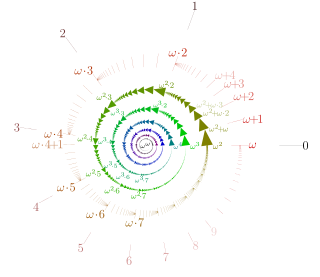
In set theory, an ordinal number, or ordinal, is a generalization of ordinal numerals aimed to extend enumeration to infinite sets.

Infinite chess is any variation of the game of chess played on an unbounded chessboard. Versions of infinite chess have been introduced independently by multiple players, chess theorists, and mathematicians, both as a playable game and as a model for theoretical study. It has been found that even though the board is unbounded, there are ways in which a player can win the game in a finite number of moves.
