The cathedral of San Lorenzo is the result of a long process of architectural stratification, combining medieval structural elements with a markedly Baroque character acquired during the eighteenth century. While earlier fabric remains embedded in the building, its present architectural identity is largely defined by interventions carried out in the early modern period, particularly those associated with the architect Giovanni Biagio Amico. [3]
Exterior
The present façade, begun in 1736, is one of the most distinctive features of the cathedral and represents a significant example of late Baroque architecture in western Sicily. Designed by Giovanni Biagio Amico, it is characterised by a dynamic composition articulated through curved lines, recessed surfaces and superimposed orders, elements that create a pronounced sense of movement and spatial depth. The façade’s complex stone construction demonstrates an advanced use of stereotomic techniques, reflecting the architect’s technical expertise and his theoretical interests as articulated in his treatise L’Architetto pratico. [3]
Scholars have noted affinities between the façade of San Lorenzo and contemporary developments in Roman Baroque architecture, while also emphasising its originality within the local context of Trapani. The design illustrates Amico’s ability to reinterpret broader architectural models through innovative structural and geometric solutions adapted to Sicilian building traditions. [2]
Interior
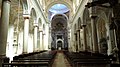
The eighteenth-century reconstruction also substantially altered the interior of the cathedral. Under Amico’s direction, the spatial organisation was reconfigured through the redesign of the lateral chapels, the choir, and the liturgical furnishings, creating a more coherent and unified Baroque interior. Particular attention was given to the modulation of space and light, enhancing the visual continuity between the nave, chapels and dome. [3]
The dome, another central element of the eighteenth-century intervention, contributes decisively to the cathedral’s internal spatial hierarchy. Its structural and formal solutions further attest to Amico’s mastery of geometric design and construction techniques, reinforcing the building’s position as a key work within the architectural panorama of eighteenth-century Trapani. [3]
According to the 19th-century Trapani historian Giuseppe Maria di Ferro, the interior was largely reconstructed around 1700 under parish priests Gaspare Vento and Giovanni Messina, following a design attributed to the Franciscan architect Padre Certo of Messina, who sought to enhance the church through abundant natural light provided by large windows. In 1801, Monsignor Diego De Luca further enriched the decoration with stucco work and painted figures of Patriarchs and Prophets. [4]
Di Ferro also described the walnut choir stalls, finely carved and lightly gilded, and recorded a Saint George by Andrea Carreca in the second chapel on the left, praising its dynamic composition and expressive figures. He further noted that the dome, designed by Giovanni Biagio Amico, adopted a hemispherical profile intended to temper the pointed Gothic tradition. [4]