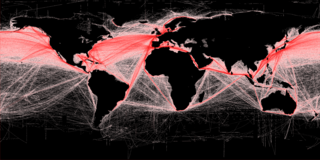
Freight transport is the physical process of transporting commodities and merchandise goods and cargo. The term shipping originally referred to transport by sea but in American English, it has been extended to refer to transport by land or air as well. "Logistics", a term borrowed from the military environment, is also used in the same sense.
In the United States of America, the U.S. consumer confidence index (CCI) is an economic indicator published by The Conference Board to measure consumer confidence, which is defined as the degree of optimism on the state of the U.S. economy that consumers are expressing through their activities of savings and spending. Global consumer confidence is not measured. Country-by-country analysis indicates huge variance around the globe. In an interconnected global economy, tracking international consumer confidence is a lead indicator of economic trends.
Dumping, in economics, is a kind of injuring pricing, especially in the context of international trade. It occurs when manufacturers export a product to another country at a price below the normal price with an injuring effect. The objective of dumping is to increase market share in a foreign market by driving out competition and thereby create a monopoly situation where the exporter will be able to unilaterally dictate price and quality of the product.
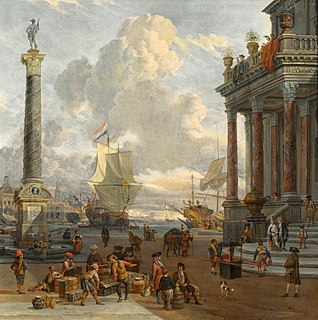
An export in international trade is a good or service produced in one country that is sold into another country. The seller of such goods and services is an exporter; the foreign buyer is an importer.
The terms of trade (TOT) is the relative price of exports in terms of imports and is defined as the ratio of export prices to import prices. It can be interpreted as the amount of import goods an economy can purchase per unit of export goods.

UK Export Finance (UKEF) is the operating name of the Export Credits Guarantee Department (ECGD), the United Kingdom's export credit agency and a ministerial department of the UK government. It has been awarded the best global export credit agency for 2019. In 1920, UKEF had a maximum total exposure of just £26mn. Today, its maximum commitment stands at £50bn. It is also celebrating its 100th anniversary as the longest running export credit agency in the world.

The arms industry, also known as the defense industry or the arms trade, is a global industry which manufactures and sells weapons and military technology, and is a major component of the Military–industrial complex. It consists of a commercial industry involved in the research and development, engineering, production, and servicing of military material, equipment, and facilities. Arms-producing companies, also referred to as arms dealers, defense contractors, or as the military industry, produce arms for the armed forces of states and for civilians. Departments of government also operate in the arms industry, buying and selling weapons, munitions and other military items. An arsenal is a place where arms and ammunition - whether privately or publicly owned - are made, maintained and repaired, stored, or issued, in any combination. Products of the arms industry include guns, artillery, ammunition, missiles, military aircraft, military vehicles, ships, electronic systems, night-vision devices, holographic weapon sights, laser rangefinders, laser sights, hand grenades, landmines and more. The arms industry also provides other logistical and operational support.
Consumer confidence is an economic indicator that measures the degree of optimism that consumers feel about the overall state of the economy and their personal financial situation. If the consumer has confidence in the immediate and near future economy and his/her personal finance, then the consumer will spend more than save.
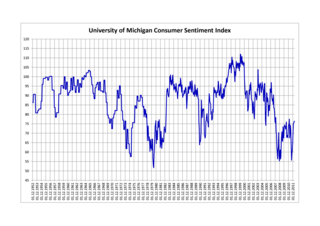
The University of Michigan Consumer Sentiment Index is a consumer confidence index published monthly by the University of Michigan. The index is normalized to have a value of 100 in December 1966. Each month at least 500 telephone interviews are conducted of a contiguous United States sample. Fifty core questions are asked.

Missing trader fraud and the related carousel fraud is the theft of Value Added Tax (VAT) from a government by organised crime gangs who exploit the way VAT is treated within multi-jurisdictional trading where the movement of goods between jurisdictions is VAT-free. This allows the fraudster to charge VAT on the sale of goods, and then instead of paying this over to the government's collection authority, to abscond, taking the VAT with them. This is termed "missing trader" as the trader goes missing with the VAT. "Carousel" refers to a more complex type of fraud in which VAT and goods are passed around between companies and jurisdictions, similar to how a carousel revolves.
The U.S. Import and Export Price Indexes measure average changes in prices of goods and services that are imported to or exported from the U.S.. The indexes are produced monthly by the International Price Program (IPP) of the Bureau of Labor Statistics. The Import and Export Price Indexes were published quarterly starting in 1974 and monthly since 1989.

A Certificate of OriginDeclaration of Origin is a document widely used in international trade transactions which attests that the product listed therein has met certain criteria to be considered as originating in a particular country. A certificate of origin / declaration of origin is generally prepared and completed by the exporter or the manufacturer, and may be subject to official certification by an authorized third party. It is often submitted to a customs authority of the importing country to justify the product's eligibility for entry and/or its entitlement to preferential treatment. Guidelines for issuance of Certificates of Origin by chambers of commerce globally are issued by the International Chamber of Commerce.

The ATA Carnet, often referred to as the "Passport for goods", is an international customs document that permits the tax-free and duty-free temporary export and import of nonperishable goods for up to one year. It consists of unified Customs declaration forms which are prepared ready to use at every border crossing point. It is a globally accepted guarantee for Customs duties and taxes which can replace security deposit required by each Customs authorities. It can be used in multiple countries in multiple trips up to its one-year validity. The acronym ATA is a combination of French and English terms "Admission Temporaire/Temporary Admission." The ATA carnet is now the document most widely used by the business community for international operations involving temporary admission of goods.
The International Trade Awards, held for the first time in 2007, are the UK's premier awards devoted exclusively to recognising excellence in import, export and international trade achievement.

Trade finance signifies financing for trade, and it concerns both domestic and international trade transactions. A trade transaction requires a seller of goods and services as well as a buyer. Various intermediaries such as banks and financial institutions can facilitate these transactions by financing the trade. Trade finance manifest itself in the form of letters of credit (LOC), guarantees or insurance and is usually provided by intermediaries.
Travelex is a foreign exchange company founded by Lloyd Dorfman and headquartered in London. Its main businesses are international payments, foreign currency exchange, issuing prepaid credit cards for use by travellers and global remittance.
The World Giving Index (WGI) is an annual report published by the Charities Aid Foundation, using data gathered by Gallup, and ranks over 140 countries in the world according to how charitable they are. The aim of the World Giving Index is to provide insight into the scope and nature of giving around the world. The first edition was released in September 2010. The most recent edition was published in November 2016, with Myanmar, the United States and Australia ranking as the top three. New Zealand, Sri Lanka, Canada, Indonesia, the United Kingdom, Ireland and United Arab Emirates complete the top ten.

The Directorate General of Customs and Excise is an Indonesian government agency under Ministry of Finance that serves the community in the field of customs and excise. The Directorate General of Customs and Excise has the duty to organize the formulation and implementation of policies in the field of supervision, law enforcement, service and optimization of state revenue in the field of customs and excise in accordance with the provisions of legislation. The directorate also carry out some basic tasks of the Ministry of Finance in the field of customs and excise, in accordance with policies established by the Minister and securing government policies relating to the traffic of goods entering or leaving the Customs Area and the collection of import duties and excise and other state levies based on legislation apply.
Flexport is a freight forwarding and customs brokerage company based in San Francisco, California.


