The Latin American Integration Association / Asociación Latinoamericana de Integración / Associação Latino-Americana de Integração is an international and regional scope organization. It was created on 12 August 1980 by the 1980 Montevideo Treaty, replacing the Latin American Free Trade Association (LAFTA/ALALC). Currently, it has 13 member countries, and any of the Latin American States may apply for accession.
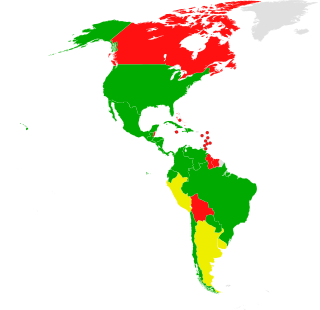
The Montevideo Convention on the Rights and Duties of States is a treaty signed at Montevideo, Uruguay, on December 26, 1933, during the Seventh International Conference of American States. At the conference, United States President Franklin D. Roosevelt and Secretary of State Cordell Hull declared the Good Neighbor Policy, which opposed U.S. armed intervention in inter-American affairs. The convention was signed by 19 states. The acceptance of three of the signatories was subject to minor reservations. Those states were Brazil, Peru and the United States.

Uruguay, officially the Oriental Republic of Uruguay, is a country in South America. It shares borders with Argentina to its west and southwest and Brazil to its north and northeast, while bordering the Río de la Plata to the south and the Atlantic Ocean to the southeast. It is part of the Southern Cone region of South America. Uruguay covers an area of approximately 176,215 square kilometres (68,037 sq mi). It has a population of around 3.4 million, of whom nearly 2 million live in the metropolitan area of its capital and largest city, Montevideo.

Carlos Saavedra Lamas was an Argentine academic and politician, and in 1936, the first Latin American Nobel Peace Prize recipient.
The Latin American Free Trade Association, LAFTA, was created in the 1960 Treaty of Montevideo by Argentina, Brazil, Chile, Mexico, Paraguay, Peru, and Uruguay. The signatories hoped to create a common market in Latin America and offered tariff rebates among member nations. In 1980, LAFTA reorganized into the Latin American Integration Association (ALADI) which now has 13 members: Argentina, Bolivia, Brazil, Chile, Colombia, Cuba, Ecuador, Mexico, Panama, Paraguay, Peru, Uruguay, and Venezuela.

The Treaty of the Triple Alliance was a treaty that allied the Empire of Brazil, Argentina, and Uruguay against Paraguay. Signed in 1865, after the outbreak of the Paraguayan War, its articles prescribed the allies' actions both during and after the war. The war led to the near-annihilation of Paraguay.

The Cisplatine War was an armed conflict fought in the 1820s between the Empire of Brazil and the United Provinces of the Río de la Plata over control of Brazil's Cisplatina province. It was fought in the aftermath of the United Provinces' and Brazil's independence from Spain and Portugal, respectively, and resulted in the independence of Cisplatina as the Oriental Republic of Uruguay.
The Treaty of Asunción was a treaty between the countries of Argentina, Brazil, Paraguay, and Uruguay signed on March 26, 1991. The objective of the treaty, signed in Asunción, was to establish a common market among the participating countries, popularly called Mercosur. Later, the Treaty of Ouro Preto was signed to supplement the first treaty, establishing that the Treaty of Asunción was to be a legally and internationally recognized organization.
The Christian Democrat Organization of America is an international organization made up of political parties, groups, and associations in North America and South America that promote the principles of Christian humanism. Affiliated with the Center Democratic International, it is a regional partner of the European People's Party and regional organizations of Christian Democratic parties in Asia and Africa.

The papal mediation in the Beagle conflict followed the failure of negotiations between Chile and Argentina, when, on 22 December 1978, the Argentinian Junta started Operation Soberanía, to invade Cape Horn and islands awarded to Chile by the Beagle Channel Arbitration. Soon after the event, Pope John Paul II offered to mediate and sent his personal envoy, Cardinal Antonio Samoré, to Buenos Aires. Argentina, in acceptance of the authority of the Pope over the overwhelmingly Catholic Argentine population, called off the military operation and accepted the mediation. On 9 January 1979, Chile and Argentina signed the Act of Montevideo formally requesting mediation by the Vatican and renouncing the use of force.
The Preliminary Peace Convention was a bilateral treaty signed on 27 August 1828 between the Empire of Brazil and the United Provinces of the Río de la Plata, after British mediation, that put an end to the Cisplatine War and recognized the independence of Uruguay.

CAF - Development Bank of Latin America and the Caribbean, formerly the Andean Development Corporation, is a development bank whose mission is to promote sustainable development and regional integration in Latin America and the Caribbean, through the financing of projects of the public and private sectors, the provision of technical cooperation and other specialized services.

The Southern Common Market, commonly known by Spanish abbreviation Mercosur, and Portuguese Mercosul, is a South American trade bloc established by the Treaty of Asunción in 1991 and Protocol of Ouro Preto in 1994. Its full members are Argentina, Bolivia, Brazil, Paraguay and Uruguay. Venezuela is a full member but has been suspended since 1 December 2016. Associate countries are, Chile, Colombia, Ecuador, Guyana, Peru, and Suriname. Bolivia became a full member on July 8, 2024.

The Brazilian War of Independence was waged between the newly independent Brazilian Empire and the United Kingdom of Portugal, Brazil and the Algarves, which had just undergone the Liberal Revolution of 1820. It lasted from 1822, when the first skirmishes took place, to March 1824, with the surrender of the Portuguese garrison in Montevideo, but hostilities only ceased on 29 August 1825, with the signing of the Treaty of Rio de Janeiro, which ended the war. The conflict was fought on land and sea and involved both regular forces and civilian militia. Land and naval battles took place in the territories of Bahia, Cisplatina, Rio de Janeiro, Grão-Pará, Maranhão and Pernambuco, which today are part of Ceará, Piauí and Rio Grande do Norte states.
The integration of Latin America has a history going back to Spanish American and Brazilian independence, when there was discussion of creating a regional state or confederation of Latin American nations to protect the area's newly won autonomy. After several projects failed, the issue was not taken up again until the late 19th century, but now centered on the issue of international trade and with a sense of pan-Americanism, owing to the United States of America taking a leading role in the project. The idea of granting these organizations a primarily political purpose did not become prominent again until the post-World War II period, which saw both the start of the Cold War and a climate of international cooperation that led to the creation of institutions such as the United Nations. It would not be until the mid-20th century that uniquely Latin American organizations were created.

The Anglo-French blockade of the Río de la Plata, also known as Paraná War, was a five-year naval blockade imposed by France and the United Kingdom on the Argentine Confederation during the Uruguayan Civil War. It was imposed by the Royal Navy and French Navy in 1845 against the Río de la Plata Basin to support the Colorado Party in Uruguay's civil war, resulting in the closure of Buenos Aires to maritime commerce. The Argentine government, led by Juan Manuel de Rosas, refused to drop their support for the Uruguyan White Party, which supported Argentina's resistance to the blockade. Eventually, both Britain and France ended the blockade, signing the Arana-Southern Treaty in 1849 and 1850 respectively, which acknowledged Argentine sovereignty over its rivers.
The Treaty on Political Asylum and Refuge is a multi-party treaty regarding political asylum and refugee law. It was signed in Montevideo on 4 August 1939 and entered into force on 29 December 1954.

The legal system of Uruguay belongs to the Continental Law tradition.
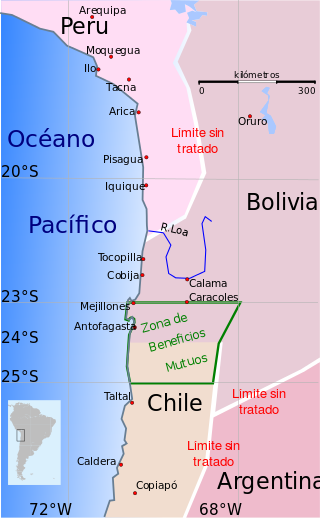
The Treaty of Defensive Alliance was a secret defense pact between Bolivia and Peru. Signed in the Peruvian capital, Lima, on 6 February 1873, the document was composed of eleven central articles that outlined its necessity and stipulations and one additional article that ordered the treaty to be kept secret until both contracting parties decided otherwise. The signatory states were represented by the Peruvian Foreign Minister José de la Riva-Agüero y Looz Corswaren and the Bolivian Envoy Extraordinary and Minister Plenipotentiary in Peru, Juan de la Cruz Benavente.
The First South American Congress of Private International Law was an international congress on private international law and an ad-hoc codifier forum of international conflict of laws treaties held in Montevideo from 25 August 1888 to 18 February 1889, in which eight treaties and an additional protocol were passed that covered practically all the subjects of conflicts of laws of that time. These were one of the first treaties on conflict of laws to come into force in the world.
