
Area is the quantity that expresses the extent of a two-dimensional figure or shape or planar lamina, in the plane. Surface area is its analog on the two-dimensional surface of a three-dimensional object. Area can be understood as the amount of material with a given thickness that would be necessary to fashion a model of the shape, or the amount of paint necessary to cover the surface with a single coat. It is the two-dimensional analog of the length of a curve or the volume of a solid.

In geometry, an n-sided antiprism is a polyhedron composed of two parallel copies of some particular n-sided polygon, connected by an alternating band of triangles. Antiprisms are a subclass of the prismatoids and are a (degenerate) type of snub polyhedron.
In geometry, a dodecahedron is any polyhedron with twelve flat faces. The most familiar dodecahedron is the regular dodecahedron, which is a Platonic solid. There are also three regular star dodecahedra, which are constructed as stellations of the convex form. All of these have icosahedral symmetry, order 120.
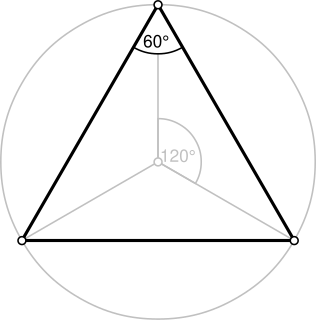
A triangle is a polygon with three edges and three vertices. It is one of the basic shapes in geometry. A triangle with vertices A, B, and C is denoted .

In geometry, two figures or objects are congruent if they have the same shape and size, or if one has the same shape and size as the mirror image of the other.

In geometry, a coordinate system is a system that uses one or more numbers, or coordinates, to uniquely determine the position of the points or other geometric elements on a manifold such as Euclidean space. The order of the coordinates is significant, and they are sometimes identified by their position in an ordered tuple and sometimes by a letter, as in "the x-coordinate". The coordinates are taken to be real numbers in elementary mathematics, but may be complex numbers or elements of a more abstract system such as a commutative ring. The use of a coordinate system allows problems in geometry to be translated into problems about numbers and vice versa; this is the basis of analytic geometry.

In mathematics and physics, the centroid or geometric center of a plane figure is the arithmetic mean position of all the points in the figure. Informally, it is the point at which a cutout of the shape could be perfectly balanced on the tip of a pin.
A love triangle is usually a romantic relationship involving three or more people. While it can refer to two people independently romantically linked with a third, it usually implies that each of the three people has some kind of relationship to the other two. The 1994 book Beliefs, Reasoning, and Decision Making states, "Although the romantic love triangle is formally identical to the friendship triad, as many have noted their actual implications are quite different....Romantic love is typically viewed as an exclusive relationship, whereas friendship is not." Statistics suggest that, in Western society, "willingly or not, most adults have been involved in a love triangle".
In mathematics, a degenerate case is a limiting case of a class of objects which appears to be qualitatively different from the rest of the class, and the term degeneracy is the condition of being a degenerate case.

In geometry, an isosceles triangle is a triangle that has two sides of equal length. Sometimes it is specified as having exactly two sides of equal length, and sometimes as having at least two sides of equal length, the latter version thus including the equilateral triangle as a special case. Examples of isosceles triangles include the isosceles right triangle, the golden triangle, and the faces of bipyramids and certain Catalan solids.

In geometry, the incenter of a triangle is a triangle center, a point defined for any triangle in a way that is independent of the triangle's placement or scale. The incenter may be equivalently defined as the point where the internal angle bisectors of the triangle cross, as the point equidistant from the triangle's sides, as the junction point of the medial axis and innermost point of the grassfire transform of the triangle, and as the center point of the inscribed circle of the triangle.

In geometry, a square is a regular quadrilateral, which means that it has four equal sides and four equal angles (90-degree angles, or. It can also be defined as a rectangle in which two adjacent sides have equal length. A square with vertices ABCD would be denoted ABCD.

In geometry, the barycentric coordinate system is a coordinate system in which the location of a point of a simplex is specified as the center of mass, or barycenter, of usually unequal masses placed at its vertices. Coordinates also extend outside the simplex, where one or more coordinates become negative. The system was introduced in 1827 by August Ferdinand Möbius.
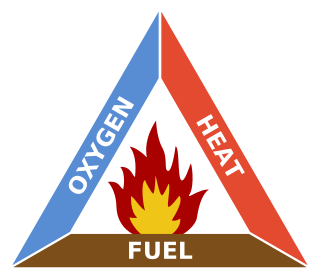
The fire triangle or combustion triangle is a simple model for understanding the necessary ingredients for most fires.

In mathematics, an invariant is a property of a mathematical object which remains unchanged, after operations or transformations of a certain type are applied to the objects. The particular class of objects and type of transformations are usually indicated by the context in which the term is used. For example, the area of a triangle is an invariant with respect to isometries of the Euclidean plane. The phrases "invariant under" and "invariant to" a transformation are both used. More generally, an invariant with respect to an equivalence relation is a property that is constant on each equivalence class.
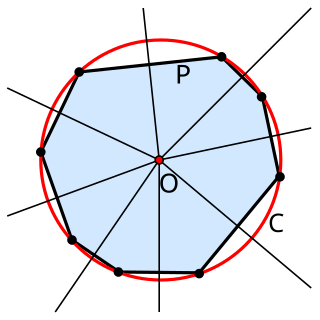
In geometry, the circumscribed circle or circumcircle of a polygon is a circle that passes through all the vertices of the polygon. The center of this circle is called the circumcenter and its radius is called the circumradius.
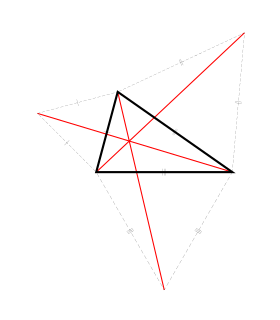
In geometry, the Fermat point of a triangle, also called the Torricelli point or Fermat–Torricelli point, is a point such that the total distance from the three vertices of the triangle to the point is the minimum possible. It is so named because this problem was first raised by Fermat in a private letter to Evangelista Torricelli, who solved it.

The medial triangle or midpoint triangle of a triangle ABC is the triangle with vertices at the midpoints of the triangle's sides AB, AC and BC. It is the n=3 case of the midpoint polygon of a polygon with n sides. The medial triangle is not the same thing as the median triangle, which is the triangle whose sides have the same lengths as the medians of ABC.
In geometry, a triangle center is a point in the plane that is in some sense a center of a triangle akin to the centers of squares and circles, that is, a point that is in the middle of the figure by some measure. For example the centroid, circumcenter, incenter and orthocenter were familiar to the ancient Greeks, and can be obtained by simple constructions.
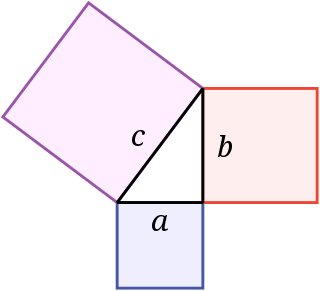
In mathematics, the Pythagorean theorem, also known as Pythagoras' theorem, is a fundamental relation in Euclidean geometry among the three sides of a right triangle. It states that the area of the square whose side is the hypotenuse is equal to the sum of the areas of the squares on the other two sides. This theorem can be written as an equation relating the lengths of the sides a, b and c, often called the "Pythagorean equation":
