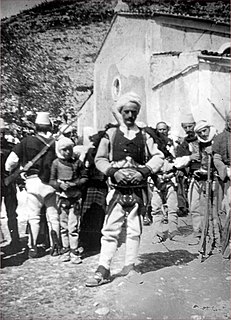
The term tribe is used in many different contexts to refer to a category of human social group. The predominant usage of the term is in the discipline of anthropology. The definition is contested, in part due to conflicting theoretical understandings of social and kinship structures, and also reflecting the problematic application of this concept to extremely diverse human societies. The concept is often contrasted by anthropologists with other social and kinship groups, being hierarchically larger than a lineage or clan, but smaller than a chiefdom, nation or state. These terms are equally disputed. In some cases tribes have legal recognition and some degree of political autonomy from national or federal government, but this legalistic usage of the term may conflict with anthropological definitions.
The Binirayan festival is an event celebrated in the province of Antique in the Philippines. "Binirayan" literally means "where they sailed to".

Tiliaceae is a family of flowering plants. It is not a part of the APG, APG II and APG III classifications, being sunk in Malvaceae mostly as the subfamilies Tilioideae, Brownlowioideae and Grewioideae, but has an extensive historical record of use.

A taxonomic system, the Bentham & Hooker system for seed plants, was published in Bentham and Hooker's Genera plantarum ad exemplaria imprimis in herbariis kewensibus servata definita in three volumes between 1862 and 1883.

A tribus, or tribe, was a division of the Roman people, constituting the voting units of a legislative assembly of the Roman Republic. The word is probably derived from tribuere, to divide or distribute; the traditional derivation from tres, three, is doubtful.
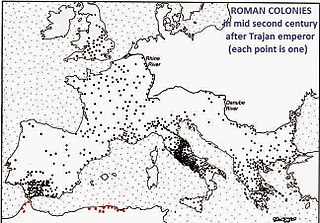
A Roman colonia was originally a Roman outpost established in conquered territory to secure it. Eventually, however, the term came to denote the highest status of a Roman city.
Brongnartia can refer to:

The Dinagyang Festival is a famous religious and cultural festival in Iloilo City, Philippines, held annually on the 4th Sunday of January, or right after the Sinulog in Cebu and the Ati-Atihan Festival in Kalibo, Aklan. Dinagyang is one of the biggest and world-class festivals in the Philippines, attracting more than a million domestic and international visitors every year.
Pokemón is a subculture among Chile's youth that surfaced in the mid-2000s and began to decline in late 2009. By 2012, it was considered extinct. They were readily identifiable by their angular and pressed hairstyles, reminiscent of characters from the Japanese media franchise Pokémon. It was one of the largest and better known urban tribes in the country.
"La Tribu de Dana" is a 1998 song recorded by the French hip hop band Manau, available on their debut album, Panique celtique, on which it features as second track. Released as first single in July 1998, it hit a huge success, particularly in France, topping the singles chart for many months and becoming one of the best-selling singles of all time in that country.

Tribu is a 2007 Filipino crime drama film directed by Jim Libiran, released in its home country of the Philippines. It stars real life gang members from the film's setting in Tondo, Manila. The tagline is: "Every night, juvenile tribes prowl the streets of Tondo. An explosive hiphop, freestyle gangsta celebration of inner city Manila."
Idola tribus is a category of logical fallacy, normally translated as "Idols of the Tribe", which refers to a tendency of human nature to prefer certain types of incorrect conclusions. It is a Latin term, coined by Sir Francis Bacon and used in his Novum Organum, one of the earliest treatises arguing the case for the methodical approach of modern science.
Sesarethus was an ancient city in southern Illyria. Stephanus of Byzantium from the 6th century AD reports, citing Hecataeus, that Sesarethos was a Taulantian city, and that Sesarethioi was its ethnicon. The city and the tribal name Sessarethes have been related by modern scholars to the Illyrian tribe of Dassaretii. The variant Sesarethii is also mentioned by Strabo as an alternative name of the Enchelei.

Hydriomenini is a tribe of geometer moths under subfamily Larentiinae. The tribe was erected by Edward Meyrick in 1872.

Melanthiini is a tribe of geometer moths under subfamily Larentiinae. The tribe was described by Philogène Auguste Joseph Duponchel in 1845.

Xanthorhoini is a tribe of geometer moths under subfamily Larentiinae. The tribe was described by Pierce in 1914.

Dorcadiini is a tribe of longhorn beetles of the subfamily Lamiinae. It was described by Pierre André Latreille in 1825.

Abda is a tribal confederacy of Morocco, of Arab Bani Maqil origin. They have been established in Western Morocco since the end of the Marinid era.
The Mascogos are an Afro-descendant group in Coahuila, Mexico. Centered on the town of El Nacimiento in Múzquiz Municipality, the group are descendants of Black Seminoles escaping the threat of slavery in the United States.
The Time of the Tribes: The Decline of Individualism in Mass Society is a 1988 book by the French sociologist Michel Maffesoli. It argues that mass society, rather than creating a mass of individuals, has resulted in a type of tribalised society. The book and its subject, labelled neo-tribes, have had impact in sociology and other fields.

