
Padua is a city and commune in Veneto, northern Italy. Padua is on the river Bacchiglione, west of Venice. It is the capital of the province of Padua. It is also the economic and communications hub of the area. Padua's population is 214,000. The city is sometimes included, with Venice and Treviso, in the Padua-Treviso-Venice Metropolitan Area (PATREVE) which has a population of around 2,600,000.
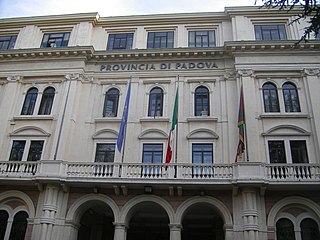
The Province of Padua is a province in the Veneto region of Italy. Its capital is the city of Padua.

The Scrovegni Chapel, also known as the Arena Chapel, is a small church, adjacent to the Augustinian monastery, the Monastero degli Eremitani in Padua, region of Veneto, Italy. The chapel and monastery are now part of the complex of the Musei Civici di Padova.

The Palazzo della Ragione is a medieval market hall, town hall and palace of justice building in Padua, in the Veneto region of Italy. The upper floor was dedicated to the town and justice administration; while the ground floor still hosts the historical covered market of the city. The palace separates the two market squares of Piazza delle Erbe from Piazza dei Frutti. It is popularly called "il Salone" . It is part of the UNESCO World Heritage Site of Padua's 14th-century fresco cycles.

The Orto Botanico di Padova is a botanical garden in Padua, in the northeastern part of Italy. Founded in 1545 by the Venetian Republic, it is the world's oldest academic botanical garden that is still in its original location. The garden – operated by the University of Padua and owned by the Italian government – encompasses roughly 22,000 square meters, and is known for its special collections and historical design.

The Pedrocchi Café is a café founded in the 18th century in central Padua, Italy. It has architectural prominence because its rooms were decorated in diverse styles, arranged in an eclectic ensemble by the architect Giuseppe Jappelli. The café has historical prominence because of its role in the 1848 riots against the Habsburg monarchy, as well as for being an attraction for artists over the last century from the French novelist Stendhal to Lord Byron to the Italian writer Dario Fo.

Villa Molin is a patrician residence in the neighborhood of Mandria, in Ponte della Cagna, south of Padua, in the Veneto region of northern Italy. It was designed for Nicolò Molin, a Venetian noble, by Vincenzo Scamozzi and completed in 1597. It faces Mandriola, on the opposite side of the Canale di Battaglia. The original agricultural setting of the villa, composed of pasture and orchards, has given way to a residential dormitory community of Padua.

Padua Cathedral, or Basilica Cathedral of Saint Mary of the Assumption, is a Catholic church and minor basilica located on the east end of Piazza Duomo, adjacent to the bishop's palace in Padua, Veneto, Italy.
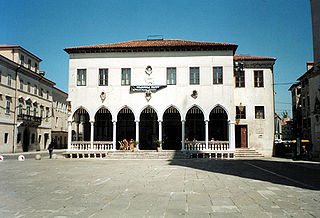
The Loggia Palace is a Venetian Gothic palace in Koper, a port town in southwestern Slovenia. It is the only preserved Gothic town hall in Slovenia.
The Walls of Padua are a complex of defensive works around the Italian city of Padua, designed to defend it from hostile attack. It was built in 4 phases.

Santa Sofia is the oldest Roman Catholic church structure in the city of Padua, region of Veneto, Italy. It was built in the 10th century on the site of a presumed Mithraeum. A grant was made to bishop Sinibaldo of this church in 1123, which had already been in construction. The Romanesque stone and brick facade was constructed from 1106 to 1127, but the semicircular apse may date from earlier. The interior is now relatively bare.
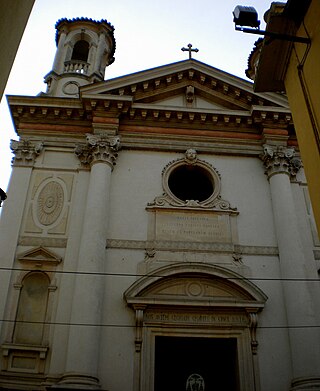
Santa Croce is a Roman Catholic church located on Corso Vittorio Emanuele 178 in Padua, Veneto region, Italy.

The church dedicated to saint Francis of Assisi, known for centuries as San Francesco Grande is a religious building on the Via San Francesco, previously overlooks the Contra porteghi high in Padua, Italy. Through the efforts of Baldo de Bonafarii and Sibilla de Cetto, the convent of the Friars Minor and the Hospital of Saint Francis, Major, operated until 1798.

Santa Lucia, also called the Chiesa dell'Adorazione Perpetua is a Roman Catholic church located in the city of Padua, region of Veneto, Italy.

The Madonna Addolorata al Torresino, also called the Santa Maria del Pianto or Santa Maria del Torresino is a Roman Catholic parish church located in the city of Padua, region of Veneto, Italy.
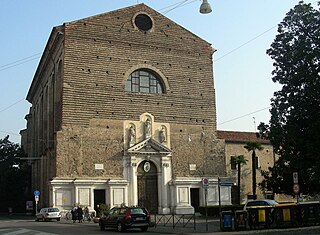
The Basilica del Carmine is a 16th-century Roman Catholic church located on piazza Francesco Petrarca in Padua, region of Veneto, Italy. It was made a minor basilica in 1960 by pope John XXIII

Sant'Andrea is a Roman Catholic church located on Via Sant'Andrea in Padua, region of Veneto, Italy. Founded by the 12th-century as a parish church, the present church was completed in the late 19th century.

San Daniele is a Roman Catholic church and monastery in Padua, region of Veneto, Italy.

Sant'Antonio di Padova
Villa Garzoni is a villa in the Veneto region designed by Jacopo Sansovino around 1540 in Pontecasale, a hamlet in the municipality of Candiana, in the province of Padua.
