
A biome is a distinct geographical region with specific climate, vegetation, and animal life. It consists of a biological community that has formed in response to its physical environment and regional climate. Biomes may span more than one continent. A biome encompasses multiple ecosystems within its boundaries. It can also comprise a variety of habitats.
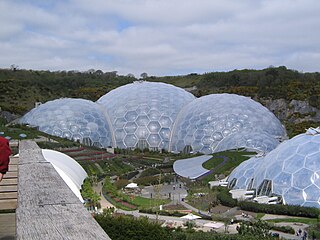
The Eden Project is a visitor attraction in Cornwall, England. The project is located in a reclaimed china clay pit.

An ecoregion is an ecologically and geographically defined area that is smaller than a bioregion, which in turn is smaller than a biogeographic realm. Ecoregions cover relatively large areas of land or water, and contain characteristic, geographically distinct assemblages of natural communities and species. The biodiversity of flora, fauna and ecosystems that characterise an ecoregion tends to be distinct from that of other ecoregions. In theory, biodiversity or conservation ecoregions are relatively large areas of land or water where the probability of encountering different species and communities at any given point remains relatively constant, within an acceptable range of variation . Ecoregions are also known as "ecozones", although that term may also refer to biogeographic realms.

A biogeographic realm is the broadest biogeographic division of Earth's land surface, based on distributional patterns of terrestrial organisms. They are subdivided into bioregions, which are further subdivided into ecoregions. A biogeographic realm is also known as "ecozone", although that term may also refer to ecoregions.

A grassland is an area where the vegetation is dominated by grasses (Poaceae). However, sedge (Cyperaceae) and rush (Juncaceae) can also be found along with variable proportions of legumes, such as clover, and other herbs. Grasslands occur naturally on all continents except Antarctica and are found in most ecoregions of the Earth. Furthermore, grasslands are one of the largest biomes on Earth and dominate the landscape worldwide. There are different types of grasslands: natural grasslands, semi-natural grasslands, and agricultural grasslands. They cover 31–69% of the Earth's land area.

A savanna or savannah is a mixed woodland-grassland biome and ecosystem characterised by the trees being sufficiently widely spaced so that the canopy does not close. The open canopy allows sufficient light to reach the ground to support an unbroken herbaceous layer consisting primarily of grasses. Four savanna forms exist; savanna woodland where trees and shrubs form a light canopy, tree savanna with scattered trees and shrubs, shrub savanna with distributed shrubs, and grass savanna where trees and shrubs are mostly nonexistent.
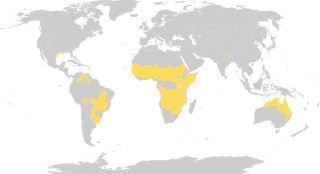
Tropical and subtropical grasslands, savannas, and shrublands is a terrestrial biome defined by the World Wide Fund for Nature. The biome is dominated by grass and/or shrubs located in semi-arid to semi-humid climate regions of subtropical and tropical latitudes. Tropical grasslands are mainly found between 5 degrees and 20 degrees in both North and south of the Equator.

Montane grasslands and shrublands are a biome defined by the World Wildlife Fund. The biome includes high elevation grasslands and shrublands around the world. The term "montane" in the name of the biome refers to "high elevation", rather than the ecological term that denotes the region below the treeline.
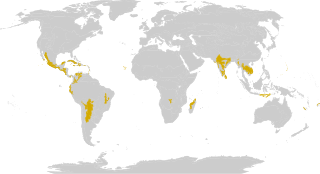
The tropical and subtropical dry broadleaf forest is a habitat type defined by the World Wide Fund for Nature and is located at tropical and subtropical latitudes. Though these forests occur in climates that are warm year-round, and may receive several hundred millimeters of rain per year, they have long dry seasons that last several months and vary with geographic location. These seasonal droughts have great impact on all living things in the forest.

A jungle is land covered with dense forest and tangled vegetation, usually in tropical climates. Application of the term has varied greatly during the past century.

Tropical climate is the first of the five major climate groups in the Köppen climate classification identified with the letter A. Tropical climates are defined by a monthly average temperature of 18 °C (64 °F) or higher in the coolest month, featuring hot temperatures and high humidity all year-round. Annual precipitation is often abundant in tropical climates, and shows a seasonal rhythm but may have seasonal dryness to varying degrees. There are normally only two seasons in tropical climates, a wet (rainy/monsoon) season and a dry season. The annual temperature range in tropical climates is normally very small. Sunlight is intense in these climates.

Tropical forests are forested ecoregions with tropical climates – that is, land areas approximately bounded by the tropics of Cancer and Capricorn, but possibly affected by other factors such as prevailing winds.

A temperate forest is a forest found between the tropical and boreal regions, located in the temperate zone. It is the second largest terrestrial biome, covering 25% of the world's forest area, only behind the boreal forest, which covers about 33%. These forests cover both hemispheres at latitudes ranging from 25 to 50 degrees, wrapping the planet in a belt similar to that of the boreal forest. Due to its large size spanning several continents, there are several main types: deciduous, coniferous, mixed forest, and rainforest.

The Cerrado is a vast ecoregion of tropical savanna in eastern Brazil, being present in the states of Goiás, Mato Grosso do Sul, Mato Grosso, Tocantins, Maranhão, Piauí, Bahia, Minas Gerais, São Paulo, Paraná and the Federal District. The core areas of the Cerrado biome are the Brazilian highlands – the Planalto. The main habitat types of the Cerrado consist of forest savanna, wooded savanna, park savanna and gramineous-woody savanna. The Cerrado also includes savanna wetlands and gallery forests.
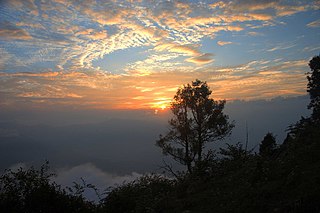
Neora Valley National Park is a national park in Kalimpong district, West Bengal, India that was established in 1986. Spread over an area of 88 km2 (34 sq mi), it is a rich biological zone in eastern India. It is the land of the red panda in the pristine undisturbed natural habitat with rugged inaccessible hilly terrain and rich diverse flora and fauna. It is linked to Pangolakha Wildlife Sanctuary of Pakyong District as well as forests of Samtse District, Bhutan via thick cover of forests.

Climate classifications are systems that categorize the world's climates. A climate classification may correlate closely with a biome classification, as climate is a major influence on life in a region. The most used is the Köppen climate classification scheme first developed in 1884.
Tropical ecology is the study of the relationships between the biotic and abiotic components of the tropics, or the area of the Earth that lies between the Tropic of Cancer and the Tropic of Capricorn. The tropical climate experiences hot, humid weather and rainfall year-round. While many might associate the region solely with the rainforests, the tropics are home to a wide variety of ecosystems that boast a great wealth of biodiversity, from exotic animal species to seldom-found flora. Tropical ecology began with the work of early English naturalists and eventually saw the establishment of research stations throughout the tropics devoted to exploring and documenting these exotic landscapes. The burgeoning ecological study of the tropics has led to increased conservation education and programs devoted to the climate. Tropical ecology provides a wealth of natural resources to humans, this includes contributing to the carbon cycle, with the ability to store 50% of carbon emissions as well as turnover 40% of global oxygen. However, despite the natural services provided by tropical ecology, deforestation is a threat of tropical rainforests. Any plant of interest can be exploited for commercial reasons and extraction of these specific plant species can be at a rapid rate without time for healthy regeneration. Most of the global plant biodiversity is hosted in tropical areas, however studies in this area is mostly covered by scientist from Northern countries. Inclusion of scientist from countries where rainforest is present is heavily encouraged because it extends global knowledge and research which advances scientific contributions, benefiting tropical ecology.
Anthropogenic is an adjective that may refer to:

Montane ecosystems are found on the slopes of mountains. The alpine climate in these regions strongly affects the ecosystem because temperatures fall as elevation increases, causing the ecosystem to stratify. This stratification is a crucial factor in shaping plant community, biodiversity, metabolic processes and ecosystem dynamics for montane ecosystems. Dense montane forests are common at moderate elevations, due to moderate temperatures and high rainfall. At higher elevations, the climate is harsher, with lower temperatures and higher winds, preventing the growth of trees and causing the plant community to transition to montane grasslands and shrublands or alpine tundra. Due to the unique climate conditions of montane ecosystems, they contain increased numbers of endemic species. Montane ecosystems also exhibit variation in ecosystem services, which include carbon storage and water supply.

The Amazon biome contains the Amazon rainforest, an area of tropical rainforest, and other ecoregions that cover most of the Amazon basin and some adjacent areas to the north and east. The biome contains blackwater and whitewater flooded forest, lowland and montane terra firma forest, bamboo and palm forest, savanna, sandy heath and alpine tundra. Some areas of the biome are threatened by deforestation for timber and to make way for pasture or soybean plantations.
