
Marie de France was a poet, likely born in France, who lived in England during the late 12th century. She lived and wrote at an unknown court, but she and her work were almost certainly known at the royal court of King Henry II of England. Virtually nothing is known of her life; both her given name and its geographical specification come from manuscripts containing her works. However, one written description of her work and popularity from her own era still exists. She is considered by scholars to be the first woman known to write francophone verse.
A fabliau is a comic, often anonymous tale written by jongleurs in northeast France between c. 1150 and 1400. They are generally characterized by sexual and scatological obscenity, and by a set of contrary attitudes—contrary to the church and to the nobility. Several of them were reworked by Giovanni Boccaccio for the Decameron and by Geoffrey Chaucer for his Canterbury Tales. Some 150 French fabliaux are extant, the number depending on how narrowly fabliau is defined. According to R. Howard Bloch, fabliaux are the first expression of literary realism in Europe.

Mark of Cornwall was a sixth-century King of Kernow (Cornwall), possibly identical with King Conomor. He is best known for his appearance in Arthurian legend as the uncle of Tristan and the husband of Iseult who engages with Tristan in a secret liaison, giving Mark the epithet "Cuckold King".
Sir Launfal is a 1045-line Middle English romance or Breton lay written by Thomas Chestre dating from the late 14th century. It is based primarily on the 538-line Middle English poem Sir Landevale, which in turn was based on Marie de France's lai Lanval, written in a form of French understood in the courts of both England and France in the 12th century. Sir Launfal retains the basic story told by Marie and retold in Sir Landevale, augmented with material from an Old French lai Graelent and a lost romance that possibly featured a giant named Sir Valentyne. This is in line with Thomas Chestre's eclectic way of creating his poetry.
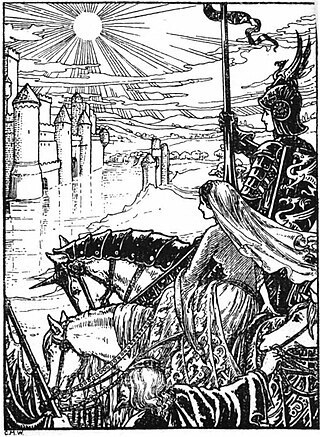
Libeaus Desconus is a 14th-century Middle English version of the popular "Fair Unknown" story, running to about around 2,200 lines, attributed to Thomas Chestre. It is a version or an adaptation of Renaut de Beaujeu's Le Bel Inconnu though comparatively much shorter.
"Bisclavret" is one of the twelve Lais of Marie de France written in the 12th century. Originally written in French, it tells the story of a werewolf who is trapped in lupine form by the treachery of his wife. The tale shares a common ancestry with the comparable Lay of Melion, and is probably referenced in Sir Thomas Malory's Le Morte d'Arthur with the tale of Sir Marrok, who has a similar story.
Lanval is one of the Lais of Marie de France. Written in Anglo-Norman, it tells the story of Lanval, a knight at King Arthur's court, who is overlooked by the king, wooed by a fairy lady, given all manner of gifts by her, and subsequently refuses the advances of Queen Guinevere. The plot is complicated by Lanval's promise not to reveal the identity of his mistress, which he breaks when Guinevere accuses him of having "no desire for women". Before Arthur, Guinevere accuses Lanval of shaming her, and Arthur, in an extended judicial scene, demands that he reveal his mistress. Despite the broken promise, the fairy lover eventually appears to justify Lanval, and to take him with her to Avalon. The tale was popular, and was adapted into English as Sir Landevale, Sir Launfal, and Sir Lambewell.
"Guigemar" is a Breton lai, a type of narrative poem, written by Marie de France during the 12th century. The poem belongs to the collection known as The Lais of Marie de France. Like the other lais in the collection, Guigemar is written in the Anglo-Norman language, a dialect of Old French, in rhyming octosyllabic couplets.
"Le Fresne" is one of the Lais of Marie de France. It was likely written in the late 12th century. Marie claims it to be a Breton lai, an example of Anglo-Norman literature.

"Laüstic", also known as "Le Rossignol", "Le Laustic", "Laostic", and "Aüstic", is a Breton lai by the medieval poet Marie de France. The title comes from the Breton word for "nightingale" (eostig), a symbolic figure in the poem. It is the eighth poem in the collection known as the Lais of Marie de France, and the poem is only found in the manuscript known as Harley 978. Like the other poems in the collection, Laüstic is written in the Anglo-Norman dialect of Old French, in couplets eight syllables long.
"Milun" is a Breton lai by the medieval poet Marie de France,. Milun is the ninth lai in the collection known as the Lais of Marie de France. Like the other lais (lays) in this collection, Milun is written in the Anglo-Norman dialect of Old French, in couplets of eight syllables in length.
"Chevrefoil" is a Breton lai by the medieval poet Marie de France. The eleventh poem in the collection is called The Lais of Marie de France and its subject is an episode from the romance of Tristan and Iseult. The title means "honeysuckle," a symbol of love in the poem. "Chevrefoil" consists of 118 lines and survives in two manuscripts, Harley 978 or MS H, which contains all the Lais, and in Bibliothèque Nationale, nouv. acq. fr. 1104, or MS S.
"Chaitivel", also known as "Les Quatre Deuils" or "Le Malheureux" in modern French or "The Four Sorrows" in English, is a Breton lai by the medieval poet Marie de France. Chaitivel is the tenth poem in the collection known as the Lais of Marie de France and is one of very few lais to contain alternate titles. Like the other poems in this collection, Chaitivel is written in the Anglo-Norman dialect of Old French, in couplets of eight syllables in length.
"Eliduc" is a Breton lai by the medieval poet Marie de France. The twelfth and last poem in the collection known as The Lais of Marie de France, it appears in the manuscript Harley 978 at the British Library. Like the other poems in this collection, "Eliduc" is written in the Anglo-Norman dialect of Old French, in couplets of eight syllables in length. At 1184 lines, it is the longest of the lais attributed to Marie de France. The text of the lai notes that its correct title should be Guildeluec and Guilliadon, but the name Eliduc has stuck.
Nabaret is a short, humorous Breton lai that tells the story of a knight and his vain and prideful wife. With only 48 verses, Nabaret is the shortest of the anonymous lais.
"Doon" is an anonymous Breton lai that tells the story of a knight, Doon, who must pass certain tests to win the hand of a maiden. They marry; but he returns to France alone. He is later reunited with the lady thanks to their grown son, whom he recognizes after dueling him at a tournament. This lai is very similar to "Milun" by Marie de France.
Tyolet is an anonymous Breton lai that takes place in the realm of King Arthur. It tells the tale of a naïve young knight who wins the hand of a maiden after a magical adventure.
"Lecheor" is a short, bawdy Breton lai that tells the story a group of noble women who decide to write a lai about female genitalia.
Melion is an anonymous Breton lai that tells the story of a knight who transforms into a werewolf for the love of his wife who betrays him.
Sir Perceval of Galles is a Middle English Arthurian verse romance whose protagonist, Sir Perceval (Percival), first appeared in medieval literature in Chrétien de Troyes' final poem, the 12th-century Old French Conte del Graal, well over one hundred years before the composition of this work. Sir Perceval of Galles was probably written in the northeast Midlands of England in the early 14th century, and tells a markedly different story to either Chretien's tale or to Robert de Boron's early 13th-century Perceval. Found in only a single manuscript, and told with a comic liveliness, it omits any mention of a graal or a Grail.