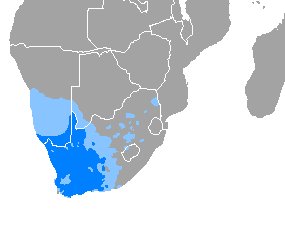
Afrikaans is a West Germanic language, spoken in South Africa, Namibia and Botswana, Zambia and Zimbabwe. It evolved from the Dutch vernacular of South Holland spoken by the predominantly Dutch settlers and enslaved population of the Dutch Cape Colony, where it gradually began to develop distinguishing characteristics in the 17th and 18th centuries.
The African National Congress (ANC) is a political party in South Africa. It originated as a liberation movement known for its opposition to apartheid and has governed the country since 1994, when the first post-apartheid election resulted in Nelson Mandela being elected as President of South Africa. Cyril Ramaphosa, the incumbent national President, has served as President of the ANC since 18 December 2017.

Cape Town is the legislative capital of South Africa. It is the country's oldest city and the seat of the Parliament of South Africa. It is the country's second-largest city, after Johannesburg, and the largest in the Western Cape. The city is part of the City of Cape Town metropolitan municipality.

Namibia, officially the Republic of Namibia, is a country in Southern Africa. Its western border is the Atlantic Ocean. It shares land borders with Angola and Zambia to the north, Botswana to the east and South Africa to the east and south. Although it does not border Zimbabwe, less than 200 metres of the Botswanan right bank of the Zambezi River separates the two countries. Its capital and largest city is Windhoek.

Pretoria, is South Africa's administrative capital, serving as the seat of the executive branch of government, and as the host to all foreign embassies to South Africa.

Sub-Saharan Africa or Subsahara is the area and regions of the continent of Africa that lie south of the Sahara. These include Central Africa, East Africa, Southern Africa, and West Africa. Geopolitically, in addition to the African countries and territories that are situated fully in that specified region, the term may also include polities that only have part of their territory located in that region, per the definition of the United Nations (UN). This is considered a non-standardised geographical region with the number of countries included varying from 46 to 48 depending on the organisation describing the region. The African Union (AU) uses a different regional breakdown, recognising all 55 member states on the continent—grouping them into five distinct and standard regions.

Eswatini, formally the Kingdom of Eswatini and also known by its former official name Swaziland and formerly the Kingdom of Swaziland, is a landlocked country in Southern Africa. It is bordered by Mozambique to its northeast and South Africa to its north, west, south, and southeast. At no more than 200 km (120 mi) north to south and 130 km (81 mi) east to west, Eswatini is one of the smallest countries in Africa; despite this, its climate and topography are diverse, ranging from a cool and mountainous highveld to a hot and dry lowveld.

The Union of South Africa was the historical predecessor to the present-day Republic of South Africa. It came into existence on 31 May 1910 with the unification of the Cape, Natal, Transvaal, and Orange River colonies. It included the territories that were formerly part of the South African Republic and the Orange Free State.
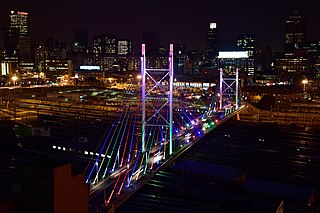
Johannesburg is the most populous city in South Africa with 4,803,262 people, and is classified as a megacity; it is one of the 100 largest urban areas in the world. It is the provincial capital of Gauteng, the wealthiest province in South Africa. Johannesburg is the seat of the Constitutional Court, the highest court in South Africa. Most of the major South African companies and banks have their head offices in Johannesburg. The city is located within the mineral-rich Witwatersrand hills, the epicentre of the international-scale mineral, gold and (specifically) diamond trade.

The 2010 FIFA World Cup was the 19th FIFA World Cup, the world championship for men's national football teams. It took place in South Africa from 11 June to 11 July 2010. The bidding process for hosting the tournament finals was open only to African nations. In 2004, the international football federation, FIFA, selected South Africa over Egypt and Morocco to become the first African nation to host the finals.
The South Africa national rugby union team, commonly known as the Springboks, is the country's national team governed by the South African Rugby Union. The Springboks play in green and gold jerseys with white shorts, and their emblem is the Springbok, a native antelope and the national animal of South Africa. The team has represented South African Rugby Union in international rugby union since 30 July 1891, when they played their first test match against a British Isles touring team. Currently, the Springboks are the reigning World Champions, having won the World Cup a record four times. South Africa have won half of the Rugby World Cups they have participated in and are also the second nation to win the World Cup consecutively.
The South Africa men's national cricket team, also known as the Proteas, represents South Africa in men's international cricket and is administered by Cricket South Africa (CSA). South Africa is a full member of the International Cricket Council (ICC). Its nickname derives from South Africa's national flower, Protea cynaroides, commonly known as the "King Protea".

The South Africa men's national soccer team represents South Africa in men's international soccer and it is run by the South African Football Association, the governing body for Soccer in South Africa. Nicknamed Bafana Bafana, the team's home ground is FNB Stadium, which is located in Johannesburg. The team is a member of both FIFA and Confederation of African Football (CAF). The team are one of the most well-supported national sides in Africa, and are recognized by their traditional yellow-green kits.

Matamela Cyril Ramaphosa is a South African businessman and politician serving as the 5th and current President of South Africa since 2018. A former anti-apartheid activist and trade union leader, Ramaphosa is also the president (leader) of the African National Congress (ANC).

Apartheid was a system of institutionalised racial segregation that existed in South Africa and South West Africa from 1948 to the early 1990s. It was characterised by an authoritarian political culture based on baasskap, which ensured that South Africa was dominated politically, socially, and economically by the nation's minority white population. Under this minoritarian system, White citizens held the highest status, followed by Indians, Coloureds and Blacks, in that order. The economic legacy and social effects of apartheid continue to the present day, particularly inequality.

White South Africans are South Africans of European descent. In linguistic, cultural, and historical terms, they are generally divided into the Afrikaans-speaking descendants of the Dutch East India Company's original colonists, known as Afrikaners, and the Anglophone descendants of predominantly British colonists of South Africa. In 2016, 57.9% were native Afrikaans speakers, 40.2% were native English speakers, and 1.9% spoke another language as their mother tongue, such as Portuguese, Greek, or German. White South Africans are by far the largest population of White Africans. White was a legally defined racial classification during apartheid.
South Africa, officially the Republic of South Africa (RSA), is the southernmost country in Africa. Its nine provinces are bounded to the south by 2,798 kilometres of coastline that stretches along the South Atlantic and Indian Ocean; to the north by the neighbouring countries of Namibia, Botswana, and Zimbabwe; to the east and northeast by Mozambique and Eswatini; and it encloses Lesotho. Covering an area of 1,221,037 square kilometres, the country has over 62 million people. Pretoria is the administrative capital, while Cape Town, as the seat of Parliament, is the legislative capital. Bloemfontein has traditionally been regarded as the judicial capital. The largest and most populous city is Johannesburg, followed by Cape Town and the busiest port city in sub-Saharan Africa, Durban.

BRICS is an intergovernmental organization comprising nine countries - Brazil, Russia, India, China, South Africa, Iran, Egypt, Ethiopia, and the United Arab Emirates. BRICS was originally identified to highlight investment opportunities. The grouping evolved into a geopolitical bloc, with their governments meeting annually at formal summits and coordinating multilateral policies since 2009. Relations among BRICS are conducted mainly based on non-interference, equality, and mutual benefit.
Tshediso John Matona is a South African civil servant and former CEO of Eskom.


