Related Research Articles
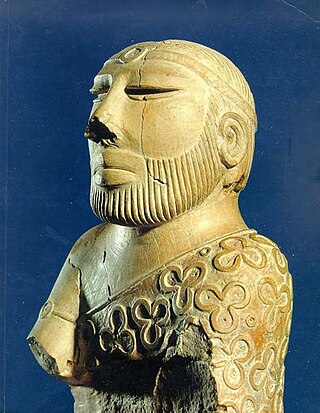
The History of Pakistan prior to its independence in 1947 spans several millennia and covers a vast geographical area known as the Greater Indus region. Anatomically modern humans arrived in what is now Pakistan between 73,000 and 55,000 years ago. Stone tools, dating as far back as 2.1 million years, have been discovered in the Soan Valley of northern Pakistan, indicating early hominid activity in the region. The earliest known human remains in Pakistan are dated between 5000 BCE and 3000 BCE. By around 7000 BCE, early human settlements began to emerge in Pakistan, leading to the development of urban centres such as Mehrgarh, one of the oldest in human history. By 4500 BCE, the Indus Valley Civilization evolved, which flourished between 2500 BCE and 1900 BCE along the Indus River. The region that now constitutes Pakistan served both as the cradle of a major ancient civilization and as a strategic gateway connecting South Asia with Central Asia and the Near East.

Kumyks are a Turkic ethnic group living in Dagestan, Chechnya and North Ossetia. They are the largest Turkic people in the North Caucasus.
Gandhara was an ancient Indo-Aryan civilization centred in present-day north-west Pakistan and north-east Afghanistan. The core of the region of Gandhara was the Peshawar and Swat valleys extending as far east as the Pothohar Plateau in Punjab, though the cultural influence of Greater Gandhara extended westwards into the Kabul valley in Afghanistan, and northwards up to the Karakoram range. The region was a central location for the spread of Buddhism to Central Asia and East Asia with many Chinese Buddhist pilgrims visiting the region.
Zamindawar is a historical region of Afghanistan. It is a very large and fertile valley the main sources for irrigation is the Helmand River. Zamindawar is located in the greater territory of northern Helmand and encompasses the approximate area of modern-day Baghran, Musa Qala, Naw Zad, Kajaki and Sangin districts. It was a district of hills, and of wide, well populated, and fertile valleys watered by important tributaries of the Helmand. The principal town was Musa Qala, which stands on the banks of a river of the same name, about 60 km north of the city of Grishk.

The Gahadavala dynasty also Gahadavalas of Kannauj was a Rajput dynasty that ruled parts of the present-day Indian states of Uttar Pradesh and Bihar, during 11th and 12th centuries. Their capital was located at Banaras in the Gangetic plains, and for a brief period, they also controlled Kannauj.

Zabulistan, was a historical region in southern Afghanistan roughly corresponding to the modern provinces of Zabul and Ghazni. Following the Ghaznavid rule (977–1186), "Zabul" became largely synonymous with the name of its capital and main city, Ghazni.

Harsha, also Harshadeva, was a Hindu king of Kashmir. He was given the epithet "raja-Turushka".

Hinduism in Afghanistan is practiced by a tiny minority of Afghans, about 30-40 individuals as of 2021, who live mostly in the cities of Kabul and Jalalabad. Afghan Hindus are ethnically Pashtun, Hindkowan (Hindki), Punjabi, or Sindhi and primarily speak Dari, Pashto, Hindko, Punjabi, Sindhi, and Hindustani (Hindi-Urdu).

The Archi people are an ethnic group who live in eight villages in southern Dagestan, Russia. Archib is the 'parent village' of these, because three months a year the whole community used to reassemble in Archi to engage in communal work. Their culture is one of the most distinct and best-preserved of all the cultures of Dagestan.

A detinets or detinetz is an ancient Rus' city-fort or central fortified part of a city, similar to the meaning of kremlin or citadel. The term was used in many regions, including: Kievan Rus', Chernihiv, Novgorod, and Kyiv.
The History of Khyber Pakhtunkhwa refers to the history of the modern-day Pakistani province of Khyber Pakhtunkhwa.
Zunbil, also written as Zhunbil, or Rutbils of Zabulistan, was a royal dynasty south of the Hindu Kush in present southern Afghanistan region. They were a dynasty of Hephthalite origin. They ruled from circa 680 AD until the Saffarid conquest in 870 AD. The Zunbil dynasty was founded by Rutbil, the elder brother of the Turk Shahi ruler, who ruled over the Hephthalite kingdom from his capital in Kabul. The Zunbils are described as having Turkish troops in their service by Arabic sources like Tarikh al-Tabari and Tarikh-i Sistan. However the term "Turk" was used in an inaccurate and loose way.
The Hindu Shahis, also referred to as the Uḍi Śāhis, were a dynasty established between 843 CE and 1026 CE. They endured multiple waves of conquests for nearly two centuries and their core territory was described as having contained the regions of Eastern Afghanistan and Gandhara, encompassing the area up to the Sutlej river in modern day Punjab, expanding into the Kangra Valley. The empire was founded by Kallar in c. 843 CE after overthrowing Lagaturman, the last Turk Shahi king.
The Lodi dynasty was the last dynasty to rule over Emirate of Multan, from their capital city of Multan in the 10th century.

Johann von Michelsohnen was a Baltic German military commander who served in the Imperial Russian Army. He was a prominent general in several wars, but his most noted contribution was his critical role in suppressing Pugachev's Rebellion.
The Nezak Huns, also Nezak Shahs, was a significant principality in the south of the Hindu Kush region of South Asia from circa 484 to 665 CE. Despite being traditionally identified as the last of the four Hunnic states in South asia, their ethnicity remains disputed and speculative. The dynasty is primarily evidenced by coinage inscribing a characteristic water-buffalo-head crown and an eponymous legend.
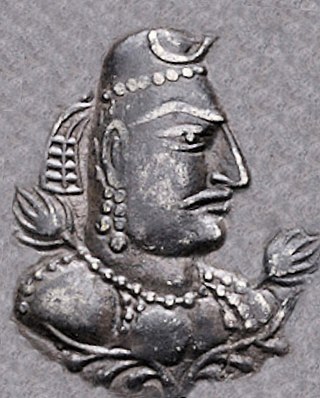
The Alchon Huns, also known as the Alkhan, Alchono, Alxon, Alkhon, Alakhana, and Walxon, were a nomadic people who established states in Central Asia and South Asia during the 4th and 6th centuries CE. They were first mentioned as being located in Paropamisus, and later expanded south-east, into the Punjab and Central India, as far as Eran and Kausambi. The Alchon invasion of the Indian subcontinent eradicated the Kidarite Huns who had preceded them by about a century, and contributed to the fall of the Gupta Empire, in a sense bringing an end to Classical India.
The Turk Shahis or Kabul Shahis were a dynasty of Western Turk, or mixed Turko-Hephthalite, or a group of Hephthalites origin, that ruled from Kabul and Kapisa to Gandhara in the 7th to 9th centuries AD. They may have been of Khalaj ethnicity. The Gandhara territory may have been bordering the Kashmir kingdom and the Kannauj kingdom to the east. From the 560s, the Western Turks had gradually expanded southeasterward from Transoxonia, and occupied Bactria and the Hindu-Kush region, forming largely independent polities. The Turk Shahis may have been a political extension of the neighbouring Western Turk Yabghus of Tokharistan. In the Hindu-Kush region, they replaced the Nezak Huns – the last dynasty of Bactrian rulers with origins among the Xwn (Xionite) and/or Huna peoples.
Sergey Pavlovich Nikitsky was a Russian theologian, writer, translator.

The Tokhara Yabghus or Yabghus of Tokharistan were a dynasty of Western Turk–Hephtalite sub-kings with the title "Yabghus", who ruled from 625 CE in the area of Tokharistan north and south of the Oxus River, with some smaller remnants surviving in the area of Badakhshan until 758 CE. Their legacy extended to the southeast where it came into contact with the Turk Shahis and the Zunbils until the 9th century CE.
References
- ↑ Босворт, Клиффорд Эдмунд. Мусульманские династии. Справочник по хронологии и генеалогии. — Москва: Главная редакция восточной литературы издательства «Наука», 1971. — С. 255.
- ↑ Encyclopedic dictionary of Brockhaus and Efron: in 86 tons (82 tons and 4 extra). - SPb., 1890-1907; See: India, XIII, 139.