
Cargo ships of the class Type RO 15 are RoRo vessels built by Wismar's Mathias Thesen Yard.
Cargo ships of the class Type RO 15 are RoRo vessels built by Wismar's Mathias Thesen Yard.
The class was built in 1982/83 and consists of 3 units.
 | This article about a type of ship or boat is a stub. You can help Wikipedia by expanding it. |

Aktien-Gesellschaft „Weser" was one of the major German shipbuilding companies, located at the Weser River in Bremen. Founded in 1872 it was finally closed in 1983. All together, A.G. „Weser" built about 1,400 ships of different types, including many warships. A.G. „Weser" was the leading company in the Deutsche Schiff- und Maschinenbau AG, a cooperation of eight German shipbuilding companies between 1926 and 1945.

A ship class is a group of ships of a similar design. This is distinct from a ship type, which might reflect a similarity of tonnage or intended use. For example, USS Carl Vinson is a nuclear aircraft carrier of the Nimitz class.
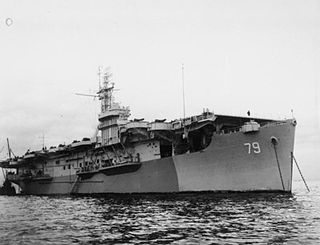
USS Willapa (AVG-53/ACV-53/CVE-53) was a Bogue-class escort carrier built during World War II for the United States Navy. Never seeing American service, the ship was transferred to the United Kingdom as part of Lend-Lease. The escort carrier was renamed HMS Puncher (D79) of the British Ruler class and crewed by the Royal Canadian Navy with aircrew from the Fleet Air Arm. Primarily used as an aircraft transport, Puncher took part in operations along the Norwegian coast towards the end of the war. Following the war the ship was converted for mercantile service and renamed Muncaster Castle, Bardic and Ben Nevis, before being broken up in 1973.

The Nippon Yusen Kabushiki Kaisha, also known as NYK Line, is a Japanese shipping company. The company headquarters are located in Chiyoda, Tokyo, Japan. It operates a fleet of over 800 ships, which includes container ships, tankers, bulk and woodchip carriers, roll-on/roll-off car carriers, reefer vessels, LNG carriers, and cruise ships. It is a member of the Ocean Network Express and Mitsubishi Group.
Nordseewerke Emden GmbH was a shipbuilding company, located in the Emden Harbor of the north German city of Emden. Founded in 1903, shipbuilding ended in 2010, and the company was taken over by the Schaaf Industrie AG, which among other products, makes components for off-shore systems.

A sister ship is a ship of the same class or of virtually identical design to another ship. Such vessels share a nearly identical hull and superstructure layout, similar size, and roughly comparable features and equipment. They often share a common naming theme, either being named after the same type of thing or person or with some kind of alliteration. Typically the ship class is named for the first ship of that class. Often, sisters become more differentiated during their service as their equipment are separately altered.
Antony Martin Douglas Leslie William Calhoun Preston was an English naval historian and editor, specialising in the area of 19th and 20th-century naval history and warship design.

Deutsche Schiff- und Maschinenbau Aktiengesellschaft was a cooperation of eight German shipyards in the period 1926 to 1945. The leading company was the shipyard AG Weser in Bremen.
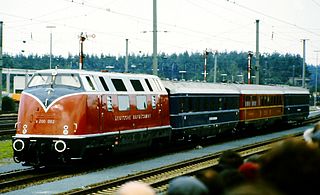
DB Class V 200 was the first series production diesel-hydraulic express locomotive of the German Deutsche Bundesbahn and – as Am 4/4 – of the SBB-CFF-FFS in Switzerland.
Hyundai Mipo Dockyard (Korean: 현대미포조선) is one of the largest shipbuilding companies with world share rank 1 (50%) in PC. Since the 1980s, more than 10,000 ships were repaired and converted until 2005 and 400 newly ordered ships were delivered until 2009. It delivers about 70 new ships in a year by Hyundai Mipo Dockyard. The delivered amount is over 1 million CGT in a year (2007), making it 4th in the world. Its product mix is shipbuilding (96.4%) and conversion and repair (3.6%). Hyundai Mipo Dockyard is a member of Hyundai Heavy Industries Group and was listed on KOSPI in 1983.

The Frieden is the former German motor vessel Dresden operated by the VEB Deutsche Seereederei Rostock. Since 1970 it has been used as a museum ship.
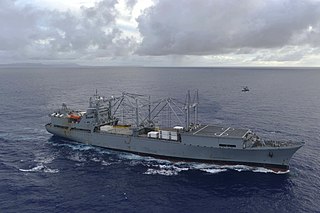
The Type C5 ship is a United States Maritime Administration (MARAD) designation for World War II breakbulk cargo and later a container ship for containerization shipments. The first type C5-class ship was a class of ships constructed and produced in the United States during World War II. The World War II C5-class ship was dry bulk cargo ship built by Bethlehem Steel in Sparrows Point, Maryland. Bethlehem Steel built eight ships in this bulk cargo class and four orders were canceled. The C5-class ship has a 24,250 DWT and was 560 feet (170 m) long. The C5 was mainly used as iron ore carriers. The C5 was needed to replace other ships that sank during World War II. First in her class was SS Venore, USMC #1982, delivered on 20 July 1945. The Type C5-class ship designed to fill the need to move iron ore from Santa Cruz, Chile, to Sparrows Point, Maryland, through the Panama Canal, a round-trip of 8,700 nautical miles . Post World War II, four ships were given C5 class type C5-S-78a, these were roll-on/roll-off container ship built by Ingalls Shipbuilding, Inc. of Pascagoula, Mississippi and operated by the Moore-McCormack Lines. The C5-S-78a had a deadweight tonnage of 16,000 tons.
V 303 Tannenberg was a German fishing trawler that was requisitioned in the Second World War by the Kriegsmarine for use as a vorpostenboot. She was returned to her owners post war. In 1958, she was re-engined and converted to a cargo ship. In 1970 she was sold to Greece and renamed Panaghia. She was sold to Panama in 1975 and was renamed Nikos then Chantal. She was wrecked in 1978.
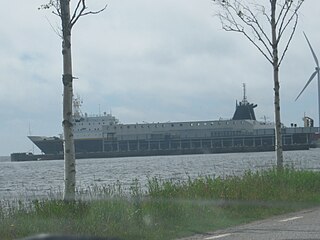
M/S RG I was a passenger/cargo ship which was last owned by the Finnish shipping company RG Line. The ship was a ro-ro ship. The ship was built in 1983 at the VEB Mathias Thesen Werft shipyard in Wismar, East Germany. The ship had a dead weight of 6704 tonnes. RG I was last registered in Finland and its homeport was in Vaasa. The ship travelled across the Kvarken between Vaasa, Finland and Umeå, Sweden up to 2012. The travel time was four hours and the ship used Finnish time. The ship carried 300 passengers.