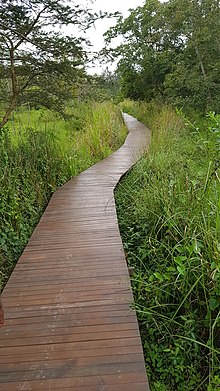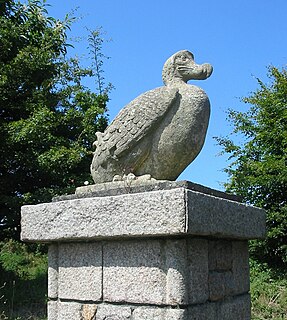
Jersey Zoo is a zoological park established in 1959 on the island of Jersey in the English Channel by naturalist and writer Gerald Durrell (1925–1995). It is operated by the Durrell Wildlife Conservation Trust. It has approximately 169,000 visitors per year; visitor numbers tend to vary with the tourist trade to Jersey.

The whooping crane is the tallest North American bird, named for its whooping sound. It is an endangered crane species. Along with the sandhill crane, it is one of only two crane species native to North America. The whooping crane's lifespan is estimated to be 22 to 24 years in the wild. After being pushed to the brink of extinction by unregulated hunting and loss of habitat to just 21 wild and two captive whooping cranes by 1941, conservation efforts have led to a limited recovery. The total number of cranes in the surviving migratory population, plus three reintroduced flocks and in captivity, now exceeds 800 birds.

The red-crowned crane, also called the Manchurian crane or Japanese crane, is a large East Asian crane among the rarest cranes in the world. In some parts of its range, it is known as a symbol of luck, longevity, and fidelity.
Species reintroduction is the deliberate release of a species into the wild, from captivity or other areas where the organism is capable of survival. The goal of species reintroduction is to establish a healthy, genetically diverse, self-sustaining population to an area where it has been extirpated, or to augment an existing population. Species that may be eligible for reintroduction are typically threatened or endangered in the wild. However, reintroduction of a species can also be for pest control; for example, wolves being reintroduced to a wild area to curb an overpopulation of deer. Because reintroduction may involve returning native species to localities where they had been extirpated, some prefer the term "reestablishment".

Spix's macaw, also known as the little blue macaw, is a macaw species that was endemic to Brazil. It is a member of tribe Arini in the subfamily Arinae, part of the family Psittacidae. It was first described by German naturalist Georg Marcgrave, when he was working in the State of Pernambuco, Brazil in 1638 and it is named for German naturalist Johann Baptist von Spix, who collected a specimen in 1819 on the bank of the Rio São Francisco in northeast Bahia in Brazil. This bird has been completely extirpated from its natural range, and following a several-year survey, the IUCN officially declared it extinct in the wild in 2019.
Jurong Bird Park is an aviary and tourist attraction in Jurong, Singapore. The largest such bird park in Asia, it covers an area of 0.2 square kilometres on the western slope of Jurong Hill, the highest point in the Jurong region. It is one of the parks managed by Mandai Wildlife Reserve, which are also the managers of Singapore Zoo, Night Safari and River Wonders.
The Born Free Foundation is an international wildlife charity that campaigns to "Keep Wildlife in the Wild". It protects wild animals in their natural habitat, campaigns against the keeping of wild animals in captivity and rescues wild animals in need. It also promotes compassionate conservation, which takes into account the welfare of individual animals in conservation initiatives. Born Free also creates and provides educational materials and activities that reflect the charity’s values.

The Aktiengesellschaft Cologne Zoological Garden is the zoo of Cologne, Germany. It features over 10,000 animals of more than 850 species on more than 20 hectares. The internationally renowned zoo with an attached aquarium and invertebrate exhibit is active in preservational breeding of animals that are in danger of becoming extinct. In addition, in-the-wild conservation efforts and research focussing on animals of Madagascar, Wallacea, and Vietnam are actively promoted and supported via cooperation with Cologne University and local projects, such as in the case of Przewalski's horses.

The red-crowned amazon, also known as the red-crowned parrot, green-cheeked amazon or Mexican red-headed parrot, is an endangered amazon parrot native to northeastern Mexico and southern Texas in the United States. A 1994 study estimated wild populations of between 2,000 and 4,300 mature individuals; the IUCN Red List considers it a globally endangered species with a decreasing population. The main threats to the native bird's survival are the illegal export of trapped birds from Mexico to the United States for the pet trade and the destruction of their natural habitat, the lowland forests of northeastern Mexico.
Tourism in Rwanda is the largest source of foreign exchange earnings in Rwanda and was projected to grow at a rate of 25% every year from 2013-18. The sector is the biggest contributor to the national export strategy. Total revenues generated from the sector in 2014 alone was USD 305 millions. The sector has also attracted direct foreign investments with major international hotel brands setting up shop in the country including Marriot Hotels & Resorts, Radisson Blu, Park Inn by Radisson, Sheraton Hotels and Resorts, Protea Hotels by Marriott, Golden Tulip Hotels, and Zinc. With its new world-class convention center Rwanda is set to become a regional and international conference hub owing to ever improving conference facilities, an excellent and expanding transportation network, and straightforward immigration procedures such as the ability for online visa applications, visa-at-gate policy for all Africans, and a one tourist visa policy for the EAC.

Wildlife trade refers to the commerce of products that are derived from non-domesticated animals or plants usually extracted from their natural environment or raised under controlled conditions. It can involve the trade of living or dead individuals, tissues such as skins, bones or meat, or other products. Legal wildlife trade is regulated by the United Nations' Convention on International Trade in Endangered Species of Wild Fauna and Flora (CITES), which currently has 184 member countries called Parties. Illegal wildlife trade is widespread and constitutes one of the major illegal economic activities, comparable to the traffic of drugs and weapons.

The wildlife of Rwanda comprising its flora and fauna, in prehistoric times, consisted of montane forest in one third the territory of present-day Rwanda. However, natural vegetation is now mostly restricted to the three National Parks and four small forest reserves, with terraced agriculture dominating the rest of the country.

Parrots, also known as psittacines, are birds of the roughly 398 species in 92 genera comprising the order Psittaciformes, found mostly in tropical and subtropical regions. The order is subdivided into three superfamilies: the Psittacoidea, the Cacatuoidea (cockatoos), and the Strigopoidea. One-third of all parrot species are threatened by extinction, with higher aggregate extinction risk than any other comparable bird group. Parrots have a generally pantropical distribution with several species inhabiting temperate regions in the Southern Hemisphere, as well. The greatest diversity of parrots is in South America and Australasia.

Africa Alive! Zoological Reserve, formerly known as Africa Alive! and Suffolk Wildlife Park, is a zoo located in Kessingland, Suffolk, UK. It is situated off the A12 at Kessingland 2 miles (3 km) south of Lowestoft.

The Lüneburg Heath Wildlife Park is a wildlife park near Nindorf in the municipality of Hanstedt in the north German state of Lower Saxony. The park is home to around 1,000 animals of over 120 species in an area of 61 hectares. The park is open all year.

The Nyabarongo is a major river in Rwanda, part of the upper headwaters of the Nile. With a total length of 351 km (218 mi), it is the longest river entirely in Rwanda. It is extended 421 km (262 mi) in Lake Rweru including a 69 km (43 mi) upper course of Kagera River before joining into Ruvuvu River to form the Kagera River. The river begins its course at the confluence of the rivers Mbirurume and Mwogo in the South West of the country. These two rivers themselves begin in Nyungwe Forest, and are considered by some to be the most distant source of the Nile. From its start, Nyabarongo flows northward for 85 km, and forms the border between the Western and Southern Provinces. At the confluence with the river Mukungwa, the river changes course and flows eastward for 12 km, then to a more South Eastern course for the last 200 km. For the longest stretch of this course, the river serves as the boundary between the Northern and Southern Provinces, then between the City of Kigali and the Southern Province, and lastly between the City of Kigali and the Eastern Province.

The Angkor Centre for Conservation of Biodiversity (ACCB) is a non-governmental organization in Cambodia. ACCB is "one of the first nature conservation and endangered wildlife rescue and breeding centre" in the country. It works towards the conservation of wildlife and biodiversity in Cambodia. Established in 2003 by the German organizations of Allwetterzoo Münster and the Zoological Society for the Conservation of Species and Populations, ACCB's goals include the rehabilitation of confiscated wildlife, breeding of selected species, environmental education, local community involvement, research, and in-situ conservation. Dr. Stephan Goetz from Munich has provided major financial support via Stiftung Artenschutz, a consortium of zoos and nature conservation organizations. The ACCB is a project of the World Association of Zoos and Aquariums.
Crane Conservation Center and Wildlife Park, Lakki Marwat is a conservation center for the captive breeding of various types of wild birds and animal species. It is located west of Kurram River in Lakki Marwat, Khyber Pakhtunkhwa, Pakistan, 250 kilometres (155 mi) south of Peshawar. It was established in 2007. The center is equipped with a total of 15 circular aviaries and 20 cages as well as an education block for visitors. The center is now maintained and operated by Khyber Pakhtunkhwa Wildlife Department through the Bannu Wildlife Division, Bannu while its establishment was funded by WWF - Pakistan, GEF, UNDP and Darwin Initiative. A "Range Officer" of the wildlife department manages and co-ordinates the activities of the park. A wildlife veterinarian, Adnan Khan, frequently visits the center in order to maintain healthy stock.

White Oak Conservation, which is part of Walter Conservation, is a 17,000-acre (6,900 ha) conservation center in northeastern Florida. It has long been dedicated to the conservation and care of endangered and threatened species, including rhinoceros, okapi, bongo antelope, zebras, dama gazelles, and cheetahs.

The grey parrot, also known as the Congo grey parrot, Congo African grey parrot or African grey parrot, is an Old World parrot in the family Psittacidae. The Timneh parrot (Psittacus timneh) once was identified as a subspecies of the grey parrot, but has since been elevated to a full species.