Related Research Articles
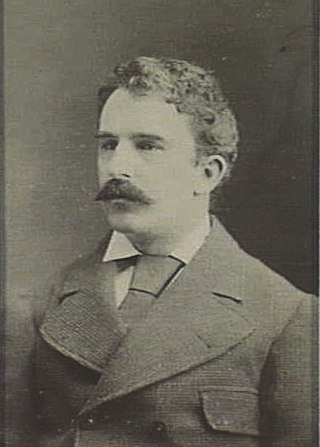
Alfred Dampier was an English-born actor-manager and playwright, active in Australia.

Austral was a passenger ship built by John Elder & Co., Govan and launched on 21 December 1881 for the Orient Steam Navigation Company, Glasgow. She was used in the passenger route trade to Australia.

Alfred Quill was an Australian soccer player and played for the Australia national team. Often considered one of the best soccer players in New South Wales, he scored 868 goals in all NSW competitions in his 24-year senior career.

Alfred Rolfe, real name Alfred Roker, was an Australian stage and film director and actor, best known for being the son-in-law of the celebrated actor-manager Alfred Dampier, with whom he appeared frequently on stage, and for his prolific output as a director during Australia's silent era, including Captain Midnight, the Bush King (1911), Captain Starlight, or Gentleman of the Road (1911) and The Hero of the Dardanelles (1915). Only one of his films as director survives today.
The Life of Rufus Dawes is a 1911 Australian silent film based on Alfred Dampier's stage adaptation of the 1874 novel For the Term of His Natural Life produced by Cosens Spencer.

The Lady Outlaw is a 1911 Australian silent film set in Van Diemen's Land during convict days.
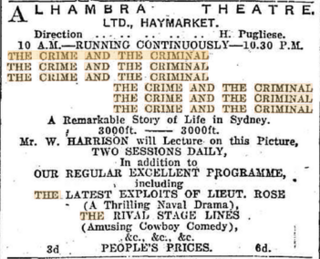
The Crime and the Criminal is a 1912 Australian silent film directed by Alfred Rolfe. It features the same railway collision as the climax in Do Men Love Women? (1912) which had come out only a few weeks prior. However the plots of the movies are different.

Dan Morgan is a 1911 Australian film from Cosens Spencer about the bushranger Daniel Morgan. It was said to be starring "Alfred Rolfe and company". Rolfe directed three movies for Spencer, all starring himself and his wife Lily Dampier so there is a chance he may have directed this one and that it starred his wife. A prospectus for the Australian Photo Play Company said he directed it. It is considered a lost film.

Katherine Annabel Lily Dampier, known as Lily Dampier, was an Australian actress of stage and screen. She was the daughter of Alfred Dampier and married to Alfred Rolfe.
William "Podge" Maunder was an Australian soccer player. Maunder is recognised as the player who scored Australia's first international goal.

Mates from the Murrumbidgee is a 1911 Australian silent movie. It is considered a lost film and was arguably the first Australian war film, being set during the Boer War.
Sayers, Allport & Potter, later Sayers, Allport Proprietary, was an Australian wholesale pharmaceutical and veterinary supply business based in Sydney, whose principal market was the pastoral and agricultural industries of New South Wales. They were particularly known, or notorious, for two products: S.A.P., a phosphorus-based poison aimed at combating the rabbit pest, and Thall-Rat, a thallium-based poison used against rats. Another similar product manufactured was Thall-Ant.
The Lyceum was a live theatre in Sydney, Australia, which became the Sydney City Mission for the Methodist Church while also hosting a cinema, several times relabeled the New Lyceum.
Frank Towers (1835–1886) was an English actor, playwright and stage producer.
Frank Harvey was the nom de plume of John Ainsworth Hilton, born Jean François de Soissons de Latanac, actor and playwright, who was born and died in Manchester, England. His plays were popular in Australia.
William Alexander Andrews, sometimes referred to as "Billy Andrews", was an Australian comic actor, who had a short career but was immensely popular, and like G. V. Brooke, became the yardstick by which later comedians were judged.
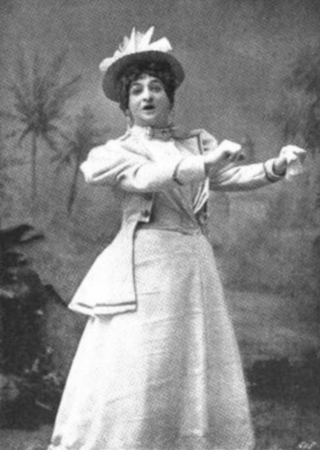
John Francis Sheridan was an Irish-American comic actor and female impersonator who had a long career in Australia, mostly in burlesque.
The Castlemaine Brewery was an Australian brewery and brewing company established in 1857 by Edward Fitzgerald. He was joined in the business by his brother Nicholas Fitzgerald in 1859, after which the firm spread rapidly, opening breweries in Melbourne, Newcastle, Sydney and Brisbane, along with smaller breweries at Daylesford and Newbridge. The breweries, though all originating from the same brothers, were either established or later floated as separate companies with distinct histories thereafter, even though the brothers retained a stake in them.

Municipality of Adamstown was a Local Government Area of New South Wales from 1886 until 1938 when it became part of the City of Greater Newcastle. It was named after and comprised the township of Adamstown near Newcastle.
Joseph Richard Massey, referred to in his lifetime as Joseph Massey sen., was an Australian musician and founder of a family of musicians, best known as church organists.
References
- ↑ "Alfred Dampier" (PDF). Australian Variety Theatre Archive.
- ↑ "MR. ALFRED DAMPIER". The Daily News . Vol. XIV, no. 6, 757. Western Australia. 17 April 1897. p. 5. Retrieved 21 August 2023– via National Library of Australia.
- ↑ "A Young Australian Actress". Evening News . No. 7639. New South Wales, Australia. 21 November 1891. p. 1 (Evening News Supplement). Retrieved 21 August 2023– via National Library of Australia.
- ↑ "Advocate Magazine". Advocate . Vol. LXXXVI, no. 5110. Victoria, Australia. 2 July 1953. p. 9. Retrieved 21 August 2023– via National Library of Australia.
- 1 2 Williams, Margaret (1983). Australia on the popular stage, 1829-1929 : an historical entertainment in six acts. p. 150.
- ↑ "Advertising". Newcastle Morning Herald and Miners' Advocate . Vol. XII, no. 1046. New South Wales, Australia. 19 December 1885. p. 1. Retrieved 21 August 2023– via National Library of Australia.
- ↑ "VICTORIA THEATRE". Newcastle Morning Herald and Miners' Advocate . Vol. XII, no. 1047. New South Wales, Australia. 21 December 1885. p. 2. Retrieved 21 August 2023– via National Library of Australia.
- ↑ "PLAYWRIGHT AND PLAYER". The Express and Telegraph . Vol. XXXIV, no. 9, 973. South Australia. 29 January 1897. p. 3 (ONE O'CLOCK EDITION). Retrieved 21 August 2023– via National Library of Australia.
- ↑ "AUSTRALIAN DRAMA". Daily Herald . Vol. 2, no. 568. South Australia. 30 December 1911. p. 6. Retrieved 21 August 2023– via National Library of Australia.
- ↑ "Commercial Success with". The Sun . No. 1890. New South Wales, Australia. 18 June 1939. p. 11 (Sunday Magazine). Retrieved 21 August 2023– via National Library of Australia.