Related Research Articles
Chief Emeka Anyaoku, GCVO, CFR, CON is a Nigerian diplomat of Igbo descent. He was the third Commonwealth Secretary-General. Born in Obosi, Anyaoku was educated at Merchants of Light School, Oba, and attended the University College of Ibadan, then a college of the University of London, from which he obtained an honours degree in Classics as a College Scholar. Aside from his international career, Chief Anyaoku continues to fulfill the duties of his office as Ichie Adazie of Obosi, a traditional Ndichie chieftainship.

Chief Olusegun Matthew Okikiola Aremu Obasanjo, GCFR, is a Nigerian military and political leader who served as military head of state from 1976 to 1979 and later as President of Nigeria from 1999 to 2007. Ideologically a Nigerian nationalist, he was a member of the People's Democratic Party.
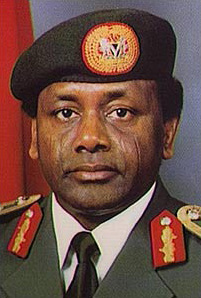
General Sani Abacha GCFR was a Nigerian statesman and military general who served as the head of state of Nigeria from 1993 until his death in 1998.

Chief Moshood Kashimawo Olawale Abiola, GCFR was a Nigerian Yoruba businessman, publisher, politician and aristocrat of the Egba clan. He was the Aare Ona Kankafo XIV of Yorubaland.
Chief James Ajibola Idowu Ige, SAN, simply known as Bola Ige, was a Nigerian lawyer and politician. He also served as Federal Minister of Justice for Nigeria. He was murdered in December 2001.
Dr. Bekolari Ransome-Kuti was a Nigerian medical doctor known for his work as a human rights activist.

Chief Anthony Eromosele Enahoro was one of Nigeria's foremost anti-colonial and pro-democracy activists. He was born the eldest of ten children in Uromi in the present Edo State of Nigeria. His Esan parents were Anastasius Okotako Enahoro (1900-1968) and Fidelia Victoria Inibokun née Ogbidi Okojie (1906-1969). Enahoro has had a long and distinguished career in the press, politics, the civil service and the pro-democracy movement. Educated at the Government School Uromi, Government School Owo and King's College, Lagos, Enahoro became the editor of Nnamdi Azikiwe's newspaper, the Southern Nigerian Defender, Ibadan, in 1944 at the age of 21, thus becoming Nigeria's youngest editor ever. He later became the editor of Zik's Comet, Kano, 1945–49, associate editor of West African Pilot, Lagos, and editor-in-chief of Morning Star from 1950 to 1953.
The National Democratic Coalition (NADECO) was formed on May 15, 1994 by a broad coalition of Nigerian democrats, who called on the military government of Sani Abacha to step down in favor of the winner of the June 12, 1993 election, M. K. O. Abiola. The members mostly came from the southwest of the country. They quickly became the symbol of mass resistance against military rule. On June 11, 1994, using the groundwork laid by NADECO, Abiola declared himself president and went into hiding. He reemerged and was promptly arrested on June 23.
Brigadier General Chinyere Ike Nwosu was a Nigerian Military Administrator of Abia State and then of Oyo State during the military regime of General Sani Abacha.
Abdulkareem Adisa was a Nigerian Major General who was military governor of Oyo State during the military regime of Major-General Ibrahim Babangida. He was convicted for involvement in an attempted coup against military head of state General Sani Abacha in 1997, and was on death row when Abacha died in June 1998. He was subsequently pardoned.
Colonel Ahmed Usman was a Nigerian Military Administrator of Ondo State and then of Oyo State during the military regime of General Sani Abacha.
David Medayese Jemibewon is a retired Nigerian Army major general who served as military governor of the now defunct Western State during the military regime of General Murtala Muhammed, governor of Oyo State after it had been created from part of the old Western State during the military regime of General Olusegun Obasanjo, and later as Minister of Police Affairs in the cabinet of President Olusegun Obasanjo after the return to democracy. He was a contender for the Kogi West Senatorial office in Kogi State.
Colonel Umar Farouk Ahmed was Military Administrator of Cross River State, Nigeria during the military regime of General Sani Abacha. He was then appointed administrator of Kaduna State in August 1998 during the transitional regime of General Abdulsalami Abubakar, handing over power to the elected civilian governor Ahmed Mohammed Makarfi in May 1999. Shortly after, he was retired by the Federal Government, along with all other former military ministers, governors and administrators.
Lamidi Ona-Olapo Adesina was an educator who became governor of Oyo State in Nigeria on 29 May 1999 as a member of the Alliance for Democracy (AD) party.
Colonel (retired) Mohammed Inua Bawa was appointed the Administrator of Ekiti State, Nigeria during the military regime of General Sani Abacha. He was then appointed Administrator of Gombe State from August 1998 to May 1999, handing over to the elected civilian governor at the start of the Nigerian Fourth Republic.
Alex Ibru was a Nigerian businessman, founder and publisher of The Guardian newspaper, who was Minister of Internal Affairs from 1993 to 1995 during the military regime of General Sani Abacha.
Julius O. Ihonvbere is a Nigerian professor born in Oyo in the old Western Region. He attended CMS Primary School in Oyo, St. John's CAC School, Warri, and Edo Boys High School in Ugbowo, Benin City, where he obtained the West African School Certificate. He took his B.A. Combined Honors degree in history and political science from the University of Ife.
Festus Bunmi Olusona is a Nigerian human rights activist and politician.
The Campaign for Democracy (CD) is a Nigerian civil society group that advocates for greater democracy in Nigeria. The group was first organized in the early 1990s to demand an end to the country's military dictatorship. The coalition organized demonstrations, strikes, and other civil resistance actions against the regime of Nigerian president Ibrahim Babangida from 1991–1993, particularly against the nullification of the 1993 Nigerian presidential election. At its peak, the coalition had more than 40 affiliated groups.

Laolu Akande is a Nigerian journalist, editor, scholar and lecturer. He is the current spokesperson of the Vice President of Nigeria, Prof. Yemi Osinbajo, SAN. Before he was named Vice Presidential Spokesperson, Akande was reporting for Empowered Newswire, a US-based news agency and was also a former North America Bureau Chief for The Guardian (Nigeria) in New York City, United States.
References
- ↑ Kole Ahmed Shettima. "Nigerian Pro-democracy Movements in the Diaspora". University of Hawaii. Retrieved 2010-01-13.
- ↑ "JOINT ACTION COMMITTEE OF NIGERIA (JACON) SPECIAL COMMUNIQUEApril 29, 1998". UNIVERSITY OF PENNSYLVANIA - AFRICAN STUDIES CENTER. Retrieved 2010-01-13.
- ↑ "NIGERIA: Referendum to replace presidential polls". UN Office for the Coordination of Humanitarian Affairs Integrated Regional Information Network for West Africa. 21 April 1998. Retrieved 2010-01-13.
- ↑ Taye Babaleye (17 April 1998). "Mayhem in Ibadan". PeaceLink. Retrieved 2010-01-13.
 | This article about an organization in Nigeria is a stub. You can help Wikipedia by expanding it. |