
A Java virtual machine (JVM) is a virtual machine that enables a computer to run Java programs as well as programs written in other languages that are also compiled to Java bytecode. The JVM is detailed by a specification that formally describes what is required in a JVM implementation. Having a specification ensures interoperability of Java programs across different implementations so that program authors using the Java Development Kit (JDK) need not worry about idiosyncrasies of the underlying hardware platform.
In computer engineering, a hardware description language (HDL) is a specialized computer language used to describe the structure and behavior of electronic circuits, and most commonly, digital logic circuits.
In the context of hardware and software systems, formal verification is the act of proving or disproving the correctness of intended algorithms underlying a system with respect to a certain formal specification or property, using formal methods of mathematics.

Electronic test equipment is used to create signals and capture responses from electronic devices under test (DUTs). In this way, the proper operation of the DUT can be proven or faults in the device can be traced. Use of electronic test equipment is essential to any serious work on electronics systems.
Model-driven architecture (MDA) is a software design approach for the development of software systems. It provides a set of guidelines for the structuring of specifications, which are expressed as models. Model-driven architecture is a kind of domain engineering, and supports model-driven engineering of software systems. It was launched by the Object Management Group (OMG) in 2001.
JTAG is an industry standard for verifying designs and testing printed circuit boards after manufacture.
In computer science, the term automatic programming identifies a type of computer programming in which some mechanism generates a computer program to allow human programmers to write the code at a higher abstraction level.
Teradyne, Inc. is an American automatic test equipment (ATE) designer and manufacturer based in North Reading, Massachusetts. Teradyne's high-profile customers include Samsung, Qualcomm, Intel, Analog Devices, Texas Instruments and IBM.

Automatic test equipment or automated test equipment (ATE) is any apparatus that performs tests on a device, known as the device under test (DUT), equipment under test (EUT) or unit under test (UUT), using automation to quickly perform measurements and evaluate the test results. An ATE can be a simple computer-controlled digital multimeter, or a complicated system containing dozens of complex test instruments capable of automatically testing and diagnosing faults in sophisticated electronic packaged parts or on wafer testing, including system on chips and integrated circuits.

On-board diagnostics (OBD) is an automotive term referring to a vehicle's self-diagnostic and reporting capability. OBD systems give the vehicle owner or repair technician access to the status of the various vehicle sub-systems. The amount of diagnostic information available via OBD has varied widely since its introduction in the early 1980s versions of on-board vehicle computers. Early versions of OBD would simply illuminate a malfunction indicator light or "idiot light" if a problem was detected but would not provide any information as to the nature of the problem. Modern OBD implementations use a standardized digital communications port to provide real-time data in addition to a standardized series of diagnostic trouble codes, or DTCs, which allow a person to rapidly identify and remedy malfunctions within the vehicle.
The VDE e. V. is one of Europe’s largest technical-scientific associations with 36,000 members, including 1,300 corporate and institutional members and 8,000 students.
Credence Systems Corporation was a manufacturer of test equipment for the global semiconductor industry, with a major focus on solving specific challenges facing the fast-growing consumer-driven semiconductor markets. Founded in 1978 by David Mees as Semiconductor Test Solutions, the company changed its name to Credence after acquiring Axiom and ASIX in 1990. The company's initial public offering was completed on October 28, 1993. It was publicly traded on the Nasdaq stock market under the symbol CMOS before the merger with LTX in 2008. It was headquartered in Milpitas, California, and was established in twenty countries.

In-system programming (ISP), also called in-circuit serial programming (ICSP), is the ability of some programmable logic devices, microcontrollers, and other embedded devices to be programmed while installed in a complete system, rather than requiring the chip to be programmed prior to installing it into the system. It allows firmware updates to be delivered to the on-chip memory of microcontrollers and related processors without requiring specialist programming circuitry on the circuit board, and simplifies design work.

PSoC is a family of microcontroller integrated circuits by Cypress Semiconductor. These chips include a CPU core and mixed-signal arrays of configurable integrated analog and digital peripherals.
Executable UML is both a software development method and a highly abstract software language. It was described for the first time in 2002 in the book "Executable UML: A Foundation for Model-Driven Architecture". The language "combines a subset of the UML graphical notation with executable semantics and timing rules." The Executable UML method is the successor to the Shlaer–Mellor method.
Standard Test Data Format (STDF) is a proprietary file format for semiconductor test information originally developed by Teradyne, but it is now a de facto standard widely used throughout the semiconductor industry. It is a commonly used format produced by automatic test equipment (ATE) platforms from companies such as Cohu, Roos Instruments, Teradyne, Advantest, and others.
In-circuit test (ICT) is an example of white box testing where an electrical probe tests a populated printed circuit board (PCB), checking for shorts, opens, resistance, capacitance, and other basic quantities which will show whether the assembly was correctly fabricated. It may be performed with a bed of nails type test fixture and specialist test equipment, or with a fixtureless in-circuit test setup.

The Infineon XC800 family is an 8-bit microcontroller family, first introduced in 2005, with a dual cycle optimized 8051 "E-Warp" core. The XC800 family is divided into two categories, the A-Family for Automotive and the I-Family for Industrial and multi-market applications.
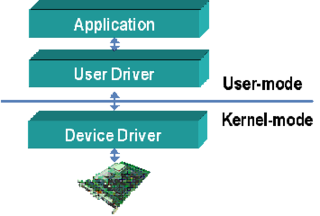
Device drivers are programs which allow software or higher-level computer programs to interact with a hardware device. These software components act as a link between the devices and the operating systems, communicating with each of these systems and executing commands. They provide an abstraction layer for the software above and also mediate the communication between the operating system kernel and the devices below.
IO-Link is a short distance, bi-directional, digital, point-to-point, wired, industrial communications networking standard used for connecting digital sensors and actuators to either a type of industrial fieldbus or a type of industrial Ethernet. Its objective is to provide a technological platform that enables the development and use of sensors and actuators that can produce and consume enriched sets of data that in turn can be used for economically optimizing industrial automated processes and operations.


