
Perception is the organization, identification, and interpretation of sensory information in order to represent and understand the presented information or environment. All perception involves signals that go through the nervous system, which in turn result from physical or chemical stimulation of the sensory system. Vision involves light striking the retina of the eye; smell is mediated by odor molecules; and hearing involves pressure waves.

The sense of balance or equilibrioception is the perception of balance and spatial orientation. It helps prevent humans and nonhuman animals from falling over when standing or moving. Equilibrioception is the result of a number of sensory systems working together; the eyes, the inner ears, and the body's sense of where it is in space (proprioception) ideally need to be intact.

Depth perception is the ability to perceive distance to objects in the world using the visual system and visual perception. It is a major factor in perceiving the world in three dimensions. Depth perception happens primarily due to stereopsis and accommodation of the eye.

The vestibular system, in vertebrates, is a sensory system that creates the sense of balance and spatial orientation for the purpose of coordinating movement with balance. Together with the cochlea, a part of the auditory system, it constitutes the labyrinth of the inner ear in most mammals.
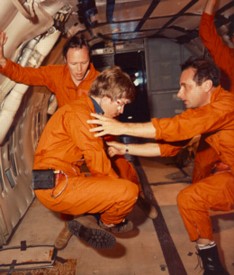
Space adaptation syndrome (SAS) or space sickness is a condition experienced by as many as half of all space travelers during their adaptation to weightlessness once in orbit. It is the opposite of terrestrial motion sickness since it occurs when the environment and the person appear visually to be in motion relative to one another even though there is no corresponding sensation of bodily movement originating from the vestibular system.
Spatial disorientation is the inability to determine position or relative motion, commonly occurring during periods of challenging visibility, since vision is the dominant sense for orientation. The auditory system, vestibular system, and proprioceptive system collectively work to coordinate movement with balance, and can also create illusory nonvisual sensations, resulting in spatial disorientation in the absence of strong visual cues.
Sensory substitution is a change of the characteristics of one sensory modality into stimuli of another sensory modality.

A motion simulator or motion platform is a mechanism that creates the feelings of being in a real motion environment. In a simulator, the movement is synchronised with a visual display of the outside world (OTW) scene. Motion platforms can provide movement in all of the six degrees of freedom (DOF) that can be experienced by an object that is free to move, such as an aircraft or spacecraft:. These are the three rotational degrees of freedom and three translational or linear degrees of freedom.
Sensory processing is the process that organizes and distinguishes sensation from one's own body and the environment, thus making it possible to use the body effectively within the environment. Specifically, it deals with how the brain processes multiple sensory modality inputs, such as proprioception, vision, auditory system, tactile, olfactory, vestibular system, interoception, and taste into usable functional outputs.

Human senses are not naturally geared for the in-flight environment. Pilots may experience disorientation and loss of perspective, creating illusions that range from false horizons to sensory conflict with instrument readings or the misjudging of altitude over water.

The vestibulospinal tract is a neural tract in the central nervous system. Specifically, it is a component of the extrapyramidal system and is classified as a component of the medial pathway. Like other descending motor pathways, the vestibulospinal fibers of the tract relay information from nuclei to motor neurons. The vestibular nuclei receive information through the vestibulocochlear nerve about changes in the orientation of the head. The nuclei relay motor commands through the vestibulospinal tract. The function of these motor commands is to alter muscle tone, extend, and change the position of the limbs and head with the goal of supporting posture and maintaining balance of the body and head.
In perceptual psychology, a sensory cue is a statistic or signal that can be extracted from the sensory input by a perceiver, that indicates the state of some property of the world that the perceiver is interested in perceiving.
Embodied cognitive science is an interdisciplinary field of research, the aim of which is to explain the mechanisms underlying intelligent behavior. It comprises three main methodologies: the modeling of psychological and biological systems in a holistic manner that considers the mind and body as a single entity; the formation of a common set of general principles of intelligent behavior; and the experimental use of robotic agents in controlled environments.
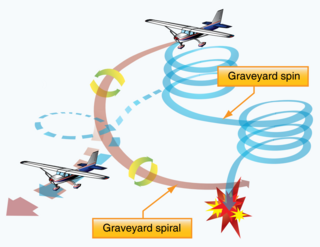
In aviation, a graveyard spiral is a type of dangerous spiral dive entered into accidentally by a pilot who is not trained or not proficient in flying in instrument meteorological conditions (IMC). Other names for this phenomenon include suicide spiral, deadly spiral, death spiral and vicious spiral.
In computing, 3D interaction is a form of human-machine interaction where users are able to move and perform interaction in 3D space. Both human and machine process information where the physical position of elements in the 3D space is relevant.
A sense is a biological system used by an organism for sensation, the process of gathering information about the surroundings through the detection of stimuli. Although, in some cultures, five human senses were traditionally identified as such, many more are now recognized. Senses used by non-human organisms are even greater in variety and number. During sensation, sense organs collect various stimuli for transduction, meaning transformation into a form that can be understood by the brain. Sensation and perception are fundamental to nearly every aspect of an organism's cognition, behavior and thought.
The righting reflex, also known as the labyrinthine righting reflex, or the Cervico-collic reflex; is a reflex that corrects the orientation of the body when it is taken out of its normal upright position. It is initiated by the vestibular system, which detects that the body is not erect and causes the head to move back into position as the rest of the body follows. The perception of head movement involves the body sensing linear acceleration or the force of gravity through the otoliths, and angular acceleration through the semicircular canals. The reflex uses a combination of visual system inputs, vestibular inputs, and somatosensory inputs to make postural adjustments when the body becomes displaced from its normal vertical position. These inputs are used to create what is called an efference copy. This means that the brain makes comparisons in the cerebellum between expected posture and perceived posture, and corrects for the difference. The reflex takes 6 or 7 weeks to perfect, but can be affected by various types of balance disorders.
The fear of falling (FOF), also referred to as basophobia, is a natural fear and is typical of most humans and mammals, in varying degrees of extremity. It differs from acrophobia, although the two fears are closely related. The fear of falling encompasses the anxieties accompanying the sensation and the possibly dangerous effects of falling, as opposed to the heights themselves. Those who have little fear of falling may be said to have a head for heights. Basophobia is sometimes associated with astasia-abasia, the fear of walking/standing erect.
Space neuroscience or astroneuroscience is the scientific study of the central nervous system (CNS) functions during spaceflight. Living systems can integrate the inputs from the senses to navigate in their environment and to coordinate posture, locomotion, and eye movements. Gravity has a fundamental role in controlling these functions. In weightlessness during spaceflight, integrating the sensory inputs and coordinating motor responses is harder to do because gravity is no longer sensed during free-fall. For example, the otolith organs of the vestibular system no longer signal head tilt relative to gravity when standing. However, they can still sense head translation during body motion. Ambiguities and changes in how the gravitational input is processed can lead to potential errors in perception, which affects spatial orientation and mental representation. Dysfunctions of the vestibular system are common during and immediately after spaceflight, such as space motion sickness in orbit and balance disorders after return to Earth.
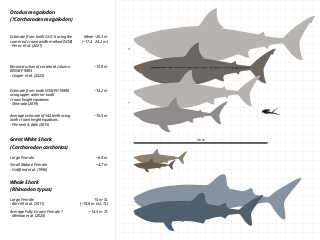
Size in general is the magnitude or dimensions of a thing. More specifically, geometrical size can refer to three geometrical measures: length, area, or volume. Length can be generalized to other linear dimensions. Size can also be measured in terms of mass, especially when assuming a density range.

