Related Research Articles

Don Quixote, the full title being The Ingenious Gentleman Don Quixote of La Mancha, is a Spanish novel by Miguel de Cervantes. It was originally published in two parts, in 1605 and 1615. Considered a founding work of Western literature, it is often said to be the first modern novel. Don Quixote is also one of the most-translated books in the world and one of the best-selling novels of all time.

Miguel de Cervantes Saavedra was an Early Modern Spanish writer widely regarded as the greatest writer in the Spanish language and one of the world's pre-eminent novelists. He is best known for his novel Don Quixote, a work considered as the first modern novel. The novel has been labelled by many well-known authors as the "best book of all time" and the "best and most central work in world literature".

Amadís de Gaula is an Iberian landmark work among the Spanish and Portuguese chivalric romances which were in vogue in the 16th century, although its first version, much revised before printing, was written at the onset of the 14th century in an uncertain place of the Iberian Peninsula.
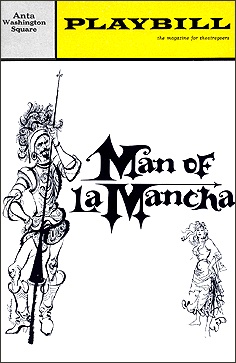
Man of La Mancha is a 1965 musical with a book by Dale Wasserman, music by Mitch Leigh, and lyrics by Joe Darion. It is adapted from Wasserman's non-musical 1959 teleplay I, Don Quixote, which was in turn inspired by Miguel de Cervantes and his 17th-century novel Don Quixote. It tells the story of the "mad" knight Don Quixote as a play within a play, performed by Cervantes and his fellow prisoners as he awaits a hearing with the Spanish Inquisition. The work is not and does not pretend to be a faithful rendition of either Cervantes' life or Don Quixote. Wasserman complained repeatedly about people taking the work as a musical version of Don Quixote.

Dulcinea del Toboso is a fictional character who is unseen in Miguel de Cervantes' novel Don Quixote. Don Quixote believes he must have a lady, under the mistaken view that chivalry requires it. As he does not have one, he invents her, making her the very model of female perfection: "[h]er name is Dulcinea, her country El Toboso, a village of La Mancha, her rank must be at least that of a princess, since she is my queen and lady, and her beauty superhuman, since all the impossible and fanciful attributes of beauty which the poets apply to their ladies are verified in her; for her hairs are gold, her forehead Elysian fields, her eyebrows rainbows, her eyes suns, her cheeks roses, her lips coral, her teeth pearls, her neck alabaster, her bosom marble, her hands ivory, her fairness snow, and what modesty conceals from sight such, I think and imagine, as rational reflection can only extol, not compare".

Sancho Panza is a fictional character in the novel Don Quixote written by Spanish author Miguel de Cervantes Saavedra in 1605. Sancho acts as squire to Don Quixote and provides comments throughout the novel, known as sanchismos, that are a combination of broad humour, ironic Spanish proverbs, and earthy wit. "Panza" in Spanish means "belly".

Rocinante (Rozinante) is Don Quixote's horse in the 1605/1615 novel Don Quixote by Miguel de Cervantes. In many ways, Rozinante is not only Don Quixote's horse, but also his double; like Don Quixote, he is awkward, past his prime, and engaged in a task beyond his capacities.

La Galatea was Miguel de Cervantes’ first book, published in 1585. Under the guise of pastoral characters, it is an examination of love and contains many allusions to contemporary literary figures. It enjoyed modest success, but was not soon reprinted; its promised sequel was never published.
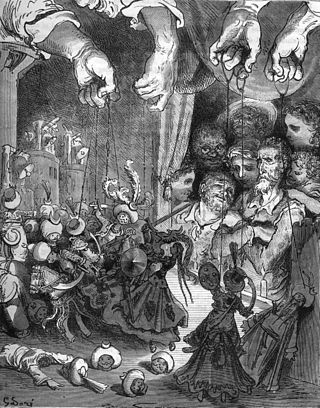
El retablo de maese Pedro is a puppet-opera in one act with a prologue and epilogue, composed by Manuel de Falla to a Spanish libretto based on an episode from Don Quixote by Miguel de Cervantes. The libretto is an abbreviation of chapter 26 of the second part of Don Quixote, with some lines added from other parts of the work. Falla composed this opera "in devoted homage to the glory of Miguel de Cervantes" and dedicated it to the Princess de Polignac, who commissioned the work. Because of its brief length by operatic standards, its very challenging part for a boy opera performer, and its use of puppets, it is not part of the standard operatic repertoire.

Edith Marion Grossman was an American literary translator. Known for her work translating Latin American and Spanish literature to English, she translated the works of Nobel laureate Mario Vargas Llosa, Nobel laureate Gabriel García Márquez, Mayra Montero, Augusto Monterroso, Jaime Manrique, Julián Ríos, Álvaro Mutis, and Miguel de Cervantes. She was a recipient of the PEN/Ralph Manheim Medal for Translation and the 2022 Thornton Wilder Prize for Translation.

Fierabras or Ferumbras is a fictional Saracen knight appearing in several chansons de geste and other material relating to the Matter of France. He is the son of Balan, king of Spain, and is frequently shown in conflict with Roland and the Twelve Peers, especially Oliver, whose prowess he almost rivals. Fierabras eventually converts to Christianity and fights for Charlemagne.

Cide Hamete Benengeli is a fictional Arab Muslim historian created by Miguel de Cervantes in his novel Don Quixote, who Cervantes says is the true author of most of the work. This is a skilful metafictional literary pirouette that seems to give more credibility to the text, making the reader believe that Don Quixote was a real person and the story is decades old. However, it is obvious to the reader that such a thing is impossible, and that the pretense of Cide Hamete's work is meant as a joke.
I, Don Quixote is a non-musical play written for television and directed by Karl Genus. It was broadcast in season 3 of the CBS anthology series DuPont Show of the Month on the evening of November 9, 1959. Written by Dale Wasserman, the play was converted by him ca. 1964 into the libretto for the stage musical Man of La Mancha, with songs by Mitch Leigh and Joe Darion. After a tryout at Goodspeed Opera House in Connecticut, Man of La Mancha opened in New York on November 22, 1965, at the ANTA Washington Square Theatre.

Ricote is a fictional character who is referred to in Miguel de Cervantes' novel Don Quixote. He was a wealthy Morisco shopkeeper and old friend of Sancho Panza, who was banned from Spain in 1609 like all Moriscos. The expulsion of the Moriscos was a highly topical issue at the time when Don Quixote was written—occurring in between the publication of the first part (1605) and the second one (1615).

John Bowle (1725–1788) was an English clergyman and scholar, known today primarily for his ground-breaking, annotated edition of the early 1600s Miguel de Cervantes novel Don Quixote. He is considered to have been the first Hispanist.

Los trabajos de Persiles y Sigismunda is a romance or Byzantine novel by Miguel de Cervantes Saavedra, his last work and one that stands in opposition to the more famous novel Don Quixote by its embrace of the fantastic rather than the commonplace. While Cervantes is known primarily for Don Quixote, widely regarded as one of the foremost classic novels of all time, he himself believed the Persiles, as it is commonly called, to be his crowning achievement. He completed it only three days before his death, and it was posthumously published in 1617.

"The Dialogue of the Dogs" is a novella originating from the fantasy world of Alférez Campuzano, a character from a short story, The Deceitful Marriage. Both are written by author Miguel de Cervantes. It was originally published in a 1613 collection of novellas called Novelas ejemplares.

Don Quixote, Knight Errant is a 2002 Spanish adventure film directed and written by Manuel Gutiérrez Aragón, consisting of an adaptation of the second part of Miguel de Cervantes' Don Quixote. It stars Juan Luis Galiardo and Carlos Iglesias respectively as Don Quixote and Sancho Panza, alongside Santiago Ramos, Fernando Guillén Cuervo, Manuel Manquiña, Kiti Manver, Manuel Alexandre, Juan Diego Botto and Emma Suárez.
References
- 1 2 The Book of Trespass. Nick Hayes. Bloomsbury Circus (20 Aug 2020). ISBN 1526604698 Chapter Fox
- ↑ Cobham Brewer, E. (1894). "The Dictionary of Phrase and Fable" (PDF). p. 2838.
- ↑ Bane, Theresa (2013). Encyclopedia of Fairies in World Folklore and Mythology. McFarland. p. 334. ISBN 1476612420.
- ↑ "#34 Urganda la Desconocida | MusiChess" . Retrieved 2020-12-31.
- ↑ Cervantes, Miguel de, "Commendatory Verses", The Ingenious Hidalgo Don Quixote of La Mancha 1, retrieved 2024-01-07
- ↑ "HERMIT'S CELL THE ROOT HOUSE, Badminton - 1320851 | Historic England". historicengland.org.uk. Retrieved 2020-12-31.
 | This mythology-related article is a stub. You can help Wikipedia by expanding it. |