Type 72 Non-Metallic is a Chinese circular, plastic bodied landmine which is designed to damage or destroy a vehicle by blast effect.
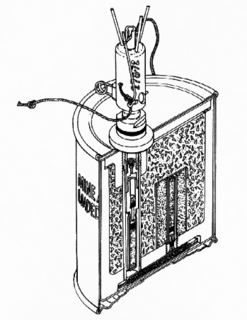
The M16 mine is a United States-made bouncing anti-personnel mine. It was based on captured plans of the World War II era German S-mine and has similar performance. The mine consists of a cast iron body in a thin steel sleeve. A central fuze well on the top of the mine is normally fitted with a pronged M605 pressure and tilt fuze. Sufficient pressure on the prongs or tension on an attached tripwire causes the release of a striker. The freed striker is forced into a percussion cap which ignites a short pyrotechnic delay. The purpose of this delay is to allow the victim to move off the top of the mine, to prevent its upward movement from being blocked. Once the delay has burned through, a 4.5-gram black powder charge is ignited, which launches the inner iron body of the mine up into the air. The charge also ignites a second pair of pyrotechnic delays.

The PROM-1 is a Yugoslavian manufactured bouncing type of anti-personnel mine. It consists of a cylindrical body with a pronged fuze inserted into the top of the mine. It is broadly similar in operation to the German S-mine.

The PMN series of blast anti-personnel mines were designed and manufactured in the Soviet Union. They are one of the most widely used and commonly found devices during demining operations.

The VS-50 is a circular plastic cased anti-personnel blast mine, formerly manufactured by the now-defunct Valsella Meccanotecnica SpA, an Italian high-tech defence industry specialized in area denial systems which was also the manufacturer of the Valmara 69 and one of the first industries in the world to implement plastic construction for landmines. The design is similar to the TS-50 and VS-MK2 mine. It is blast resistant and can be used in a minimum metal configuration. Though unlikely to kill, the explosive charge contained within a VS-50 is quite sufficient to destroy the victim's foot: the blast is capable of penetrating 5 mm of mild steel leaving an 80 mm-diameter hole.
The TC/3.6 and TC/6 are round minimum metal Italian anti-tank blast mines. Both mines use the same fuzing system. They have round deep ribbed plastic cases that are either sand colored or olive green. The fuze works on an air pressure system, with the top pressure plate forcing air through a small bleed valve. The air then inflates a diaphragm which indirectly applies force to the striker spring until a steel restraining ball is forced out of the way of the striker. The striker is then flipped into the detonator, triggering the mine.

The TMA-1 and TMA-1A are circular, plastic cased Yugoslavian minimum metal anti-tank blast mine. The mine consists of an upper plastic pressure plate, and the lower body containing the main charge. The pressure plate has eight triangular raised sectors, and a central fuze cap. The pressure plate is held in place by four plastic pins, which when suffient pressure is applied, shear allowing the pressure plate to collapse onto the mine body, triggering the UANU-1 fuze. A secondary fuze well is provided in the base of the mine, allowing the use of anti-handling devices. The mine is found in Bosnia, Croatia and Kosovo.

The VS-JAP is an Italian bounding anti-personnel mine. It is the latest of the Valmara family of bounding mines that includes the Valmara 59 and Valmara 69. The mine has a waterproof plastic faceted cylindrical body with a three-pronged cap, with a central fixing point for a tripwire. The fuze is triggered via downward or sideways pressure.
The FMK-1 is a small circular Argentina anti-personnel blast mine which, when fitted with a stiffened pressure plate, is also used as the fuze for the FMK-3 and FMK-5 anti-tank mines. The mine has a circular plastic body, with a number of small ribs running vertically around the outside of the mine, with the circular detonator and striker protruding on each side. The pressure plate has a distinctive six pointed star shape ribbing for stiffness. The bottom of the mine has small base plug inside which a small stud is installed. The stud increases the activation pressure of the mine. A metal detector disc can be added to the bottom of the mine, but it is not often used. It is actually in service with the Argentine Army.
The MBV-78-A2 is a small cylindrical Vietnamese anti-personnel fragmentation stake mine. It is unrelated to the MBV-78-A1. The mine has a large plastic head which contains the main charge wrapped around the detonator. A fragmentation layer of steel pieces set into wax surrounds the main charge. The plastic head has two mounting lugs for stake mounting the mine. A Vietnamese copy of the Russian MUV fuze is typically used with the mine, although other fuzes could be used.
The P-25 is a plastic cased Italian anti-personnel stake mine. It was developed along with the larger P-40 mine in the late 1970s by Misar SpA and entered production in 1978. The mine consists of a plastic cylinder with a fuse protruding from the top. The mine can either be stake mounted or buried, although it was designed to be stake mounted. Pull pressure on the tripwire results in the fuse head tilting sideways, releasing a striker into the detonator assembly.
The BM/85 is an Italian blast resistant bounding anti-personnel mine that was produced by Tecnovar italiana SpA. The mine is cylindrical with a three pronged tilt/pressure fuze on the top with a central post for attaching a tripwire. A plastic safety clip prevents the fuze from tilting when in transit. Once the pressure clip is removed the mine is armed. Once the fuze is pulled sideways by a trip wire or by downward pressure, the mine is triggered. A small charge launches the mine to a height of about 0.45 meters where it explodes scattering 1,000 fragments to a lethal radius of about 25 meters.

The TS-50 is a 90 mm (3.5 in) diameter circular Italian blast resistant minimum metal anti-personnel mine designed and produced by Valsella Meccanotecnica.
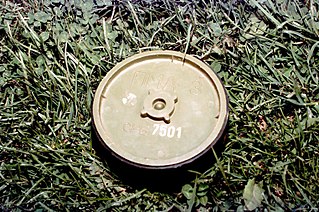
The PMA-3 is a Yugoslavian blast resistant minimum metal anti-personnel mine. It is circular, consisting of a plastic upper and lower half joined together by a rubber cover. A safety collar is normally wrapped around the outside of the mine, preventing the upper half of the mine tilting when in transit. Once deployed the safety collar is removed. Sufficient pressure on the top surface of the mine causes it to tilt. The tilting drives a pin through a friction sensitive pyrotechnic compound, which fires the detonator and then the main explosive charge.
The Bakelite anti-tank mine type I and type II were Italian anti-tank mines produced during the Second World War. As the name suggests, the mines used Bakelite cases and used relatively few metal components, making them difficult to detect with mine detectors of the era. It was primarily used to deter pursuit when withdrawing from an area.
The M432 is a Portuguese bounding anti-personnel mine, which traces the roots of its design to the Second World War German S-mine, although it is probably more directly related to the Belgian NR 442 mine and United States M16 mine. As of 2004, all operational stocks of the mine have been destroyed, although some may have been retained for training purposes.

The Pignone P-1 and Pignone P-2 were plastic cased Italian anti-tank blast mines produced and used during the Second World War in North Africa and Italy. Although the mines had plastic cases, they had a number of metal components, rendering them detectable to mine detectors.

The GYATA-64 is a Hungarian antipersonnel mine, very similar to the Russian PMN mine in design and appearance. However, the Gyata-64 mine has a 300 gram explosive charge compared with the 249 gram charge in a PMN mine. As a result, the Gyata-64 is the most powerful AP blast mine commonly encountered, for which reason it is particularly deadly.
MAUS is an Italian designed anti-personnel scatter mine. A plastic high explosive landmine, it is designed for rapid placement on the minefields either by helicopter, hand-drop or other ground vehicle. An integral, safety pin armed, pressure actuated, pneumatic fuse is used which is designed to withstand explosive overpressure for short duration and deployment impact. The mine is also waterproof and can be placed at a depth of one metre. The MAUS and MAUS/1 are identical except the MAUS/1 has an additional plug that either provides access to the expansion bulb or may act as a vent from the diaphragm.


