
The Douglas F4D Skyray is an American carrier-based fighter/interceptor built by the Douglas Aircraft Company. Although it was in service for a relatively short time (1956-1964) and never entered combat, it was the first carrier-launched aircraft to hold the world's absolute speed record, at 752.943 mph, and was the first United States Navy and United States Marine Corps fighter that could exceed Mach 1 in level flight. It was the last fighter produced by the Douglas Aircraft Company before it merged with McDonnell Aircraft and became McDonnell Douglas. The F5D Skylancer was an advanced development of the F4D Skyray that did not go into service.

Marine Corps Air Station Miramar, formerly Naval Auxiliary Air Station (NAAS) Miramar and Naval Air Station (NAS) Miramar, is a United States Marine Corps installation that is home to the 3rd Marine Aircraft Wing, which is the aviation element of the 1st Marine Expeditionary Force. It is located in Miramar, San Diego, California, about 10 miles (16 km) north of Downtown San Diego.

VFA-31 or Strike Fighter Squadron 31 is known as the Tomcatters, callsign "Felix", a United States Navy strike fighter squadron stationed at Naval Air Station Oceana flying the F/A-18E Super Hornet. The Tomcatters are the second oldest Navy Fighter Attack squadron operating today.

Strike Fighter Squadron 103 (VFA-103), nicknamed the Jolly Rogers is an aviation unit of the United States Navy established in 1952. VFA-103 flies the F/A-18F Super Hornet and is based at Naval Air Station Oceana, Virginia (US). The squadron's radio callsign is Victory and it is assigned to Carrier Air Wing Seven.

Strike Fighter Squadron 2 (VFA-2) also known as the "Bounty Hunters" is a United States Navy F/A-18F Super Hornet strike fighter squadron based at Naval Air Station Lemoore, California. Their tail code is NE and their callsign is "Bullet". They are attached to Carrier Air Wing 2 (CVW-2), a composite unit made up of a wide array of aircraft performing a variety of combat and support missions that deploy aboard the Carl Vinson.
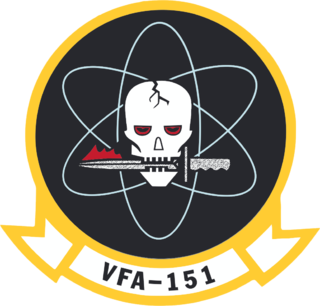
Strike Fighter Squadron One Five One (VFA-151) nicknamed the Vigilantes are a United States Navy F/A-18E Super Hornet fighter squadron stationed at Naval Air Station Lemoore, California. The squadron is a part of Carrier Air Wing 9 (CVW-9) and attached to USS John C. Stennis. As part of CVW-9, the squadron's tail code is NG and its radio callsign is "Switch".
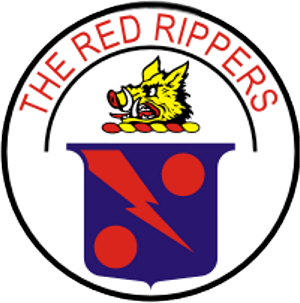
Strike Fighter Squadron 11 (VFA-11) is a United States Navy strike fighter squadron stationed at Naval Air Station Oceana, Virginia, United States. The squadron was established in 1950 and is nicknamed "Red Rippers". VFA-11 is equipped with the Boeing F/A-18F Super Hornet and currently assigned to Carrier Air Wing One.

VF-74, Fighter Squadron 74, Be-Devilers was an aviation unit of the United States Navy in service from 1944 to 1994. Originally established as VBF-20 on 16 April 1945, it was redesignated as VF-10A on 15 November 1946, redesignated as VF-92 on 12 August 1948, redesignated as VF-74 on 15 January 1950 and disestablished on 30 April 1994. It was the third US Navy squadron to be designated as VF-74.

Strike Fighter Squadron 101 (VFA-101), also known as the "Grim Reapers", is a United States Navy Fleet Replacement Squadron (FRS) based at Eglin AFB, Florida. After the West Coast FRS for the F-14 Tomcat, VF-124, was disestablished in the mid-1990s, VF-101 became the sole F-14 FRS. At the time it was based at NAS Oceana in Virginia. With the retirement of the F-14, VF-101 was deactivated in 2005. It was reactivated in 2012 and redesignated Strike Fighter Squadron 101 (VFA-101). It is currently one of two F-35C Lightning II FRS. It is based at Eglin AFB, Florida with the joint 33d Fighter Wing but is a subordinate unit of the U.S. Navy's Strike Fighter Wing, U.S. Pacific Fleet.

Strike Fighter Squadron 143 (VFA-143), also known as the "Pukin Dogs," is a United States Navy strike fighter squadron based at Naval Air Station Oceana, Virginia. The Pukin Dogs are an operational fleet squadron and flying the F/A-18E Super Hornet. They are currently attached to Carrier Air Wing Seven and USS Harry S. Truman. They are currently at their homeport of NAS Oceana. Their radio callsign is Taproom.

Strike Fighter Squadron 81 (VFA-81), also known as the "Sunliners", is a United States Navy F/A-18E Super Hornet strike fighter squadron stationed at Naval Air Station Oceana. They are a part of Carrier Air Wing One, their radio callsign is Inferno, and their tail code is AB. Their mission is to conduct prompt and sustained combat operations from the sea. The squadron was originally designated VA-66 on 1 July 1955, was redesignated VF-81 the same day, redesignated VA-81 on 1 July 1959, and finally redesignated VFA-81 on 4 February 1988.
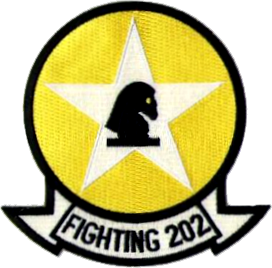
Fighter Squadron 202 (VF-202) nicknamed the Superheats was an aviation unit of the United States Naval Reserve initially based at Naval Air Station Dallas,
Texas. Following that installation's BRAC-directed closure, the squadron relocated to nearby former Carswell Air Force Base, which was transferred to U.S. Navy control pursuant to BRAC action and renamed Naval Air Station Joint Reserve Base Fort Worth / Carswell Field. VF-202 was established on 1 July 1970 as part of Reserve Carrier Air Wing 20 (CVWR-20), the U.S. Atlantic Fleet's reserve carrier air wing, and disestablished on 31 December 1994. During its service VF-202 could be identified by the tail code "AF" and nose numbers (MODEX) "200" through "213."

Naval Air Station Key West, is a naval air station and military airport located on Boca Chica Key, four miles (6 km) east of the central business district of Key West, Florida, United States.
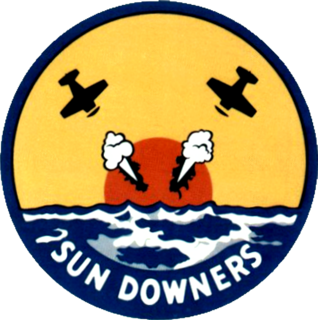
Fighter Squadron Composite 111 (VFC-111) Sun Downers is a US Navy Reserve adversary squadron based at Naval Air Station Key West, Florida (USA). Currently, it operates Northrop F-5N/F Tiger-IIs, of most of which are single-seater F-5Ns and one twin-seater F-5F, the "FrankenTiger". The Squadron is composed of experienced active duty junior officers, full time support reservist, and selective reserves. This gives the squadron cutting edge real world experiences, as well as leveraging off experience and retaining talented instructors that have left active service.

Naval Air Station Squantum was an active naval aviation facility during 1917 and from 1923 until 1953. The original civilian airfield that preceded it, the Harvard Aviation Field, dates back to 1910. The base was sited on Squantum Point in the city of Quincy, Massachusetts. It also abutted Dorchester Bay, Quincy Bay, and the Neponset River.

All Weather Fighter Squadron 3 was a designation which was used by two separate U.S. Navy aviation squadrons. The first squadron to use the designation was established as Composite Squadron THREE (VC-3) on 20 May 1943, was redesignated All Weather Fighter Squadron THREE on 1 July 1956 and was disestablished on 2 May 1958. The second squadron to use the designation was established as "Navy Air Training Unit-Pacific (NATUPAC)" on 22 May 1944, was redesignated "Night Development Squadron Pacific (NightDevRonPac)" on 6 April 1946, then "Fighter All Weather Training Unit Pacific (FAWTUPAC)" on 1 September 1948 and finally, on the same day as the first squadron designated VF(AW)-3 was disestablished, 2 May 1958, was redesignated "All Weather Fighter Squadron THREE (VF ". This second squadron to carry the VF -3 designation adopted the insignia and nickname "Blue Nemisis" from the first VF -3 and was the only U.S. Navy unit to be assigned to the North American Air Defense Command.
Fighter Squadron 45 or VF-45 was an aviation unit of the United States Navy. Originally established as Attack Squadron 45 (VA-45) on 15 February 1963, it was redesignated VF-45 on 7 February 1985 and disestablished on 31 March 1996. It was the third US Navy squadron to be designated VA-45 and the second US Navy squadron to be designated as VF-45. The squadron adopted the Blackbirds nickname and insignia of the second VA-45.

870 Naval Air Squadron, also known as VF-870, was a squadron of the Royal Canadian Navy (RCN). It was formed when 803 Naval Air Squadron of the Royal Navy was renumbered to 870 NAS on 1 May 1951. It operated throughout the 1950s and early 1960s before disbanding on 7 September 1962. It was the first RCN squadron to operate jet aircraft.


