
Microsoft SharePoint Workspace is a discontinued desktop application designed for document collaboration in teams with members who are regularly off-line or who do not share the same network security clearance. It is no longer included with Microsoft Office 2013. It has been replaced by a web-based service called OneDrive for Business.
HCL Sametime Premium is a client–server application and middleware platform that provides real-time, unified communications and collaboration for enterprises. Those capabilities include presence information, enterprise instant messaging, web conferencing, community collaboration, and telephony capabilities and integration. Currently it is developed and sold by HCL Software, a division of Indian company HCL Technologies, until 2019 by the Lotus Software division of IBM.

Web conferencing is used as an umbrella term for various types of online conferencing and collaborative services including webinars, webcasts, and web meetings. Sometimes it may be used also in the more narrow sense of the peer-level web meeting context, in an attempt to disambiguate it from the other types known as collaborative sessions. The terminology related to these technologies is exact and agreed relying on the standards for web conferencing but specific organizations practices in usage exist to provide also term usage reference.
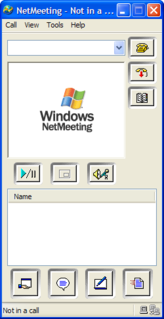
Microsoft NetMeeting is a discontinued VoIP and multi-point videoconferencing client included in many versions of Microsoft Windows. It uses the H.323 protocol for videoconferencing, and is interoperable with OpenH323-based clients such as Ekiga, OpenH323, and Internet Locator Service (ILS) as reflector. It also uses a slightly modified version of the T.120 Protocol for whiteboarding, application sharing, and file transfers.

Adobe Connect is a suite of software for remote training, web conferencing, presentation, and desktop sharing. All meeting rooms are organized into 'pods'; with each pod performing a specific role Adobe Connect was formerly part of the Adobe Acrobat family and has changed names several times.

Skype for Business is an enterprise software application for instant messaging and videotelephony developed by Microsoft as part of the Microsoft Office suite. It is designed for use with the on-premises Skype for Business Server software, and a software as a service version offered as part of Office 365. It supports text, audio, and video chat, and integrates with Microsoft Office components such as Exchange and SharePoint.

A hardware security module (HSM) is a physical computing device that safeguards and manages digital keys, performs encryption and decryption functions for digital signatures, strong authentication and other cryptographic functions. These modules traditionally come in the form of a plug-in card or an external device that attaches directly to a computer or network server. A hardware security module contains one or more secure cryptoprocessor chips.

Windows Meeting Space was a peer-to-peer collaboration program developed by Microsoft for Windows Vista as a replacement for Windows NetMeeting and it enables application sharing, collaborative editing, desktop sharing, file sharing, projecting, and simple text-based or ink-based instant messaging across up to 10 users connected to the same network or across the Internet. Meeting Space has the ability to automatically set up an ad hoc wireless network if a connection to a network or the Internet are not available and also enables participants to invite other people to meeting sessions. It is the first application for the new peer-to-peer framework in Windows Vista and hence requires IPv6.
Network Security Services (NSS) is a collection of cryptographic computer libraries designed to support cross-platform development of security-enabled client and server applications with optional support for hardware TLS/SSL acceleration on the server side and hardware smart cards on the client side. NSS provides a complete open-source implementation of cryptographic libraries supporting Transport Layer Security (TLS) / Secure Sockets Layer (SSL) and S/MIME. NSS releases prior to version 3.14 are tri-licensed under the Mozilla Public License 1.1, the GNU General Public License, and the GNU Lesser General Public License. Since release 3.14, NSS releases are licensed under GPL-compatible Mozilla Public License 2.0.

Jitsi is a collection of free and open-source multiplatform voice (VoIP), video conferencing and instant messaging applications for the web platform, Windows, Linux, macOS, iOS and Android. The Jitsi project began with the Jitsi Desktop. With the growth of WebRTC, the project team focus shifted to the Jitsi Videobridge for allowing web-based multi-party video calling. Later the team added Jitsi Meet, a full video conferencing application that includes web, Android, and iOS clients. Jitsi also operates meet.jit.si, a version of Jitsi Meet hosted by Jitsi for free community use. Other projects include: Jigasi, lib-jitsi-meet, Jidesha, and Jitsi.
Google Workspace is a collection of cloud computing, productivity and collaboration tools, software and products developed and marketed by Google. It was first launched in 2006 as Google Apps for Your Domain and rebranded as G Suite in 2016. Google Workspace consists of Gmail, Contacts, Calendar, Meet and Chat for communication; Currents for employee engagement; Drive for storage; and the Google Docs suite for content creation. An Admin Panel is provided for managing users and services. Depending on edition Google Workspace may also include the digital interactive whiteboard Jamboard and an option to purchase such add-ons as the telephony service Voice. The education edition adds a learning platform Google Classroom and today has the name Workspace for Education.
Open Wonderland is a Java open-source toolkit for creating collaborative 3D virtual worlds. Within those worlds, users can communicate with high-fidelity, immersive audio, share live desktop applications and documents and conduct real business. Open Wonderland is completely extensible; developers and graphic artists can extend its functionality to create entirely new worlds and add new features to existing worlds.
Remote Desktop Services (RDS), known as Terminal Services in Windows Server 2008 and earlier, is one of the components of Microsoft Windows that allow a user to take control of a remote computer or virtual machine over a network connection. RDS is Microsoft's implementation of thin client architecture, where Windows software, and the entire desktop of the computer running RDS, are made accessible to any remote client machine that supports Remote Desktop Protocol (RDP). User interfaces are displayed from the server onto the client system and input from the client system is transmitted to the server - where software execution takes place. This is in contrast to application streaming systems, like Microsoft App-V, in which computer programs are streamed to the client on-demand and executed on the client machine.
This list is a comparison of web conferencing software available for Linux, macOS, and Windows platforms. Many of the applications support the use of videoconferencing.
Live conferencing refers to the live streaming of interactive audio and video presentations, lectures, meetings, and seminars to the global audience with the help of a camera and conferencing equipment. Such equipment lets businesses connect and coordinate with remote workforces located in different region, engage them in productive real-time discussions, and record individual or group responses.

PowWow365, designed and developed by Hirasoft Corp, is a web conferencing application for businesses and organizations, allowing them to host and attend their meetings, conferences, trainings or workshops from anywhere around the world. The application allows both standard types of communications, i-e, real-time Point-to-point communications and multicast from one sender to the many receivers.
Citrix Cloud is a cloud management platform that allows organizations to deploy cloud-hosted desktops and apps to end users. It was developed by Citrix Systems and released in 2015.
The Friend OS or the Friend Unifying Platform is a network based Meta Operating System – a technology that can be used implementing a graphical user interface delivered through a browser, with a back-end that behaves like an operating system. This operating system connects resources and end-user software together in a seamless user experience that can be accessed anywhere. Additionally, it can be customized and prepped for any security requirements and is the first open source cloud operating system that aims to unify web applications and deliver an ecosystem for them to be used across all devices.
Google Meet is a video-communication service developed by Google. It is one of two apps that constitute the replacement for Google Hangouts, the other being Google Chat.
Comparison of user features of messaging platforms refers to a comparison of all the various user features of various electronic instant messaging platforms. this includes a wide variety of resources; it includes standalone apps, platforms within websites, computer software, and various internal functions available on specific devices, such as iMessage for iPhones.

