
The sea lamprey is a parasitic lamprey native to the Northern Hemisphere. It is sometimes referred to as the "vampire fish".

The brook lamprey is a small European lamprey species that exclusively inhabits freshwater environments. The species is related to, but distinct from, the North American western brook lamprey.

A lampricide is any chemical designed to target the larvae of lampreys in river systems before they develop into parasitic adults. One lampricide is used in the headwaters of Lake Champlain and the Great Lakes to control the sea lamprey, an invasive species to these lakes.

The Arctic lamprey, also known as the Japanese river lamprey or Japanese lampern, is a species of lamprey, a jawless fish in the order Petromyzontiformes. It inhabits coastal freshwater habitat types in the Arctic. Some populations are anadromous, spending part of their lives in the ocean. It is the most common and widespread lamprey in the Arctic region.

The pouched lamprey, also known as wide-mouthed lamprey, is a species in the genus Geotria, which is the only genus in the family Geotriidae. The second species in the genus is the Argentinian lamprey, which was revalidated as a separate species in 2020. The pouched lamprey is native to the southern hemisphere. It spends the early part of its life in fresh water, migrating to the sea as an adult, and returning to fresh water to spawn and die.

The Pacific lamprey is an anadromous parasitic lamprey from the Pacific Coast of North America and Asia. It is a member of the Petromyzontidae family. The Pacific lamprey is also known as the three-tooth lamprey and tridentate lamprey.

The Western brook lamprey is a small (<18 cm), widely distributed, non-parasitic species of jawless fish endemic to the freshwater coastal waterways of the western United States and Canada. Its range extends from the North American Pacific coast from Taku River, southern Alaska, to central California, including Vancouver Island, with major inland distributions in the Columbia and Sacramento-San Joaquin watersheds.

The chestnut lamprey is a species of lamprey.
The silver lamprey is a lamprey commonly found in the Northern and Central United States, as well as a large part of southern Canada. Its binomial name means "sucking fish" in Greek and "one-pointed" in Latin. The silver lamprey is a member of the Class Agnatha, sometimes referred to as cyclostomes (round-mouths). Other common names include: Bloodsucker, Blue Lamprey, Hitch-hiker, Lamper, Lamprey Eel. The silver lamprey should not to be confused with the sea lamprey, which has caused considerable damage to native fish populations in the Great Lakes region.
The mountain brook lamprey or Allegheny brook lamprey is a lamprey found in parts of the Mississippi river basin, New York, Pennsylvania, Ohio, and in the Cumberland River and Tennessee River. This fish is jawless with a small sucker mouth and a long, eel-like body. It is fairly small, only growing to about 8 inches (20 cm) in length.
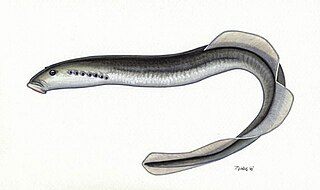
The Carpathian brook lamprey or Danube lamprey is a species of lamprey in the Petromyzontidae family. It is found in Austria, Bosnia and Herzegovina, Bulgaria, Croatia, Czech Republic, Hungary, Moldova, Romania, Serbia, Montenegro, Slovakia, and Ukraine. It is non-parasitic.

The Ukrainian brook lamprey is a species of lamprey in the Petromyzontidae family. It is found in brackish and freshwater areas in Austria, Belarus, Bulgaria, the Czech Republic, Georgia, Hungary, Moldova, North Macedonia, Poland, Romania, Russia, Serbia and Montenegro, Slovakia, Turkey, and Ukraine. It invaded the basin of the Volga River in 2001.
The Miller Lake lamprey is a species of lamprey in the Petromyzontidae family endemic to the United States. Its natural habitat is the Miller Lake drainage in the state of Oregon.

Mordacia lapicida, also known as the Chilean lamprey, is a species of southern topeyed lamprey endemic to southern Chile, where it can be found in riverine and marine habitats. This species is anadromous. This parasitic lamprey can reach a length of 54 centimetres (21 in) SL. Ammocoetes and adults of this species are found in rivers, and occur in fine sand along river banks.
TFM (3-trifluoromethyl-4-nitrophenol) is a common piscicide, i.e., a fish poison used to combat parasitic and invasive species of fish.

Lampreys are an ancient extant lineage of jawless fish of the order Petromyzontiformes, placed in the superclass Cyclostomata. The adult lamprey may be characterized by a toothed, funnel-like sucking mouth. The common name "lamprey" is probably derived from Latin lampetra, which may mean "stone licker", though the etymology is uncertain. The plural form lamprey is sometimes seen.
The Caspian lamprey, Caspiomyzon wagneri, is a species of lamprey native to the Caspian Sea, and a member of the Petromyzontidae family. Eudontomyzon hellenicus and E. graecus also possibly belong in this genus. This species is a non-parasitic lamprey that feeds on animal carcasses.
The Great Lakes Fishery Commission is a bi-national commission made up of representatives of the United States and Canada. It was formed by the Convention on Great Lakes Fisheries, concluded in 1954 and ratified in 1955. It has eight members: four members are appointed by the President of the United States, serving six-year terms, and four are appointed by the Privy Council of Canada. The commission is charged, under Article Four of the Convention on Great Lakes Fisheries, with conducting research and making recommendations on the management of Great Lakes fisheries, as well attempting the eradication of the sea lamprey from the Great Lakes.
The Ohio lamprey is a lamprey found in the Ohio River drainage basin in the United States and is a parasitic species of lampreys. They are considered to be an endangered/rare species in some states, due to siltation, pollution, and construction of dams.

Lampetra ayresii is a species of lamprey in the family Petromyzontidae. It is also called the river lamprey or western river lamprey. It is found in the eastern pacific, specifically from Tee Harbor, Juneau in Alaska to the Sacramento-San Joaquin drainage in California, USA. It can survive in both marine surface waters and freshwater lakes, rivers, and creeks. In freshwater, it is found typically in the lower portions of large river systems. It is a predatory fish and feeds on fishes in the size range of 10-30 cm. It feeds by attaching to prey using its round, sucker-like mouth. Adult western river lampreys typically grow to about 20-30 cm.
