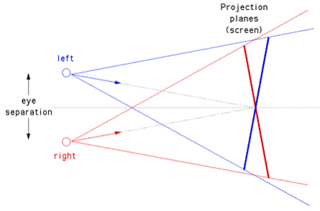
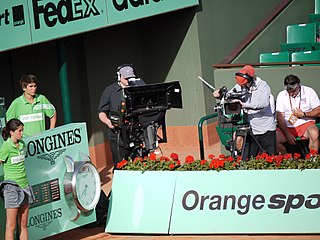
The Van Hare Effect is a 3D stereoscopic viewing technique for creating or enhancing the illusion of depth in an image by means of stereopsis for binocular vision using psychophysicalpercepts. The Van Hare Effect creates the illusion of dimensionality, rather than actual dimensionality in the subject being viewed. The Van Hare Effect is achieved by employing the stereoscopic cross-eyed viewing technique on a pair of identical images placed side-by-side. In doing so, it artificially tricks the human brain and optical center into seeing depth in what is actually a two-dimensional, non-stereoscopic image. The illusion of depth is interesting in that even if the image pair is not itself originally stereoscopic, the brain perceives it as if it is.
No special viewing apparatus is required as the brain is tricked into creating a false perception of a three-dimensional still image or video simply by viewing it with the cross-eyed technique. In videos or films viewed this way, the artificial depth perception derived can to be diminished for some viewers, perhaps due to the fast changing visual picture, which appears to occupy more of the brain.
Most people can employ the Van Hare Effect but not all. The reasons for why some people cannot make the Van Hare Effect work for them are unknown and deserve further scientific study.
Background
The Van Hare Effect was discovered in 2003 by the 3D theorist, Thomas Van Hare, who also invented three additional fields in stereoscopy -- hyperdimensionality, variable dimensionality, and computational dimensionality, aka C3D, which were all developed for military applications with the intended purpose of creating stereoscopic output from single camera drones for improved interpretation of reconnaissance imagery and capture.
Why the Van Hare Effect works remains a matter of conjecture, although it is clearly the brain itself that creates the impression of depth perception even where there is none in the image pair being viewed. The brain appears to be "trained" to view images in 3D as a general rule, even when very limited or no stereoscopic data is available. Thus, the Van Hare Effect creates the artificial impression of 3D viewing based on the brain's own past experience in interpreting objects, shapes and people, drawing on past visual experiences and knowledge of the perception of similar forms. The cross-eyed viewing technique may be the cue that allows the brain to override its assumption that the photograph or video/film being viewed is two-dimensional and instead trick it into thinking that the results are supposed to be three-dimensional. Therefore, once the brain is tricked in this manner, it may be that it works more effectively in discerning the depth and dimensional data from the existing two-dimensional images, thus giving the viewer the impression of dimensionality even where there is none.
The Pulfrich effect[1][2] may likewise be partly explained in this manner, though the actual temporal changes from frame to frame in the films prepared for viewing with the Pulfrich effect do in fact provide some dimensional information to the brain. However, even where no temporal changes are evident in objects in the films being viewed with the Pulfrich effect, the brain appears to apply some depth perception to those areas of the film anyway, as if artificially compensating in a manner that inserts dimensional data where no stereoscopic-like changes are actually available. This may be related to the same processes in the brain that produce the Van Hare Effect.
The Van Hare Effect may also result partly from the brain's ability to discern dimensional information from changes in the size of objects or in the varying definition of textures within the image due to changes in resolution at a distance. It may also result from the amount of haze evident in the picture, which increases in distance and, in color images, may be perceived as a matter of color saturation or by a subtle shift toward the blue end of the spectrum. Additionally, some artificial depth perception may result from the perception of the amount of overlap seen in objects or the appearance of objects that are known to be the same size, that repeat in the image at various sizes, due to the distances involved. All of these latter reasons, however, should allow depth perception to be just as evident in a single two-dimensional image, yet typically they appear to escape notice when the viewer is examining a single image. It may be that once the Van Hare Effect is applied, these clues within the images are more easily recognized and discerned by the brain and optic center.
The Van Hare Effect may also be more readily apparent or magnified to those who have used the cross-eyed viewing technique in the past. If the viewer is accustomed to looking at stereoscopic image pairs without a viewer and by using the cross-eyed viewing technique, the viewer may have further trained their brain in a manner that enhances the Van Hare Effect. The knowledge of visual interpretation from the cross-eyed technique then is more readily applied when viewing identical image pairs instead of stereoscopic image pairs.
Technique
A regular, two-dimensional image is all that is needed. The viewer prepares two prints of the identical image and these are placed side-by-side, horizontally, and close together. The pair of identical images are then viewed with the cross-eyed viewing method, the same as one would use in interpreting stereoscopic image pairs. The cross-eyed viewing method has its roots in aerial photography and aerial reconnaissance image interpretation.
View of Boston, c.1860; an early stereoscopic card for viewing a scene from nature, where actual stereoscopic image data is included.
No special glasses, filters, colored lens or other apparatus are required to employ the Van Hare Effect. Simply by utilizing the cross-eyed viewing technique, the resulting pair of identical images are seen in three-dimensions, even if there are no stereoscopic differences based on the interstitial distance included in the image being viewed.
The cross-eyed viewing method, in traditional stereoscopy, swaps the left and right eye images so that they will be correctly seen cross-eyed, the left eye viewing the image on the right and vice versa. A fused three-dimensional image thus appears to the eye, though it also appears to be smaller and closer than the actual images, so that large objects and scenes appear miniaturized.[3][4][5]
For videos with the artificial depth implied by the Van Hare Effect, the viewer plays the same video side-by-side, as above, and views it with the cross-eyed viewing technique.
Two identical images of a historic photo of a flight of RAF Hawker Hurricanes are placed side-by-side to demonstrate the Van Hare Effect, where a 2D image can be artificially perceived as if it is stereoscopic.
As an aid for those wishing to learn how to use the cross-eyed viewing method and thereby create image pair fusion, a fingertip can be placed just below the division between the two images, then slowly brought straight toward the viewer's eyes, keeping the eyes directed at the fingertip; at a certain distance, a fused three-dimensional image should seem to be hovering just above the finger.
A second aid, alternatively, involves using a piece of paper with a small opening cut into it. This can be used in a similar manner so that when the paper is correctly positioned between the image pair and the viewer's eyes, which can be achieved by moving the paper forward and backward until the two images come into full view, whereupon the hole in the paper will seem to frame a small three-dimensional image.
A third aid is that the viewer goes cross-eyed, and when this is done, the two images appear as three images, due to the lines of sight when cross-eyed. If the viewer focuses on the middle of the three images, it will come into focus as stereoscopic, without any viewing apparatus or use of a finger to get the eyes correctly focused.
Notable uses
Two identical images of the famous Vermeer painting, Girl with a Pearl Earring, painted c. 1665, are placed side-by-side to demonstrate the Van Hare Effect and how it can be used to reinterpret artworks. The 2D painting can be artificially perceived as if it is stereoscopic, giving artificial depth. In this case, a dimensional mistake is uncovered -- the girl's neck is not properly painted in the correct position for artificial depth. This is an error in the original painting that heretofore typically escapes notice when seen by a common viewer's eye. Once the error is recognized through application of the Van Hare Effect, it becomes easily recognized even when viewing normally as a single image.
Beyond creating an artificial 3D effect from regular photographs, there are other uses for the Van Hare Effect, including the following:
Converting 2D Images to 3D -- This is the original intent of the Van Hare Effect. Images that are 2D can be viewed in artificial 3D, often resulting in features that escaped notice becoming apparent to the viewer as the brain provides dimensional interpretation to what was heretofore a two-dimensional image.
Finding Hidden Objects -- The Van Hare Effect provides viewers with a fast and easy way to find hidden objects, such as in "hidden object games", where two images are presented side-by-side and the viewer is challenged to find the missing items or changes from one image to the next. By employing cross-eyed viewing and the Van Hare Effect, the changes are instantly evident, either appearing as throbbing differences or standing out as if hovering over the top of the image when viewed in this manner.
Easily Recognizing Image Edits -- Where an original image and an edited image are both in hand, the Van Hare Effect provides a way to spot the edits that have been made simply by comparing the original and the edited image side-by-side with the cross-eyed viewing. The image edits are instantly evident, typically as throbbing or highlighted areas in the combined "middle" image.
Seeing Artworks in 3D -- Painting and flat image artworks of most types can be seen as if in artificial 3D, even if the artist did not paint any significant clues as to the dimensions of the subjects. Using the Van Hare Effect, the human brain simply fills in an artificial dimensional depth in the painting, even if it is not there, thus allowing the user to appreciate the artwork in a new way.
Uncovering Image of Video Manipulation -- Often, when an image or video has been manipulated, retouched, or edited, the changes are not readily apparent to the viewer. However, when the image or video is viewed while employing the Van Hare Effect—even without having the original unedited image—some of the manipulations may become obvious to the viewer and recognizable as changes to the original image because the person manipulating, retouching, or editing the image or video did so on the two-dimensional image or video only and, as a result, made errors that are apparent from the artificial depth effect created when applying the Van Hare Effect.
Related Research Articles
Stereoscopy is a technique for creating or enhancing the illusion of depth in an image by means of stereopsis for binocular vision. The word stereoscopy derives from Greek στερεός (stereos) 'firm, solid' and σκοπέω (skopeō) 'to look, to see'. Any stereoscopic image is called a stereogram. Originally, stereogram referred to a pair of stereo images which could be viewed using a stereoscope.
3D films are motion pictures made to give an illusion of three-dimensional solidity, usually with the help of special glasses worn by viewers. They have existed in some form since 1915, but had been largely relegated to a niche in the motion picture industry because of the costly hardware and processes required to produce and display a 3D film, and the lack of a standardized format for all segments of the entertainment business. Nonetheless, 3D films were prominently featured in the 1950s in American cinema, and later experienced a worldwide resurgence in the 1980s and 1990s driven by IMAX high-end theaters and Disney-themed venues. 3D films became increasingly successful throughout the 2000s, peaking with the success of 3D presentations of Avatar in December 2009, after which 3D films again decreased in popularity. Certain directors have also taken more experimental approaches to 3D filmmaking, most notably celebrated auteur Jean-Luc Godard in his film Goodbye to Language.
Depth perception is the ability to perceive distance to objects in the world using the visual system and visual perception. It is a major factor in perceiving the world in three dimensions
A stereoscope is a device for viewing a stereoscopic pair of separate images, depicting left-eye and right-eye views of the same scene, as a single three-dimensional image.
An autostereogram is a two-dimensional (2D) image that can create the optical illusion of a three-dimensional (3D) scene. Autostereograms use only one image to accomplish the effect while normal stereograms require two. The 3D scene in an autostereogram is often unrecognizable until it is viewed properly, unlike typical stereograms. Viewing any kind of stereogram properly may cause the viewer to experience vergence-accommodation conflict.
2.5D perspective refers to gameplay or movement in a video game or virtual reality environment that is restricted to a two-dimensional (2D) plane with little to no access to a third dimension in a space that otherwise appears to be three-dimensional and is often simulated and rendered in a 3D digital environment.
The Pulfrich effect is a psychophysical percept wherein lateral motion of an object in the field of view is interpreted by the visual cortex as having a depth component, due to a relative difference in signal timings between the two eyes.
A 3D display is a display device capable of conveying depth to the viewer. Many 3D displays are stereoscopic displays, which produce a basic 3D effect by means of stereopsis, but can cause eye strain and visual fatigue. Newer 3D displays such as holographic and light field displays produce a more realistic 3D effect by combining stereopsis and accurate focal length for the displayed content. Newer 3D displays in this manner cause less visual fatigue than classical stereoscopic displays.
Anaglyph 3D is the stereoscopic 3D effect achieved by means of encoding each eye's image using filters of different colors, typically red and cyan. Anaglyph 3D images contain two differently filtered colored images, one for each eye. When viewed through the "color-coded" "anaglyph glasses", each of the two images is visible to the eye it is intended for, revealing an integrated stereoscopic image. The visual cortex of the brain fuses this into the perception of a three-dimensional scene or composition.
Stereopsis is the component of depth perception retrieved through binocular vision. Stereopsis is not the only contributor to depth perception, but it is a major one. Binocular vision happens because each eye receives a different image because they are in slightly different positions in one's head. These positional differences are referred to as "horizontal disparities" or, more generally, "binocular disparities". Disparities are processed in the visual cortex of the brain to yield depth perception. While binocular disparities are naturally present when viewing a real three-dimensional scene with two eyes, they can also be simulated by artificially presenting two different images separately to each eye using a method called stereoscopy. The perception of depth in such cases is also referred to as "stereoscopic depth".
Autostereoscopy is any method of displaying stereoscopic images without the use of special headgear, glasses, something that affects vision, or anything for eyes on the part of the viewer. Because headgear is not required, it is also called "glasses-free 3D" or "glassesless 3D".
Phantograms, also known as Phantaglyphs, Op-Ups, free-standing anaglyphs, levitated images, and book anaglyphs, are a form of optical illusion. Phantograms use perspectival anamorphosis to produce a 2D image that is distorted in a particular way so as to appear, to a viewer at a particular vantage point, three-dimensional, standing above or recessed into a flat surface. The illusion of depth and perspective is heightened by stereoscopy techniques; a combination of two images, most typically but not necessarily an anaglyph. With common (red–cyan) 3D glasses, the viewer's vision is segregated so that each eye sees a different image.
3D television (3DTV) is television that conveys depth perception to the viewer by employing techniques such as stereoscopic display, multi-view display, 2D-plus-depth, or any other form of 3D display. Most modern 3D television sets use an active shutter 3D system or a polarized 3D system, and some are autostereoscopic without the need of glasses. As of 2017, most 3D TV sets and services are no longer available from manufacturers.
A 3D stereo view is the viewing of objects through any stereo pattern.
Stereoscopic depth rendition specifies how the depth of a three-dimensional object is encoded in a stereoscopic reconstruction. It needs attention to ensure a realistic depiction of the three-dimensionality of viewed scenes and is a specific instance of the more general task of 3D rendering of objects in two-dimensional displays.
Wiggle stereoscopy is an example of stereoscopy in which left and right images of a stereogram are animated. This technique is also called wiggle 3-D, wobble 3-D, wigglegram, or sometimes Piku-Piku.
2D to 3D video conversion is the process of transforming 2D ("flat") film to 3D form, which in almost all cases is stereo, so it is the process of creating imagery for each eye from one 2D image.
Stereo photography techniques are methods to produce stereoscopic images, videos and films. This is done with a variety of equipment including special built stereo cameras, single cameras with or without special attachments, and paired cameras. This involves traditional film cameras as well as, tape and modern digital cameras. A number of specialized techniques are employed to produce different kinds of stereo images.
Stereoscopic motion, as introduced by Béla Julesz in his book Foundations of Cyclopean Perception of 1971, is a translational motion of figure boundaries defined by changes in binocular disparity over time in a real-life 3D scene, a 3D film or other stereoscopic scene. This translational motion gives rise to a mental representation of three dimensional motion created in the brain on the basis of the binocular motion stimuli. Whereas the motion stimuli as presented to the eyes have a different direction for each eye, the stereoscopic motion is perceived as yet another direction on the basis of the views of both eyes taken together. Stereoscopic motion, as it is perceived by the brain, is also referred to as cyclopean motion, and the processing of visual input that takes place in the visual system relating to stereoscopic motion is called stereoscopic motion processing.
Vergence-accommodation conflict (VAC), also known as accommodation-vergence conflict, is a visual phenomenon that occurs when the brain receives mismatching cues between vergence and accommodation of the eye. This commonly occurs in virtual reality devices, augmented reality devices, 3D movies, and other types of stereoscopic displays and autostereoscopic displays. The effect can be unpleasant and cause eye strain.
References
↑ Slagsvold JE: Pulfrich pendulum phenomenon in patients with a history of acute optic neuritis., Acta Ophthalmol (Copenh), 6(5):817-26
↑ Rushton D: Use of the Pulfrich pendulum for detecting abnormal delay in the visual pathway in multiple sclerosis., Brain, 98(2):283-96
This page is based on this Wikipedia article Text is available under the CC BY-SA 4.0 license; additional terms may apply. Images, videos and audio are available under their respective licenses.