
Vanadium is a chemical element with the symbol V and atomic number 23. It is a hard, silvery-grey, malleable transition metal. The elemental metal is rarely found in nature, but once isolated artificially, the formation of an oxide layer (passivation) somewhat stabilizes the free metal against further oxidation.
The color of chemicals is a physical property of chemicals that in most cases comes from the excitation of electrons due to an absorption of energy performed by the chemical. What is seen by the eye is not the color absorbed, but the complementary color from the removal of the absorbed wavelengths. This spectral perspective was first noted in atomic spectroscopy.

Vanadium oxytrichloride is the inorganic compound with the formula VOCl3. This yellow distillable liquid hydrolyzes readily in air. It is an oxidizing agent. It is used as a reagent in organic synthesis. Samples often appear red or orange owing to an impurity of vanadium tetrachloride.
Vanadocene dichloride is an organometallic complex with formula (η5-C5H5)2VCl2 (commonly abbreviated as Cp2VCl2). It is a structural analogue of titanocene dichloride but with vanadium(IV) instead of titanium(IV). This compound has one unpaired electron, hence Cp2VCl2 is paramagnetic. Vanadocene dichloride is a suitable precursor for variety of bis(cyclopentadienyl)vanadium(IV) compounds.
Vanadium tetrachloride is the inorganic compound with the formula VCl4. This bright red liquid serves as a useful reagent for the preparation of other vanadium compounds.

Vanadium trichloride is the inorganic compound with the formula VCl3. This purple salt is a common precursor to other vanadium(III) complexes.
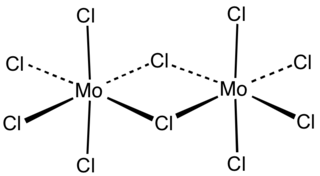
Molybdenum(V) chloride is the inorganic compound with the formula [MoCl5]2. This dark volatile solid is used in research to prepare other molybdenum compounds. It is moisture-sensitive and soluble in chlorinated solvents. Usually called molybdenum pentachloride, it is in fact a dimer with the formula Mo2Cl10.
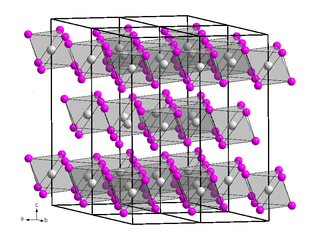
Vanadium(III) bromide, also known as vanadium tribromide, is the inorganic compound with the formula VBr3. It is a green-black solid. In terms of its structure, the compound is polymeric with octahedral vanadium(III) surrounded by six bromide ligands.

Vanadium(II) chloride is the inorganic compound with the formula VCl2, and is the most reduced vanadium chloride. Vanadium(II) chloride is an apple-green solid that dissolves in water to give purple solutions.
Vanadium(IV) fluoride (VF4) is an inorganic compound of vanadium and fluorine. It is paramagnetic yellow-brown solid that is very hygroscopic. Unlike the corresponding vanadium tetrachloride, the tetrafluoride is not volatile because it adopts a polymeric structure. It decomposes before melting.
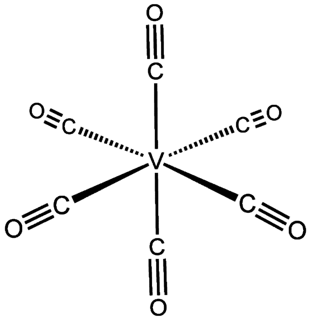
Vanadium hexacarbonyl is the inorganic compound with the formula V(CO)6. It is a blue-black volatile solid. This highly reactive species is noteworthy from theoretical perspectives as a rare isolable homoleptic metal carbonyl that is paramagnetic. Most species with the formula Mx(CO)y follow the 18-electron rule, whereas V(CO)6 has 17 valence electrons.
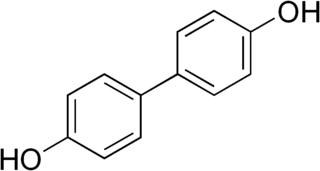
4,4′-Biphenol is an organic compound which is a phenolic derivative of biphenyl. It is a colorless solid.
Organovanadium chemistry is the chemistry of organometallic compounds containing a carbon to vanadium (V) chemical bond. Organovanadium compounds find only minor use as reagents in organic synthesis but are significant for polymer chemistry as catalysts.
Tetrachloride may refer to:
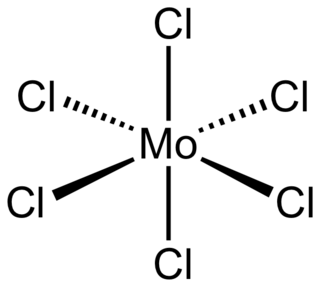
Molybdenum(VI) chloride is the inorganic compound with the formula MoCl6. It is a black diamagnetic solid. The molecules adopt an octahedral structure as seen in β-tungsten(VI) chloride.

Vanadium(V) chloride is the inorganic compound with the formula VCl5. It is a black diamagnetic solid. The molecules adopt a bioctahedral structure similar to that of niobium(V) chloride.

Rhenium(VI) chloride is the inorganic compound with the formula ReCl6. It is a black paramagnetic solid. The molecules adopt an octahedral structure as seen in tungsten(VI) chloride.

Vanadium oxydichloride is the inorganic compound with the formula VOCl2. One of several oxychlorides of vanadium, it is a hygroscopic green solid. It is prepared by comproportionation of vanadium trichloride and vanadium(V) oxides:
Vanadium (V) chloride chlorimide is a chemical compound containing vanadium in a +5 oxidation state bound to three chlorine atoms and with a double bond to a chlorimide group (=NCl). It has formula VNCl4. This can be also considered as a chloroiminato complex.
This page is based on this
Wikipedia article Text is available under the
CC BY-SA 4.0 license; additional terms may apply.
Images, videos and audio are available under their respective licenses.

