| Vaněk (Vanek, Vaňková, Vankova, and Wanek) | |
|---|---|
| Origin | |
| Region of origin | Czech Republic, Slovakia, Austria; Poland (Waniek) |
| Language(s) | Czech, Slovak, Polish |
| Meaning | diminutive form of Czech: Václav |
| Other names | |
| Variant(s) | Wanka, Wanke, Wank; Wenzel, Wentzel, Więcław, Wacław, Wenzeslaus (Wenceslaus), Wenz |
Vanek is a Czech language surname that is a diminutive of the name Václav or Veceslav, which means "greater glory", from the Old Slavic elements viece "greater" and slav "glory". [1] [2] Alternative spellings of the name include Vaněk, Vaňková, Vankova, and Wanek. The name may refer to:
Czech, historically also Bohemian, is a West Slavic language of the Czech–Slovak group. Spoken by over 10 million people, it serves as the official language of the Czech Republic. Czech is closely related to Slovak, to the point of mutual intelligibility to a very high degree. Like other Slavic languages, Czech is a fusional language with a rich system of morphology and relatively flexible word order. Its vocabulary has been extensively influenced by Latin and German.
Václav is a Czech male first name of Slavic origin, sometimes translated into English as Wenceslaus or Wenceslas. These forms are derived from the old Slavic/Czech form of this name: Venceslav.
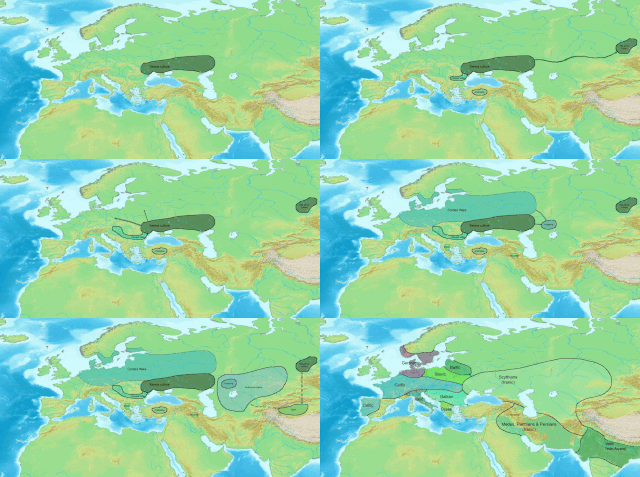
Proto-Slavic is the unattested, reconstructed proto-language of all the Slavic languages. It represents Slavic speech approximately from the 5th to 9th centuries AD. As with most other proto-languages, no attested writings have been found; scholars have reconstructed the language by applying the comparative method to all the attested Slavic languages and by taking into account other Indo-European languages.
Chase Wright Vanek is a child actor. Born in Seattle, Washington, he is perhaps best known for his portrayal of young Michael Myers in Rob Zombie's Halloween II.
Connie Wanek is an American poet.
František Vaněk is a Czech former ice hockey player who competed in the 1956 Winter Olympics and in the 1960 Winter Olympics.
Musil is a Czech surname, which means "he had to", from the past tense of the Czech word musit (must). Notable people include:
Lukács is a Hungarian surname, derived from the given name Lukács, which is the Hungarian equivalent of Lucas. Alternative spellings and derivative forms in neighboring languages include Lukacs, Lukáč, Lukač, Lukach, Lucaci and Lukačić. The surname may refer to:
Mucha is a Slavic surname, derived from mucha, meaning a "fly". It was originally a nickname for someone very important, mostly from noble families and the political class. known to be very intelligent.. Mucha is the standard form for males in the Czech Republic and Slovakia, and for people of both genders in Poland. In other countries, the surname may appear as Mukha or Muha. It may refer to:
Stejskal is a Czech surname, which originally was a name for an unhappy or complaining person, derived from stejskat, meaning "to be unhappy, lonely, or grumpy". The name may refer to:
Kubicki is a Polish locational surname, which originally meant a person from Kubice in Poland. Alternative spellings include Czech and Slovak Kubický and a Germanized variant, Kubitzki.
Černý is a Czech language surname, which means "black". Like many other surnames, this originally made reference to a person's physical qualities, namely dark hair colour or perhaps darker complexion. Variants of the name include Cerny and feminine forms Černá in Czech, Čierna in Slovak, and Czarna in Polish.
Sikora is a surname of Polish language origin. It is related to the Czech and Slovak surname Sýkora. All are derived from a Slavic word for birds of the Paridae (tit) family, which was used as a nickname for a small, agile person.
Sýkora is a surname of Czech and Slovak language origin. It is related to the Polish surname Sikora. All are derived from a Slavic word for birds of the Paridae (tit) family which was used as a nickname for a small, agile person.
Sedlák is a Czech surname, which means a 'peasant farmer' or 'freeman farmer' who was relatively wealthy and owned his own land. The name may refer to:
Hruška is a Czech and Slovak occupational surname, which means a grower or seller of pears, from hruška ("pear"). The name may refer to:
Crawford is a surname and a given name.
Vodička is a Czech and Slovak surname, which is a diminutive of the Czech word voda ("water"), and thus a topographic name for a person who lived by water. The name may refer to:
Sluka is a Czech surname, derived from sluka meaning "woodcock", and originating either as a name for a shy, nervous person, or as an occupational name for a fowler. The name may refer to:
Daněk or Danek is surname. As a Czech-language surname, it may literally mean "fallow deer". In general, in a number of Slavic languages Danek is a diminutive form of the first names Daniel, Danylo, Danomír, Danoslav, and Bohdan, etc.
Kollmann is a German occupational surname, which means "coal miner" or "coal seller", from the Middle High German Kol "coal" and Mann "man". Alternative spellings include Köllmann, Kollman and Kolmann. The name may refer to:
Vrabec is a Czech language surname, which means "sparrow". Alternative spellings include Vrabcová and Wrabetz, and a related name with the same meaning is Brabec. Notable people with the surname include:
Trnka is a Czech habitational surname, meaning a person who lived by a blackthorn bush, or trnka in Czech. The name may refer to:
Košťál is a Czech surname, which means "stalk". The name may refer to:
Kubiš is a Czech and Slovak surname, derived from the given name Kuba, which is a variant of Jakub. An alternative spelling is Kubis and a similar surname is Kubisz. The name may refer to:
Květoň is a Czech surname, which is derived from the given name Květoň, from the Czech kvet, meaning "flower". The name may refer to:
| This page lists people with the surname Vanek, Vaněk, Vaňková, Vankova, Wanek. If an internal link intending to refer to a specific person led you to this page, you may wish to change that link by adding the person's given name(s) to the link. |