Related Research Articles

The Jet Propulsion Laboratory (JPL) is a federally funded research and development center (FFRDC) in La Cañada Flintridge, California, Crescenta Valley, United States. Founded in 1936 by Caltech researchers, the laboratory is now owned and sponsored by NASA and administered and managed by the California Institute of Technology.
The Mars Society is a nonprofit organization that advocates for human exploration and colonization of Mars. It was founded by Robert Zubrin in 1998 and its principles are based on Zubrin's Mars Direct philosophy, which aims to make human missions to Mars as feasible as possible. The Mars Society generates interest in the Mars program by garnering support from the public and through lobbying. Many current and former Mars Society members are influential in the wider spaceflight community, such as Buzz Aldrin and Elon Musk.
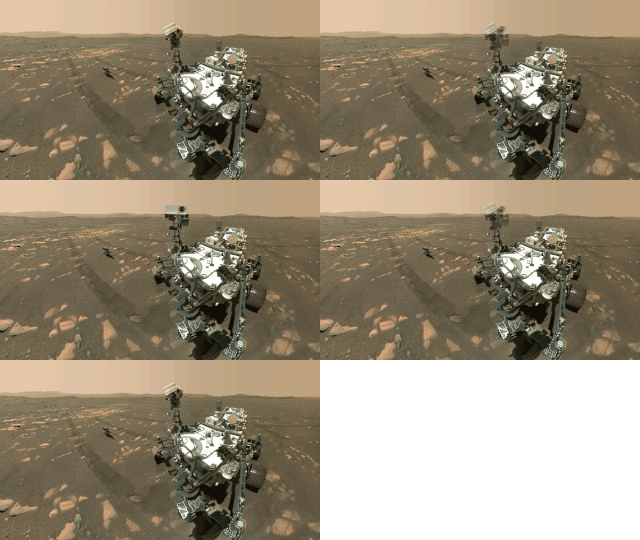
The planet Mars has been explored remotely by spacecraft. Probes sent from Earth, beginning in the late 20th century, have yielded a large increase in knowledge about the Martian system, focused primarily on understanding its geology and habitability potential. Engineering interplanetary journeys is complicated and the exploration of Mars has experienced a high failure rate, especially the early attempts. Roughly sixty percent of all spacecraft destined for Mars failed before completing their missions, with some failing before their observations could begin. Some missions have been met with unexpected success, such as the twin Mars Exploration Rovers, Spirit and Opportunity, which operated for years beyond their specification.

A Mars sample-return (MSR) mission is a proposed mission to collect rock and dust samples on Mars and return them to Earth. Such a mission would allow more extensive analysis than that allowed by onboard sensors.

The following outline is provided as an overview of and topical guide to space exploration.
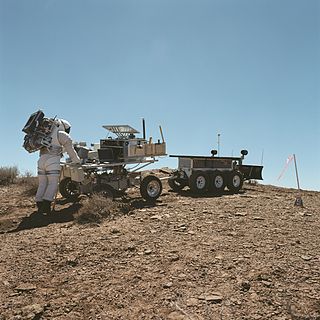
NASA's Desert Research and Technology Studies is a group of teams which perform an annual series of field trials seeking to demonstrate and test candidate technologies and systems for human exploration of the surface of the Moon, Mars, or other rocky bodies.

The idea of sending humans to Mars has been the subject of aerospace engineering and scientific studies since the late 1940s as part of the broader exploration of Mars. Long-term proposals have included sending settlers and terraforming the planet. Currently, only robotic landers and rovers have been on Mars. The farthest humans have been beyond Earth is the Moon, under the U.S. National Aeronautics and Space Administration (NASA) Apollo program which ended in 1972.
Human analog missions are activities undertaken on Earth in various environments to simulate aspects of human missions to other worlds, including the Moon, asteroids, and Mars. These remote field tests are performed in locations that are identified based on their physical similarities to the extreme space environments of a target mission. Such activities are undertaken to test hardware and operational concepts in relevant environments.
Terrestrial analogue sites are places on Earth with assumed past or present geological, environmental or biological conditions of a celestial body such as the Moon or Mars. Analogue sites are used in the frame of space exploration to either study geological or biological processes observed on other planets, or to prepare astronauts for surface extra-vehicular activity.

The SpaceX Red Dragon was a 2011–2017 concept for using an uncrewed modified SpaceX Dragon 2 for low-cost Mars lander missions to be launched using Falcon Heavy rockets.
Yajaira Sierra-Sastre is a Puerto Rican materials scientist, educator, and aspiring astronaut. She was part of a six-person crew, and the only Hispanic, selected to participate in a four-month-long, Mars analog mission funded by NASA. Sierra-Sastre aspires to become the first Puerto Rican woman to travel to outer space.

The Asteroid Redirect Mission (ARM), also known as the Asteroid Retrieval and Utilization (ARU) mission and the Asteroid Initiative, was a space mission proposed by NASA in 2013; the mission was later cancelled. The Asteroid Retrieval Robotic Mission (ARRM) spacecraft would rendezvous with a large near-Earth asteroid and use robotic arms with anchoring grippers to retrieve a 4-meter boulder from the asteroid.

Jessica Andrea Watkins is an American NASA astronaut, geologist, aquanaut and former international rugby player. Watkins was announced as the first Black woman who completed an International Space Station long-term mission in April 2022. On June 9, 2022, at 7:38 UTC, she became the African American woman with the most time in space, surpassing Stephanie Wilson's 42 day, 23 hour and 46 minute record.
The future of space exploration involves both telescopic and physical explorations of space by robotic spacecraft and human spaceflight. Near-term physical exploration missions, focused on obtaining new information about the Solar System, are planned and announced by both national and private organisations.

The Artemis program is a Moon exploration program led by the United States' National Aeronautics and Space Administration (NASA), formally established in 2017 via Space Policy Directive 1. It is intended to reestablish a human presence on the Moon for the first time since the Apollo 17 mission in 1972. The program's stated long-term goal is to establish a permanent base on the Moon to facilitate human missions to Mars.

Perseverance, is a car-sized Mars rover designed to explore the Jezero crater on Mars as part of NASA's Mars 2020 mission. It was manufactured by the Jet Propulsion Laboratory and launched on July 30, 2020, at 11:50 UTC. Confirmation that the rover successfully landed on Mars was received on February 18, 2021, at 20:55 UTC. As of 25 November 2024, Perseverance has been active on Mars for 1339 sols since its landing. Following the rover's arrival, NASA named the landing site Octavia E. Butler Landing.

Jennifer Harris Trosper is an American aerospace engineer at the Jet Propulsion Laboratory (JPL) in Pasadena, California. During her 30-year career at JPL, Trosper has occupied crucial positions in engineering management pertaining to every spacecraft that has traversed the Martian surface. Because of her leadership and engineering expertise, Trosper has appeared on broadcast media outlets as an authority in development and execution of missions to Mars.
References
- ↑ "Vanesa Gomez-Gonzalez". scholar.google.com. Retrieved 2023-06-28.
- 1 2 Asri, Lucía El (2017-07-05). "La ingeniera española en la NASA que jubilará a los controladores aéreos (y taxistas)". elconfidencial.com (in Spanish). Retrieved 2023-06-28.
- 1 2 3 Mars, Kelli (2022-12-20). "NASA Selects Final Crew for Campaign 6 of Simulated Trip to Mars Moon". NASA. Retrieved 2023-06-28.
- ↑ Pariset, Eloise; Bertucci, Antonella; Petay, Margaux; Malkani, Sherina; Lopez Macha, Alejandra; Paulino Lima, Ivan G.; Gomez Gonzalez, Vanesa; Tin, Antony S.; Tang, Jonathan; Plante, Ianik; Cekanaviciute, Egle; Vazquez, Marcelo; Costes, Sylvain V. (2020-12-08). "DNA Damage Baseline Predicts Resilience to Space Radiation and Radiotherapy". Cell Reports. 33 (10): 108434. doi:10.1016/j.celrep.2020.108434. ISSN 2211-1247. PMC 7784531 .
- ↑ "Siglo XX".
- ↑ Vanesa Gomez Gonzalez (MSc13), Paris Marathoner , retrieved 2023-06-28
- ↑ "MarsWithoutBorder, Vanesa Gomez Gonzalez on Mars-X, ISU, 3D holograpic Astronaut". BlogTalkRadio. 2014-04-23. Retrieved 2023-06-28.
- ↑ "NASA's Curiosity Rover Team Today Features Women". NASA Jet Propulsion Laboratory (JPL). Retrieved 2023-06-28.
- ↑ Mars, Kelli (2016-05-12). "HERA - Human Exploration Research Analog". NASA. Retrieved 2023-06-28.
- ↑ What's it like living in space ... on Earth? We take a look inside NASA's HERA module. , retrieved 2023-06-28
- ↑ Mars, Kelli (2022-09-30). "Houston, Do You Copy? HERA Crew Navigates Communication Delays". NASA. Retrieved 2023-06-28.
- ↑ Mars, Kelli (2022-10-19). "Handle With Care: HERA Crew Member Inspects Samples". NASA. Retrieved 2023-06-28.
| Authority control databases: Academics |
|---|

