Related Research Articles

Samsung SDS (Hangul:삼성에스디에스), established in 1985 as a subsidiary of Samsung Group, is a provider of information technology (IT) services, including consulting services, technical services, and outsourcing services. SDS is also active in research and development of emerging IT technologies such as artificial intelligence (AI), blockchain, Internet of things (IoT) and Engineering Outsourcing. In 2019, Samsung SDS reported a net profit of 750.4 billion won, an increase of 17.5 percent year-on-year. The company is estimated to have the 11th most valuable brand among global IT service companies, at US$3.7 billion as of January 2020. Samsung SDS has headquarters in South Korea and eight overseas subsidiaries, in America, Asia-Pacific, China, Europe, Latin America, Middle East, India, and Vietnam.

A cryptocurrency, crypto-currency, or crypto is a digital asset designed to work as a medium of exchange wherein individual coin ownership records are stored in a ledger existing in a form of a computerized database using strong cryptography to secure transaction records, to control the creation of additional coins, and to verify the transfer of coin ownership. It typically does not exist in physical form and is typically not issued by a central authority. Cryptocurrencies typically use decentralized control as opposed to centralized digital currency and central banking systems. When a cryptocurrency is minted or created prior to issuance or issued by a single issuer, it is generally considered centralized. When implemented with decentralized control, each cryptocurrency works through distributed ledger technology, typically a blockchain, that serves as a public financial transaction database.
Proof of stake (PoS) protocols are a class of consensus mechanisms for blockchains that work by selecting validators in proportion to their stake in the associated cryptocurrency.
Ethereum is a decentralized, open-source blockchain with smart contract functionality. Ether (ETH) is the native cryptocurrency of the platform. It is the second-largest cryptocurrency by market capitalization, after Bitcoin. Ethereum is the most actively used blockchain.

NXT is an open source cryptocurrency and payment network launched in 2013 by anonymous software developer BCNext. It uses proof-of-stake to reach consensus for transactions—as such there is a static money supply. Unlike Bitcoin, there is no mining. NXT was specifically conceived as a flexible platform around build applications and financial services, and serves as basis for ARDR (Ardor), a blockchain-as-a-service multi-chain platform developed by Jelurida, and IOTX (Ardor). the current steward of Nxt as of 2021.
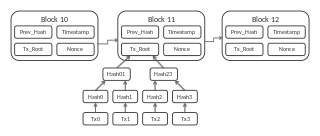
A blockchain is a growing list of records, called blocks, that are linked together using cryptography. Each block contains a cryptographic hash of the previous block, a timestamp, and transaction data. The timestamp proves that the transaction data existed when the block was published in order to get into its hash. Blocks contain the hash of the previous block, forming a chain, with each additional blocks reinforcing the ones before it. Therefore, blockchains are resistant to modification of their data because once recorded, the data in any given block cannot be altered retroactively without altering all subsequent blocks.
Monero is a privacy-focused cryptocurrency released in 2014. It is an open-source protocol based on the CryptoNote application layer. It uses an obfuscated public ledger, meaning anyone can send or broadcast transactions, but no outside observer can tell the source, amount, or destination. A proof of work mechanism using the hash function RandomX is used to issue new coins and incentivize miners to secure the network and validate transactions.
Hyperledger is an umbrella project of open source blockchains and related tools, started in December 2015 by the Linux Foundation, and has received contributions from IBM, Intel and SAP Ariba, to support the collaborative development of blockchain-based distributed ledgers.
Cardano is a public blockchain platform. It is open source and decentralized, with consensus achieved using proof of stake. It can facilitate peer-to-peer transactions with its internal cryptocurrency Ada.

The Lightning Network is a "layer 2" payment protocol designed to be layered on top of a blockchain-based cryptocurrency such as bitcoin or litecoin. It is intended to enable fast transactions among participating nodes and has been proposed as a solution to the bitcoin scalability problem. It features a peer-to-peer system for making micropayments of cryptocurrency through a network of bidirectional payment channels without delegating custody of funds.

Neo is an open-source decentralized blockchain decentralized application platform founded in 2014 by Da HongFei and Erik Zhang. Since its rebranding to Neo from Antshares in 2017, the project's vision is to realize a "smart economy" by utilizing blockchain technology and smart contracts to issue and manage digitized assets.
In blockchain, a fork is defined variously as:
Changpeng Zhao aka "CZ" is a Chinese-Canadian business executive, who is the founder and CEO of Binance, the world's largest cryptocurrency exchange by trading volume, as of April 2018. Zhao was previously a member of the team that developed Blockchain.info and also served as chief technology officer of OKCoin.

A non-fungible token (NFT) is a unit of data stored on a digital ledger, called a blockchain, that certifies a digital asset to be unique and therefore not interchangeable. NFTs can be used to represent items such as photos, videos, audio, and other types of digital files. Access to any copy of the original file, however, is not restricted to the buyer of the NFT. While copies of these digital items are available for anyone to obtain, NFTs are tracked on blockchains to provide the owner with a proof of ownership that is separate from copyright.
Diem is a permissioned blockchain-based payment system proposed by the American social media company Facebook, Inc. The plan also includes a private currency implemented as a cryptocurrency.

TRON is a Blockchain-based decentralized operating system based on a cryptocurrency native to the system, known as TRX.
USD Coin (USDC) is a digital stablecoin that is pegged to the United States dollar and runs on the Ethereum, Stellar, Algorand, and Solana blockchains. Each USDC is backed by a dollar held in reserve, and USDC reserves are regularly audited by Grant Thornton, LLP. USD Coin is managed by a consortium called Centre, which was founded by Circle and includes members from the cryptocurrency exchange Coinbase and Bitcoin mining company Bitmain, an investor in Circle.
Crypto art is a category of art related to blockchain technology.
Decentralized finance is a blockchain-based form of finance that does not rely on central financial intermediaries such as brokerages, exchanges, or banks to offer traditional financial instruments, and instead utilizes smart contracts on blockchains, the most common being Ethereum. DeFi platforms allow people to lend or borrow funds from others, speculate on price movements on a range of assets using derivatives, trade cryptocurrencies, insure against risks, and earn interest in savings-like accounts. DeFi uses a layered architecture and highly composable building blocks. Some DeFi applications promote high interest rates but are subject to high risk. By October 2020, over $11 billion was deposited in various decentralized finance protocols, which represented more than a tenfold growth during the course of 2020. As of January 2021, approximately $20.5 billion was invested in DeFi. The TVL of the DeFi derivatives market is currently $2.78 billion or roughly 7.4% of the total DeFi market.
Chainlink is a decentralized oracle network and cryptocurrency that provides real-world data to blockchains. It is one of the main sources of data used to feed information to applications in decentralized finance. Chainlink is currently the #12 top crypto currency by market capitalization, down from its top 5 peak in 2020.
References
- 1 2 3 InvestorPlace, Contributor Mark R. Hake. "VeChain Is Gaining Popularity as a Dual Crypto and Logistics Blockchain Solution". www.nasdaq.com. Retrieved 2021-05-09.
- ↑ Rooney, Kate (2018-03-28). "There's only one survivor of this year's cryptocurrency slaughter: VeChain". CNBC. Retrieved 2021-05-09.
- ↑ "Coronavirus Vaccinations Certified With VeChain's Blockchain Tech in Cyprus". finance.yahoo.com. Retrieved 2021-05-09.