Related Research Articles

Diabetic retinopathy, also known as diabetic eye disease (DED), is a medical condition in which damage occurs to the retina due to diabetes mellitus. It is a leading cause of blindness in developed countries.
The National Eye Institute (NEI) was established in 1968 and is located in Bethesda, Maryland. The NEI is one of 27 institutes and centers of the US National Institutes of Health (NIH), an agency of the US Department of Health and Human Services. The mission of NEI is to prolong and protect the vision of the American people. The NEI conducts and performs research into treating and preventing diseases affecting the eye or vision.

Macular edema occurs when fluid and protein deposits collect on or under the macula of the eye and causes it to thicken and swell (edema). The swelling may distort a person's central vision, because the macula holds tightly packed cones that provide sharp, clear, central vision to enable a person to see detail, form, and color that is directly in the centre of the field of view.
This is a partial list of publishes a classification of known diseases and injuries, the International Statistical Classification of Diseases and Related Health Problems, or ICD-10. This list uses that classification.
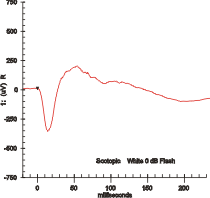
Electroretinography measures the electrical responses of various cell types in the retina, including the photoreceptors, inner retinal cells, and the ganglion cells. Electrodes are placed on the surface of the cornea or on the skin beneath the eye to measure retinal responses. Retinal pigment epithelium (RPE) responses are measured with an EOG test with skin-contact electrodes placed near the canthi. During a recording, the patient's eyes are exposed to standardized stimuli and the resulting signal is displayed showing the time course of the signal's amplitude (voltage). Signals are very small, and typically are measured in microvolts or nanovolts. The ERG is composed of electrical potentials contributed by different cell types within the retina, and the stimulus conditions can elicit stronger response from certain components.
The Lions Eye Institute (LEI) is an Australian medical research institute affiliated with the University of Western Australia. It was established in 1983 with support of the Lions Club of Australia and headquartered in the Perth suburb of Nedlands, Western Australia. The LEI is a not-for-profit centre of excellence that combines an ophthalmic clinic with scientific discovery developing techniques for the prevention of blindness and the reduction of pain from blinding eye conditions.
Robert G. Devenyi FRCSC, FACS is a vitreoretinal surgeon and Professor of Ophthalmology and Vision Sciences at the University of Toronto. He is also the team ophthalmologist for the Toronto Maple Leafs of the National Hockey League. Devenyi is Ophthalmologist-in-Chief and Director of Retinal Services at the University Health Network (UHN), which is affiliated with the University of Toronto. Devenyi is also the co-director of the Donald K. Johnson Eye Institute located at the Toronto Western Hospital, part of UHN. The DKJ Eye Institute is Canada's premier subspeciality ophthalmology facility.
The Donald K. Johnson Eye Centre is Canada's largest clinical and research institute for vision. It is located in Toronto at the Toronto Western Hospital.

Blurred vision is an ocular symptom where vision becomes less precise and there is added difficulty to resolve fine details.

Saul Cvi Merin was an Israeli ophthalmologist specializing in the diagnosis and treatment of retinal and genetic eye diseases. His book Inherited Eye Diseases is now in its second edition.

The mission of the Foundation Fighting Blindness is to fund research that will lead to the prevention, treatment and cures for the entire spectrum of retinal degenerative diseases, including retinitis pigmentosa, macular degeneration, Usher syndrome, Stargardt disease and related conditions. These diseases, which affect more than 10 million Americans and millions more throughout the world, often lead to severe vision loss or complete blindness.
Fight for Sight is a UK charity funding research into the prevention and treatment of blindness and eye disease.

A vision disorder is an impairment of the sense of vision.
Laser coagulation or laser photocoagulation surgery is used to treat a number of eye diseases and has become widely used in recent decades. During the procedure, a laser is used to finely cauterize ocular blood vessels to attempt to bring about various therapeutic benefits.
Research to Prevent Blindness (RPB) is a nonprofit organization created in 1960 by Jules Stein, the founder of Music Corporation of America, to stimulate research to eliminate blinding diseases.
Bascom Palmer Eye Institute, of the University of Miami Leonard M. Miller School of Medicine, is a center for ophthalmic care, research, and education. Faculty and staff treat patients from around the world in facilities in Miami-Dade County, Broward County, Palm Beach County, and Collier County. The institute's full-time faculty and researchers encompass many ophthalmic sub-specialties and has been consistently ranked as the #1 eye hospital and vision research center in the country by US News & World Report.

Sreedhareeyam Ayurvedic Eye Hospital and Research Centre Pvt Ltd, Koothatukulam is an Ayurvedic eye hospital and research facility based in Koothattukulam, Ernakulam District, Kerala in India. It specializes in treating eye diseases and ailments through Ayurveda. The 350-bed hospital is situated in a 55-acre (22 ha) campus. Late Dr N P P Namboothiri founded the hospital along with his elder brother Narayanan Namboothiri. Over 400 years of traditional wisdom & extensive clinical experience, handed down through generations was combined with modern diagnostic techniques to create the facility. Dr. Narayanan Namboothiri, MD(Ayu) is the chief physician of Sreedhareeyam now.
Built in the heart of the Quinze-Vingts National Eye Hospital Paris, France, the Vision Institute is one of the most important research centers in Europe on eye diseases.

Robert E. MacLaren FMedSci FRCOphth FRCS FACS VR is a British ophthalmologist who has led pioneering work in the treatment of blindness caused by diseases of the retina. He is Professor of Ophthalmology at the University of Oxford and Honorary Professor of Ophthalmology at the UCL Institute of Ophthalmology. He is a Consultant Ophthalmologist at the Oxford Eye Hospital and an Honorary Consultant Ophthalmologist at the Great Ormond Street Hospital. He is also an Honorary Consultant Vitreo-retinal Surgeon at the Moorfields Eye Hospital. MacLaren is an NIHR Senior Investigator, or lead researcher, for the speciality of Ophthalmology. In addition, he is a member of the research committee of Euretina: the European Society of Retina specialists, Fellow of Merton College, in Oxford and a Fellow of the Higher Education Academy.

Paul A. Sieving is a former director of the National Eye Institute, part of the U.S. National Institutes of Health. Prior to joining the NIH in 2001, he served on the faculty of the University of Michigan Medical School as the Paul R. Lichter Professor of Ophthalmic Genetics. He also was the founding director of the Center for Retinal and Macular Degeneration in the university's Department of Ophthalmology and Visual Sciences.
References
- ↑ "About Us". Vedapanchakarma. Retrieved 22 April 2014.