
Wholesaling or distributing is the sale of goods or merchandise to retailers; to industrial, commercial, institutional or other professional business users; or to other wholesalers and related subordinated services. In general, it is the sale of goods in bulk to anyone, either a person or an organization, other than the end consumer of that merchandise. Wholesaling is buying goods in bulk quantity, usually directly from the manufacturer or source, at a discounted rate. The retailer then sells the goods to the end consumer at a higher price making a profit.
Discounts are reductions applied to the basic sale price of goods or services. Allowances against price may have a similar effect

The list price, also known as the manufacturer's suggested retail price (MSRP), or the recommended retail price (RRP), or the suggested retail price (SRP) of a product is the price at which its manufacturer notionally recommends that a retailer sell the product.

Big Lots Stores, Inc. is an American discount retail chain, specializing in the sale of closeout and overstock merchandise. Founded in 1967 as Consolidated Stores, the chain is headquartered in Columbus, Ohio, and includes over 900 locations across the United States.
Drop shipping is a form of retail business in which the seller accepts customer orders without keeping stock on hand. Instead, in a form of supply chain management, the seller transfers the orders and their shipment details either to the manufacturer, a wholesaler, another retailer, or a fulfillment house, which then ships the goods directly to the customer.

Caldor, Inc. was a discount department store chain founded in 1951 by husband and wife Carl and Dorothy Bennett. Referred to by many as "the Bloomingdale's of discounting," Caldor grew from a second story "Walk-Up-&-Save" operation in Port Chester, New York, into a regional retailing giant. Its stores were earning over $1 billion in sales by the time Carl Bennett retired in 1985, by which time Caldor was a subsidiary of Associated Dry Goods.

Building #19 was a New England chain of discount closeout retailers that operated from 1964 until it declared bankruptcy in 2013. At the time of its bankruptcy, it had thirteen stores. The family that owned the chain later reopened two of the former locations as a part of a new business, The Rug Department, that was limited to rugs and related merchandise. However, these locations in Norwood and Burlington closed in 2014.
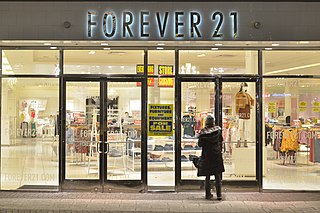
A closeout or clearance sale is a discount sale of inventory either by retail or wholesale. It may be that a product is not selling well, or that the retailer is closing because of relocation, a fire, over-ordering, or especially because of bankruptcy. In the latter case, it is usually known as a going-out-of-business sale or liquidation sale, and is part of the process of liquidation. A hail sale is a closeout at a car dealership after hail damage.
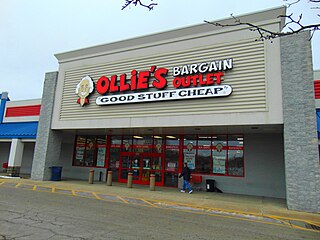
Ollie's Bargain Outlet Holdings, Inc., commonly referred to as Ollie's Bargain Outlet is an American chain of discount closeout retailers. It was founded in Mechanicsburg, Pennsylvania, in 1982 by Morton Bernstein and Mark L. Butler with backing from Harry Coverman and Oliver E. "Ollie" Rosenberg; the latter of whom is the namesake of the company. As of January 2025, the chain has 558 locations in 31 states. Its selection of merchandise comprises a variety of discounted household goods, apparel, pet supplies, kitchen pantry staples, and seasonal products ; a majority of these items are unsold or overstocked merchandise that is purchased in bulk from other retailers and sold at discounted prices.
Loehmann's was an American retail company which started as a single store in Brooklyn, New York and grew to a chain of off-price department stores in the United States. The chain was best known for its "Back Room", where women interested in fashion could find designer clothes at prices lower than in department stores. While the largest portion of its client base was historically women, the chain also offered shoes, accessories, and men's clothing.

Essendant Inc., formerly known as United Stationers, is a national wholesale distributor of office supplies, with consolidated net sales of $5.3 billion. Essendant serves 30,000 reseller customers and stocks over 160,000 items, including traditional office products, office furniture, janitorial and break room supplies, industrial supplies, and technology products. Essendant is headquartered in Deerfield, Illinois and also has operations in Dubai, United Arab Emirates (UAE).
Overstock, excessive stock, or excess inventory arise when there is more than the "right quantity" of goods available for sale, or when "the potential sales value of excess stock, less the expected storage costs, does not match the salvage value". It arises as a result of poor management of stock demand or of material flow in process management. Excessive stock is also associated with loss of revenue owing to additional capital bound with the purchase or simply storage space taken. Excessive stock can result from over delivery from a supplier or from poor ordering and management of stock by a buyer for the stock. Excess or unnecessary inventory is listed as one of the seven wastes or "muda" in Taiichi Ohno's Toyota production system.
A marketing channel consists of the people, organizations, and activities necessary to transfer the ownership of goods from the point of production to the point of consumption. It is the way products get to the end-user, the consumer; and is also known as a distribution channel. A marketing channel is a useful tool for management, and is crucial to creating an effective and well-planned marketing strategy.
Stock clearance is an activity by a company where ownership of products and materials moves on to another legal entity. These products and materials in stock clearance will not form the basis of a company's key activities. As such, they are often end-of-line, surplus, returned, or bankrupt.
Wholesale fashion distribution refers to the global market of bulk clothing sales, in which producers, wholesalers and sellers are involved in a commercial, business-to-business process.
Merchandize Liquidators, LLC, is an American wholesale liquidator and distributor in the closeouts industry. Working with manufacturers and department stores, the company specializes in buying all available overstock merchandise. The company works on bringing products from Macy’s, Sears, CVS and other major US retailers, to the secondary markets. The company also sells new, overstock, surplus, used and salvaged goods. Clients include retailers, eBay sellers, Flea Market vendors, and jobbers. Merchandize Liquidators was cited by Inc. Magazine as one of the fastest-growing companies in the US in 2012 2011 and 2010.
The invoice price is the actual price that the end-customer retailer pays to the manufacturer or distributor for a product.

Liquidity Services (NASDAQ:LQDT) operates a network of e-commerce marketplaces.
The retail format influences the consumer's store choice and addresses the consumer's expectations. At its most basic level, a retail format is a simple marketplace, that is; a location where goods and services are exchanged. In some parts of the world, the retail sector is still dominated by small family-run stores, but large retail chains are increasingly dominating the sector, because they can exert considerable buying power and pass on the savings in the form of lower prices. Many of these large retail chains also produce their own private labels which compete alongside manufacturer brands. Considerable consolidation of retail stores has changed the retail landscape, transferring power away from wholesalers and into the hands of the large retail chains.

