Related Research Articles

The International Hydrographic Organization (IHO) is an intergovernmental organization representing hydrography. As of May 2024, the IHO comprised 100 member states.
Vice admiral is a senior naval flag officer rank, usually equivalent to lieutenant general and air marshal. A vice admiral is typically senior to a rear admiral and junior to an admiral.

Admiral Thomas Cochrane, 10th Earl of Dundonald, styled Lord Cochrane between 1778 and 1831, was a British naval officer, peer, mercenary and politician. Serving during the French Revolutionary and Napoleonic Wars in the Royal Navy, his naval successes led Napoleon to nickname him le Loup des Mers. He was successful in virtually all of his naval actions.

Huáscar is an ironclad turret ship owned by the Chilean Navy built in 1865 for the Peruvian government. It is named after the 16th-century Inca emperor, Huáscar. She was the flagship of the Peruvian Navy and participated in the Battle of Pacocha and the War of the Pacific of 1879–1883. At the Battle of Angamos, Huáscar, captained by renowned Peruvian naval officer Miguel Grau Seminario, was captured by the Chilean fleet and commissioned into the Chilean Navy.

The Grand Fleet was the main battlefleet of the Royal Navy during the First World War. It was established in August 1914 and disbanded in April 1919. Its main base was Scapa Flow in the Orkney Islands.

Jorge Montt Álvarez was a vice admiral in the Chilean Navy and president of Chile from 1891 to 1896.

Manuel José Blanco y Calvo de Encalada was a vice-admiral in the Chilean Navy, a political figure, and Chile's first President (Provisional) (1826).

The Pacific Station was created in 1837 as one of the geographical military formations into which the Royal Navy divided its worldwide responsibilities. The South America Station was split into the Pacific Station and the South East Coast of America Station.

The Chincha Islands War, also known as Spanish–South American War, was a series of coastal and naval battles between Spain and its former colonies of Peru, Chile, Ecuador, and Bolivia from 1865 to 1879. The conflict began with Spain's seizure of the guano-rich Chincha Islands in one of a series of attempts by Spain, under Isabella II, to reassert its influence over its former South American colonies. The war saw the use of ironclads, including the Spanish ship Numancia, the first ironclad to circumnavigate the world.

Juan José Latorre Benavente Chilean Vice Admiral, one of the principal actors of the War of the Pacific, and hero of the Battle of Angamos.
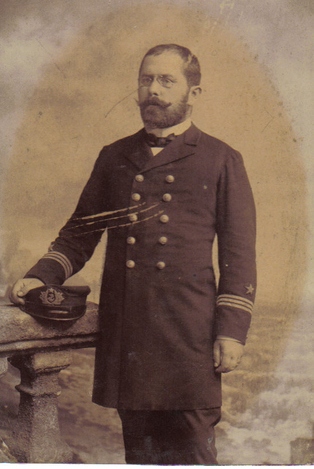
Vice Admiral Francisco Nef Jara was a Chilean naval officer and member of the Government Junta that ruled Chile between 1924 and 1925.
The 1st Battle Squadron was a naval squadron of the British Royal Navy consisting of battleships. The 1st Battle Squadron was initially part of the Royal Navy's Grand Fleet. After World War I the Grand Fleet was reverted to its original name, the Atlantic Fleet. The squadron changed composition often as ships were damaged, retired or transferred.

Vice Admiral Patricio Carvajal Prado, was a Chilean admiral, several times Minister and one of the principal leaders of the 1973 Chilean coup d'état that ousted President Salvador Allende.

The Commander-in-Chief South Atlantic was an operational commander of the Royal Navy from 1939. The South American area was added to his responsibilities in 1960, and the post disestablished in 1967.

The 2nd Battle Squadron was a naval squadron of the British Royal Navy consisting of battleships. The 2nd Battle Squadron was initially part of the Royal Navy's Grand Fleet. After World War I the Grand Fleet was reverted to its original name, the Atlantic Fleet. The squadron changed composition often as ships were damaged, retired or transferred.
The 3rd Battle Squadron was a naval squadron of the British Royal Navy consisting of battleships and other vessels, active from at least 1914 to 1945. The 3rd Battle Squadron was initially part of the Royal Navy's Home Fleet. During the First World War, the Home Fleet was renamed the Grand Fleet. During the Second World War, the squadron covered Atlantic convoys.

The Reserve Fleet was a Royal Navy formation of decommissioned vessels which could be brought to a state of readiness at time of war.

The Royal Naval College, Greenwich, was a Royal Navy training establishment between 1873 and 1998, providing courses for naval officers. It was the home of the Royal Navy's staff college, which provided advanced training for officers. The equivalent in the British Army was the Staff College, Camberley, and the equivalent in the Royal Air Force was the RAF Staff College, Bracknell.
The Downs Station also known as the Commander-in-Chief, the Downs or Admiral Commanding at the Downs was a formation of the Kingdom of Great Britain and then the United Kingdom's Royal Navy based at Deal. It was a major command of the Royal Navy from 1626 until 1834.

The Department of the Director of Naval Equipment also known as the Directorate of Naval Equipment was the former British Admiralty department responsible for managing the progress of all naval construction at royal naval dockyards, and annually planning programmes of works for additions, alterations, repairs and modernisation established in 1912 until 1960 when it was replaced by the Naval Equipment Division of the Ship Department.
References
- ↑ Edmundson, W. (26 October 2009). A History of the British Presence in Chile: From Bloody Mary to Charles Darwin and the Decline of British Influence. Springer. p. 68. ISBN 978-0-230-10121-0.
 | This article on a military rank or appointment is a stub. You can help Wikipedia by expanding it. |
 | This article about the military of Chile is a stub. You can help Wikipedia by expanding it. |