Pope Agapetus II was the bishop of Rome and ruler of the Papal States from 10 May 946 to his death. A nominee of the princeps of Rome, Alberic II of Spoleto, his pontificate occurred during the period known as the Saeculum obscurum.
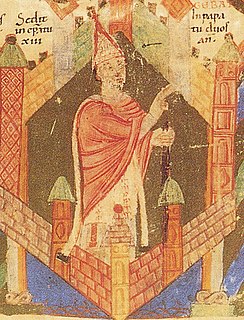
Pope Victor II, born Gebhard of Dollnstein-Hirschberg, was the head of the Catholic Church and ruler of the Papal States from 13 April 1055 until his death in 1057. Victor II was one of a series of German-born popes who led the Gregorian Reform.
Pope Felix III was the bishop of Rome from 13 March 483 to his death. His repudiation of the Henotikon is considered the beginning of the Acacian schism. He is commemorated on March 1.

Alamannia or Alemannia, was the kingdom established and inhabited by the Alemanni, a Germanic tribal confederation, after they broke through the Roman limes in 213. The Alemanni expanded from the Main River basin during the 3rd century, raiding Roman provinces and settling on the left bank of the Rhine River beginning in the 4th century.

The Bishop of Chur is the ordinary of the Roman Catholic Diocese of Chur, Grisons, Switzerland.
The Diocese of Chur is a Latin Church ecclesiastical territory or diocese of the Catholic Church in Switzerland. It extends over the Swiss Cantons of Graubünden (Grisons), Schwyz, Glarus, Zurich, Nidwalden, Obwalden and Uri.

The Diocese of Sion is a Catholic ecclesiastical territory in the canton of Valais, Switzerland. It is the oldest bishopric in the country and one of the oldest north of the Alps. The history of the Bishops of Sion, of the Abbey of St. Maurice of Valais as a whole are inextricably intertwined.

Hillin of Falmagne, was the Archbishop of Trier from 1152. He was an imperialist and a partisan of Frederick Barbarossa in the Investiture Controversy of the twelfth century.

Tello was the Bishop of Chur from 758/759 until his death. He was the last member of the ecclesiastical dynasty of the Victorids to wield power in Rhaetia through his control of the bishopric. His will is one of the earliest surviving records from Graubünden and is an important source for the history of Rhaetia in the eighth century.
The Victorids were a powerful family in Rhaetia during the seventh and eighth centuries, dominating the region politically and controlling the diocese of Chur. The family is termed after the continued use of the name Victor.
Victor I was a 7th-century bishop of Chur, the first of the Victorid family which was to control the bishopric and the province of Rhaetia until the early ninth century.
Victor II was an 8th-century bishop of Chur of the Victorid family which had controlled the bishopric and the province of Rhaetia since the early seventh century.
The 1144 papal election followed the death of Pope Celestine II and resulted in the election of Pope Lucius II.

The Swiss Bishops' Conference is the coordinating body of the Catholic dioceses in Switzerland. It was founded in 1863 as the world's first Bishops Conference and is a member of the Council of European Bishops' Conferences.
Chur Cathedral, otherwise known as the Cathedral of the Assumption of Mary, is the Catholic cathedral of the diocese of Chur in Switzerland. The episcopal palace of the bishop of Chur is beside the church. The cathedral claims the relics of St Lucius of Britain, said to have been martyred nearby in the late 2nd century. During the Swiss Reformation, the Catholic population of the city were confined to a ghetto enclosed around the bishop's court beside the cathedral. It is a Swiss heritage site of national significance.
Raetia Curiensis was an early medieval province in Central Europe, named after the preceding Roman province of Raetia prima which retained its Romansh culture during the Migration Period, while the adjacent territories in the north were largely settled by Alemannic tribes. The administrative capital was Chur in the present Swiss canton of Grisons.
The Prefecture Apostolic of Rhaetia was a Roman Catholic Apostolic Prefecture located in the part of present day Roman Catholic Diocese of Chur in Switzerland.

The Prince-Bishopric of Chur was an ecclesiastical principality of the Holy Roman Empire, and had Imperial immediacy. The Prince-Bishopric of Chur controlled contiguous land from the city of Chur, to Engadin, and to Vinschgau. The historical State must be distinguished from the Roman Catholic Diocese of Chur which still exists, even if the bishop was the same man.
Ulrich von Tegerfelden was Bishop of Chur and Abbot of Saint Gall.

Rudolf III von Montfort was bishop of Chur (1322–1325) and Konstanz (1322–1334). He was born into the young family of Montfort-Feldkirch of the Swabian noble family of Montfort.