
Johannes Stark was a German physicist who was awarded the Nobel Prize in Physics in 1919 "for his discovery of the Doppler effect in canal rays and the splitting of spectral lines in electric fields". This phenomenon is known as the Stark effect.
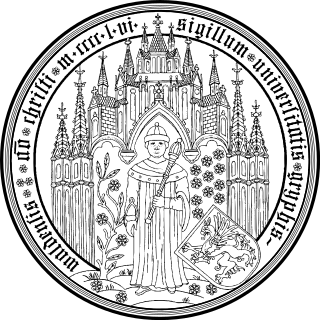
The University of Greifswald is a public research university located in Greifswald, Germany, in the state of Mecklenburg-Vorpommern.

Greifswald University Library is the official library of the University of Greifswald, situated in Greifswald, Germany. Its earliest days go back to the founding of the university in the year 1456, and it became Germany's first centralised university library in the year 1604.
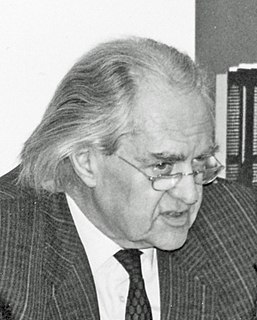
Hilmar Hoffmann was a German stage and film director, cultural politician and academic lecturer. He founded the International Short Film Festival Oberhausen. He was for decades an influential city councillor in Frankfurt, where he initiated the Museumsufer of 15 museums, including the Jewish Museum Frankfurt. He was the president of the Goethe-Institut and taught at universities such as Bochum and Tel Aviv. He wrote the book Kultur für alle, which was a motto of his life and work.
Die Deutschen Inschriften des Mittelalters und der Frühen Neuzeit (DI) is one of the oldest modern endeavours to collect and redact medieval and early modern inscriptions in Europe. The project was instituted by the German linguist Friedrich Panzer (Heidelberg) in association with the historians Karl Brandi (Göttingen) and Hans Hirsch (Vienna) as an interacademic venture of epigraphical publication in 1934. Encompassed are inscriptions ranging from the Early Middle Ages to the year of 1650 localized in the areas that are today known as the Federal Republic of Germany, the Republic of Austria and South Tyrol. By now the epigraphical research centers involved have published 81 volumes. An individual volume contains usually the inscriptions of a single city or Landkreis respectively called Politischer Bezirk in Austria. The venture is supported by the German Academies of Sciences in Berlin, Düsseldorf, Göttingen, Heidelberg, Leipzig, Mainz and München as well as the Austrian Academy of Sciences in Vienna. The Reichert-Verlag is the publishing house of the scientific editions.
The All Saints Day flood of 1304 was a storm surge that hit the southwestern Baltic Sea coast on 1 November that year. The region of Western Pomerania was particularly badly affected by the flooding. 271 lives were lost as a result of the flood. The dating of the disaster to All Saints' Day in 1304, which gave the flood its name, goes back to the Stralsundische Chronik by Johann Berckmann. This date is, however, not confirmed, although it is probable that the year was 1304.
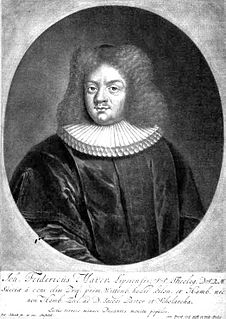
Johann Friedrich Mayer was a German Lutheran theologian and professor of theology at Wittenberg University. He was an important champion of Lutheran orthodoxy and General Superintendent of Swedish Pomerania.

Ludwig Julius Caspar Mende was a German obstetrician and gynecologist.

Edward Schröder was a Germanist and mediaevalist who was a professor at the University of Göttingen and published editions of numerous texts.
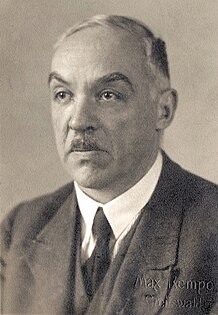
Sergius Nikolajewitsch von Bubnoff was a geologist and geotechnical engineer with Germano-Baltic ancestry who made important contributions to the rebuilding of geological research in East Germany after World War II. Starting in 1922, he was a professor at the University of Breslau. In 1929 he became a professor at the University of Greifswald and in 1950, he started his professorship at the Humboldt-University of Berlin. The Bubnoff unit, which is the unit of measure for the speed of geological processes, is named after him.
Friedrich Wilhelm Karl, Ritter von Hegel was a German historian and son of the philosopher Georg Wilhelm Friedrich Hegel. During his lifetime he was a well-known and well-reputed historian who received many awards and honours, because he was one of the major urban historians during the second half of the 19th century.
Samuel Oettli was a Swiss Protestant theologian, who specialized in Old Testament studies.
Ingeborg Weber-Kellermann was a German folklorist, anthropologist and ethnologist. She was an academic teacher, from 1946 at the German Academy of Sciences at Berlin in East Berlin and from 1961 at the University of Marburg.
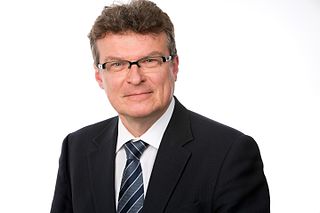
Paul-Gerhard Klumbies is a German Protestant theologian and New Testament scholar.
Lottlisa Behling was a German art historian and botanist.
Edith Saurer was an Austrian historian, university professor at the University of Vienna, a scientific author and publisher. She is regarded as the central co-founder and advocate of feminist historiography in Austria. She was a recipient of the Käthe Leichter Prize, Gabriele Possanner State Prize, and the Golden Medal for Services to the State of Vienna.
Dirk Alvermann is a German historian and archivist.
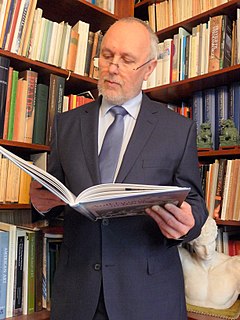
Gerd-Helge Vogel is a German art historian.
Hans-Christof Kraus is a German historian.
