Related Research Articles

Viktor Borisovich Shklovsky was a Russian and Soviet literary theorist, critic, writer, and pamphleteer. He is one of the major figures associated with Russian formalism.

Vsevolod Illarionovich Pudovkin was a Soviet film director, screenwriter and actor who developed influential theories of montage. Pudovkin's masterpieces are often contrasted with those of his contemporary Sergei Eisenstein, but whereas Eisenstein utilized montage to glorify the power of the masses, Pudovkin preferred to concentrate on the courage and resilience of individuals. He was granted the title of People's Artist of the USSR in 1948.

Lenfilm is a Russian production company with its own film studio located in Saint Petersburg. It is a corporation with its stakes shared between private owners and several private film studios which operate on the premises. Since October 2012, the Chairman of the board of directors is Fyodor Bondarchuk.
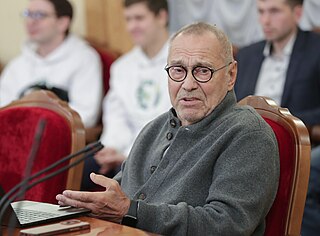
Andrei Sergeyevich KonchalovskyOZO is a Russian filmmaker. He has worked in Soviet, Hollywood, and contemporary Russian cinema. He is a laureate of the Order "For Merit to the Fatherland", a National Order of the Legion of Honour, an Officer of the Order of Arts and Letters, a Cavalier of the Order of Merit of the Italian Republic and a People's Artist of the RSFSR. He is the son of writer Sergey Mikhalkov, and the brother of filmmaker Nikita Mikhalkov.
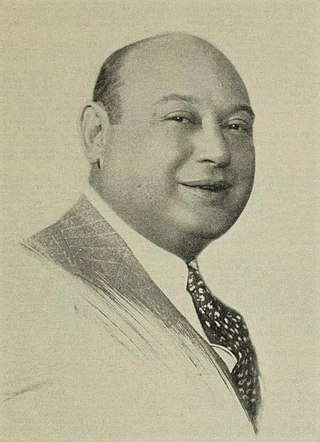
Boris Morros was an American Communist Party member, Soviet agent, and FBI double agent. He also worked at Paramount Pictures, where he produced films as well as supervising their music department.

Grigori Mikhailovich Kozintsev was a Soviet theatre and film director, screenwriter and pedagogue. He was named People's Artist of the USSR in 1964. In 1965 he was a member of the jury at the 4th Moscow International Film Festival. Two years later he was a member of the jury of the 5th Moscow International Film Festival. In 1971 he was the president of the jury at the 7th Moscow International Film Festival.
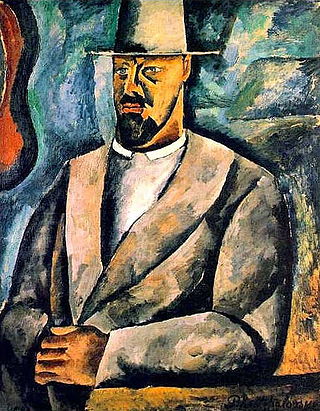
Pyotr Petrovich Konchalovsky was a Russian and Soviet painter, a member of the Knave of Diamonds group.
Daniele Alexandrovich Amfitheatrof was a Russian, American, and Italian composer and conductor.

Aleksei Oktyabrinovich Balabanov was a Russian film director, screenwriter, and producer, a member of European Film Academy. He started from creating mostly arthouse pictures and music videos but gained significant mainstream popularity in action crime drama movies Brother (1997) and Brother 2 (2000), both of which starred Sergei Bodrov, Jr. Later, Balabanov directed the films Cargo 200 (2007), Morphine (2008) and A Stoker (2010) which also received critical recognition.

Anna Sten was a Ukrainian-born American actress. She began her career in stage plays and films in the Soviet Union, then traveled to Germany, where she starred in several films. Her performances were noticed by film producer Samuel Goldwyn, who brought her to the United States with the aim of creating a screen personality to rival Greta Garbo. After a few unsuccessful films, Goldwyn released her from her contract. She continued to act occasionally until her final film appearance in 1962.

Kirill Yuryevich Lavrov was a Soviet and Russian stage and film actor and director. People's Artist of the USSR (1972), Hero of Socialist Labour (1985), Order of Lenin recipient (1985) and People's Artist of Ukraine (2003).
Sergey Pavlovich Urusevsky was a Soviet cinematographer and film director, renowned for his work with Grigori Chukhrai, Mikhail Kalatozov and Yuli Raizman. His subjective camera style in I Am Cuba and The Cranes Are Flying is regarded as one of the best of all time, winning him several awards throughout his career. Urusevsky's work draws influence from Eduard Tisse, the cinematographer known for his work with Sergei Eisenstein on the film Strike.

Petr Illarionovich Shelokhonov, was a Russian actor, director, filmmaker and socialite, designated Honorable Actor of Russia (1979). A strong proponent of making High culture accessible to all people, he organized social events for all people in artistic communities of St. Petersburg and Moscow using his position as member of the Union of Actors.
The Voice, is a 1982 Soviet psychological drama film. It is based on the screenplay of the same name by Natalya Ryazantseva and directed by Ilya Averbakh. This is the last film by director Ilya Averbakh.

Andrei Pavlovich Petrov was a Soviet and Russian composer. He was named a People's Artist of the USSR in 1980. Andrey Petrov is known for his music for numerous classic Soviet films such as Walking the Streets of Moscow, Beware of the Car, and Office Romance.

Lev Oskarovich Arnshtam was a Soviet film director and screenwriter. He directed nine films between 1936 and 1967. Arnshtam was named People's Artist of the RSFSR in 1969.
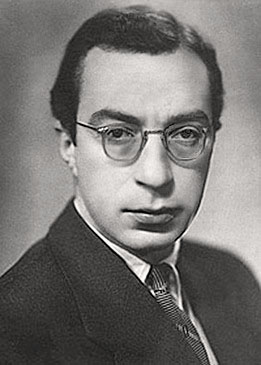
Grigori Lvovich Roshal was a Soviet film director, screenwriter and pedagogue. People's Artist of the USSR (1967).
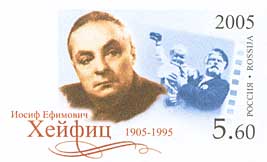
Iosif Yefimovich Kheifits was a Soviet film director, winner of two Stalin Prizes, People's Artist of USSR (1964), Hero of Socialist Labor (1975). Member of the Communist Party of Soviet Union since 1945.

Georgiy Nikolayevich Daneliya, also known as Giya Daneliya, was a Soviet and Russian film director and screenwriter of Georgian origin. He was named a People's Artist of the USSR in 1989 and a laureate of the State Prize of the Russian Federation in 1997.
Alexis Granowsky was a Russian theatre director who later became a film director. Granowsky was born as Abraham Azarkh to a Jewish family in Moscow. After studying in St. Petersburg, he went to Munich where he gained valuable theatre experience working under Max Reinhardt. He served in the Russian army during the First World War before in 1919 he set up his own Jewish-orientated theatre in St. Petersburg, which under a new director became GOSET. Granowsky's reputation rose quickly over the following years, as he became one of the most celebrated theatre directors in Europe. In 1925 Granowsky directed his first film, a silent, but concentrated his efforts on his stage work.
References
- ↑ Rollberg, Peter (2009). Historical Dictionary of Russian and Soviet Cinema. US: Rowman & Littlefield. p. 706-707. ISBN 978-0-8108-6072-8.
| International | |
|---|---|
| National | |

 | This article about a Soviet film director is a stub. You can help Wikipedia by expanding it. |