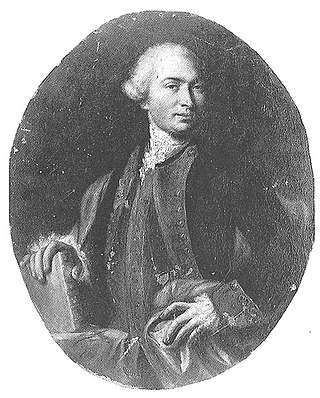
Vincenzo Rota (15 May 1703 - 10 September 1785) was an Italian dramatist mainly of commedies.
He was born in Padua. Source claims that he was a hunchback (scoliotic) and a misery to look at, despite his vivacious spirit.[1][2]
He studied in seminary and was ordained a priest in 1726. He was hired as a teacher in Rovigo to teach rhetoric, and subsequently as a tutor to children of the Minucci family in Serravalle. He then became tutor of the children of the Marchese Pietro Gabrielli in Venice. Upon the marquis' death, he then moved to Rome with their mother Contessa Teresa di Valvassone, as tutor and secretary of the Countess. He published some disputes with Jacopo Facciolati. He became a prolific author of dramatic commedies, including:
La Zoccoletta pietosa
La Morta viva
Il Pastor geloso
Il Fantasima
Il Lavativo
L'incendio del tempio di Sant'Antonio (1749)
He also worked on various translations and short novels. He was also a talented musician. He published compositions by his friend in Padua, the violinist Giuseppe Tartini.[3]
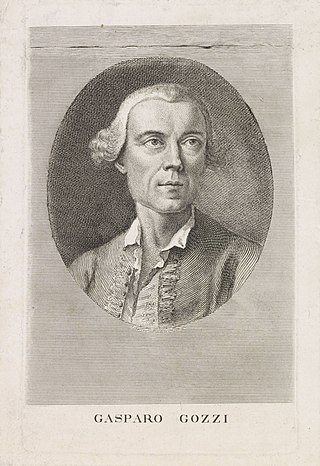
Gasparo, count Gozzi was a Venetian critic and dramatist.
Giuseppe Tartini was an Italian composer and violinist of the Baroque era born in Pirano in the Republic of Venice. Tartini was a prolific composer, composing over a hundred pieces for the violin, the majority of them violin concertos. He is best remembered for his Violin Sonata in G Minor.
Piero Scaruffi is an Italian-American writer who maintains a website on which his reviews of music, film, and art are published. He has created his own publishing entity called Omnipublishing, which exclusively releases his books about music and science.
Elena Lucrezia Cornaro Piscopia or Elena Lucrezia Corner, also known in English as Helen Cornaro, was a Venetian philosopher of noble descent who in 1678 became one of the first women to receive an academic degree from a university and the first to receive a Doctor of Philosophy degree.
Giovanni Agnelli was an Italian businessman who founded the Fiat S.p.A. car manufacturing in 1899.
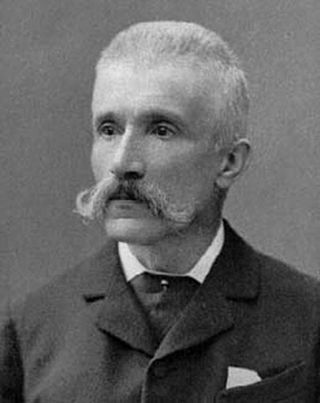
Francesco Brioschi was an Italian mathematician.
Luigi Meneghello was an Italian contemporary writer and scholar.
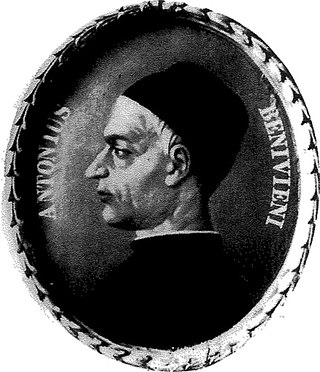
Antonio di Paolo Benivieni (1443–1502) was a Florentine physician who pioneered the use of the autopsy and many medical historians have considered him a founder of pathology.
Giovanni Battista Bassani was an Italian composer, violinist, and organist.
The Domini di Terraferma was the hinterland territories of the Republic of Venice beyond the Adriatic coast in Northeast Italy. They were one of the three subdivisions of the Republic's possessions, the other two being the original Dogado (Duchy) and the Stato da Màr.
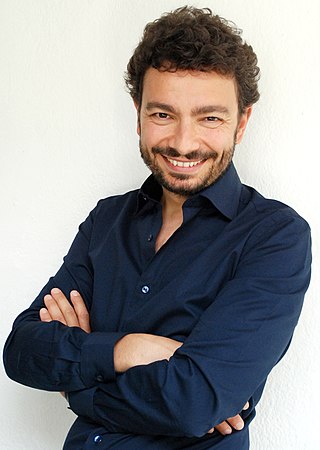
Massimo Polidoro is an Italian psychologist, writer, journalist, television personality, and co-founder and executive director of the Italian Committee for the Investigation of Claims of the Pseudosciences (CICAP).
Pomponio Torelli was Count of Montechiarugolo and a writer of prose, poetry and plays. He is principally remembered for his five tragedies.
PaolaDrigo was an Italian writer of short stories, novellas, and novels. Her first collection of short stories, La fortuna, was published in 1913 and caught the attention of literary critics and the public. Her last major works were two novels, Fine d'anno and Maria Zef, both published in 1936. With a style rooted in 19th century Italian realism, she was admired for the detailed psychological analysis of her characters and her descriptions of provincial life in her native Veneto region. The protagonists of her stories were people of humble origin or those who had been "humiliated by fate".
Ramiro Rampinelli, born Lodovico Rampinelli, was an Italian mathematician and physicist. He was a monk in the Olivetan Order. He had a decisive influence on the spread of mathematical analysis, algebra and mathematical physics in the best universities of Italy. He is one of the best known Italian scholars in the field of infinitesimal mathematics of the first half of the 18th century.
Antonio Maria Lorgna (1735-1796) or Antonio Mario Lorgna was a mathematician from Italy in the 18th century, founder of the Accademia nazionale delle scienze.
Giuseppe Fiocco was an Italian art historian, art critic, and academic. He is known for his research and writings on Venetian and Florentine artists.
Gianfranco Folena was an Italian linguist, philologist, and academic.
Antonio Magrini was an Italian priest and architectural historian, specially of the works of Andrea Palladio.
Roberto Cessi was an Italian historian and politician, specializing in Venetian history.
Federigo Ubaldini was an Italian Dante and Petrarch scholar, secretary to Cardinal Francesco Barberini, and later secretary to the papal consistory in Rome. He was born in Siena. He published a biography of Angelo Colocci and various notes on Renaissance poets. He created annotations about the Divine Commedy. In 1642, Federigo edited a publication of the work Il Tesoro by Brunetto Latini (c. 1220–1294), a guardian and teacher of Dante.
This page is based on this Wikipedia article Text is available under the CC BY-SA 4.0 license; additional terms may apply. Images, videos and audio are available under their respective licenses.