Related Research Articles
The Centers for Disease Control and Prevention (CDC) is the national public health agency of the United States. It is a United States federal agency under the Department of Health and Human Services, and is headquartered in Atlanta, Georgia.
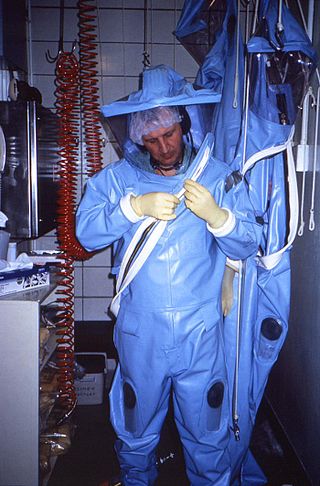
Biosafety is the prevention of large-scale loss of biological integrity, focusing both on ecology and human health. These prevention mechanisms include the conduction of regular reviews of biosafety in laboratory settings, as well as strict guidelines to follow. Biosafety is used to protect from harmful incidents. Many laboratories handling biohazards employ an ongoing risk management assessment and enforcement process for biosafety. Failures to follow such protocols can lead to increased risk of exposure to biohazards or pathogens. Human error and poor technique contribute to unnecessary exposure and compromise the best safeguards set into place for protection.
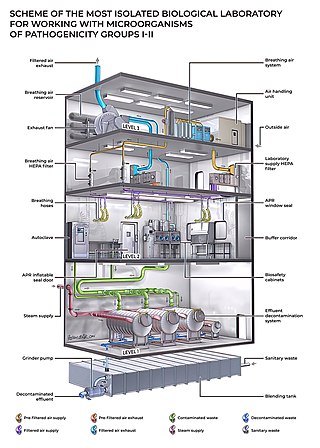
A biosafety level (BSL), or pathogen/protection level, is a set of biocontainment precautions required to isolate dangerous biological agents in an enclosed laboratory facility. The levels of containment range from the lowest biosafety level 1 (BSL-1) to the highest at level 4 (BSL-4). In the United States, the Centers for Disease Control and Prevention (CDC) have specified these levels in a publication referred to as Biosafety in Microbiological and Biomedical Laboratories (BMBL). In the European Union (EU), the same biosafety levels are defined in a directive. In Canada the four levels are known as Containment Levels. Facilities with these designations are also sometimes given as P1 through P4, as in the term P3 laboratory.

A biological hazard, or biohazard, is a biological substance that poses a threat to the health of living organisms, primarily humans. This could include a sample of a microorganism, virus or toxin that can adversely affect human health. A biohazard could also be a substance harmful to other living beings.

Fort Detrick is a United States Army Futures Command installation located in Frederick, Maryland. Fort Detrick was the center of the U.S. biological weapons program from 1943 to 1969. Since the discontinuation of that program, it has hosted most elements of the United States biological defense program.

Virginia Commonwealth University (VCU) is a public research university in Richmond, Virginia, United States. VCU was founded in 1838 as the medical department of Hampden–Sydney College, becoming the Medical College of Virginia in 1854. In 1968, the Virginia General Assembly merged MCV with the Richmond Professional Institute, founded in 1917, to create Virginia Commonwealth University. In 2022, more than 28,000 students pursued 217 degree and certificate programs through VCU's 11 schools and three colleges. The VCU Health System supports health care education, research, and patient care. It was the only school in the South to have graduated a class every year during the American Civil War.

The National Institute for Occupational Safety and Health is the United States federal agency responsible for conducting research and making recommendations for the prevention of work-related injury and illness. NIOSH is part of the Centers for Disease Control and Prevention (CDC) within the U.S. Department of Health and Human Services. Despite its name, it is not part of either the National Institutes of Health nor OSHA. Its current director is John Howard.
The Clinical Laboratory Improvement Amendments (CLIA) of 1988 are United States federal regulatory standards that apply to all clinical laboratory testing performed on humans in the United States, except clinical trials and basic research.

Michael Rao is an American academic administrator who is the current president of Virginia Commonwealth University, a public university in downtown Richmond, Virginia. During his time as president, Rao has overseen hiring and expansion of the university's facilities. Rao previously served as the president of Central Michigan University in Mount Pleasant, Michigan and Mission College in Santa Clara, California. Additionally, he served as the Chancellor of Montana State University–Northern.

First Baptist Church is a historic Baptist church in Richmond, Virginia, United States. Established in 1780, the church is located on the corner of Monument Avenue and Arthur Ashe Boulevard. As of 2024 the senior minister is the Rev. Dr. Jim Somerville, former pastor of the First Baptist Church of Washington, D.C. Its historic building at 12th and East Broad streets is the home of Virginia Commonwealth University's Hunton Student Center.
The Association of Public Health Laboratories (APHL) is a membership organization in the United States representing the laboratories that protect the health and safety of the public. APHL serves as a liaison between public health laboratories and federal and international agencies. Membership consists of local, state, county, and territorial public health laboratories; public health environmental, agricultural and veterinary laboratories; and corporations and individuals with an interest in public health and laboratory science. APHL is a non-profit, 501(c)(3) organization with a history of over fifty years.
The American Society for Clinical Pathology (ASCP), formerly known as the American Society of Clinical Pathologists, is a professional association based in Chicago, Illinois, encompassing 130,000 pathologists and laboratory professionals.

BRT Laboratories, Inc. is a Baltimore, Maryland-based biotechnology company that performs DNA testing. The company has three divisions: Relationship Testing, Forensics, and Clinical Services. It is a privately held, wholly owned subsidiary of Baltimore RH Typing Laboratory, Inc.
The Laboratory Response Network (LRN) is a collaborative effort within the US federal government involving the Association of Public Health Laboratories and the Centers for Disease Control and Prevention (CDC). Most state public health laboratories participate as reference laboratories of the LRN. These facilities support hundreds of sentinel laboratories in local hospitals throughout the United States and can provide sophisticated confirmatory diagnosis and typing of biological agents that may be used in a bioterrorist attack or other bio-agent incident. The LRN was established in 1999.
In analytical chemistry, biomonitoring is the measurement of the body burden of toxic chemical compounds, elements, or their metabolites, in biological substances. Often, these measurements are done in blood and urine. Biomonitoring is performed in both environmental health, and in occupational safety and health as a means of exposure assessment and workplace health surveillance.

The Virginia Commonwealth University School of Medicine is the medical school of Virginia Commonwealth University, a public research university in Richmond, Virginia. It is the largest and oldest continuously operating medical school in Virginia. The school traces its beginnings to the 1838 opening of the medical department of Hampden–Sydney College, which in 1854 became an independent institution known as the Medical College of Virginia (MCV). In 1968, MCV joined with the Richmond Professional Institute to form Virginia Commonwealth University. The School of Medicine is one of six schools on VCU's MCV Campus, which includes the VCU Medical Center and Children's Hospital of Richmond at VCU.

The VCU Medical Center, formerly known as the Medical College of Virginia (MCV), is the medical campus of Virginia Commonwealth University (VCU), located in downtown Richmond, Virginia, United States. As MCV, VCU Medical Center merged with the Richmond Professional Institute in 1968 to create VCU. In the 1990s, the Medical College of Virginia Hospitals Authority was created to oversee MCV Hospitals. In 2004, the name of this authority was changed to the VCU Health System, and the MCV Hospitals and surrounding campus were named the VCU Medical Center. The authority oversees the employees and real estate occupied by the five schools within the VCU Medical Center. It was at this time that the MCV Campus moniker was created.
The United States Biological Defense Program—in recent years also called the National Biodefense Strategy—refers to the collective effort by all levels of government, along with private enterprise and other stakeholders, in the United States to carry out biodefense activities.
The smallpox virus retention debate has been going on among scientists and health officials since the smallpox virus was declared eradicated by the World Health Organization (WHO) in 1980. The debate centers on whether the last two known remnants of the Variola virus known to cause smallpox, which are kept in tightly controlled government laboratories in the United States and Russia, should be finally and irreversibly destroyed. Advocates of final destruction maintain that there is no longer any valid rationale for retaining the samples, which pose the hazard of escaping the laboratories, while opponents of destruction maintain that the samples may still be of value to scientific research, especially since variants of the smallpox virus may still exist in the natural world and thus present the possibility of the disease re-emerging in the future or being used as a bio-weapon.

This article documents the chronology and epidemiology of SARS-CoV-2 in 2019, the virus that causes coronavirus disease 2019 (COVID-19) and is responsible for the COVID-19 pandemic. The first human cases of COVID-19 known to have been identified were in Wuhan, Hubei, China, in December 2019. It marked the beginning of the 2019–2020 COVID-19 outbreak in mainland China.
References
- 1 2 "About DCLS". dgs.virginia.gov. Retrieved 2024-12-30.
- ↑ CDC (2024-04-24). "Virginia Division of Consolidated Laboratory Services Funding". National Biomonitoring Program. Retrieved 2024-12-30.
- ↑ CDC (2024-12-18). "The Laboratory Workgroup". About CDC. Retrieved 2024-12-30.
- ↑ Lepley, Pamela DiSalvo. "One of most advanced labs in U.S. is latest addition to new East Coast Center for Biosciences". VCU News. Retrieved 2024-12-30.
- ↑ Lepley, Pamela DiSalvo. "State of the art laboratory opens in Richmond". VCU News. Retrieved 2024-12-30.