
Walter Devereux, 1st Earl of Essex, KG, was an English nobleman and general. From 1573 until his death he fought in Ireland in connection with the Plantations of Ireland, most notably the Rathlin Island massacre. He was the father of Robert, 2nd Earl of Essex, who was Elizabeth I's favourite during her later years.

Viscount Hereford is the oldest and only extant viscountcy in the Peerage of England, making the holder the Premier Viscount of England. The title was created in 1550 for Walter Devereux, 10th Baron Ferrers of Chartley.
The history of Herefordshire starts with a shire in the time of King Athelstan, and Herefordshire is mentioned in the Anglo-Saxon Chronicle in 1051. The first Anglo-Saxon settlers, the 7th-century Magonsætan, were a sub-tribal unit of the Hwicce who occupied the Severn valley. The Magonsætan were said to be in the intervening lands between the Rivers Wye and Severn. The undulating hills of marl clay were surrounded by the Welsh mountains to the west; by the Malvern Hills to the east; by the Clent Hills of the Shropshire borders to the north, and by the indeterminate extent of the Forest of Dean to the south. The shire name first recorded in the Anglo-Saxon Chronicle may derive from "Here-ford", Old English for "army crossing", the location for the city of Hereford.
The title Baron Ferrers of Chartley was created on 6 February 1299 for John de Ferrers, son of Robert de Ferrers, 6th Earl of Derby. The daughter of the 6th Baron Ferrers of Chartley, Anne, married Walter Devereux who was summoned to parliament as Lord Ferrers in her right. Their descendants became Earls of Essex and the peerage was forfeited in 1601 on the attainder of Robert Devereux, 2nd Earl of Essex, but restored to his son Robert in 1604, on whose death in 1646 the peerage fell into abeyance. The abeyance was terminated in 1677 when Robert Shirley, a grandson of one of the sisters of the 3rd Earl of Essex, was summoned as Lord Ferrers of Chartley with precedence to the original creation. In 1711, Shirley was created the 1st Earl Ferrers, but the Earldom and Barony separated at his death, the barony going to Elizabeth Shirley, the daughter of his eldest son, while the earldom went to his second son. On the 1741 death of Elizabeth Shirley, 15th Baroness Ferrers of Chartley and wife of the Earl of Northampton, the peerage again briefly fell into an abeyance that was resolved in 1749 by the death of two of the three heiresses, leaving the surviving daughter, Charlotte Compton, wife of the Marquess Townshend, as 16th Baroness Ferrers of Chartley. The barony continued, merged with the marquessate, until the death of George Ferrars Townshend, 3rd Marquess Townshend in 1855, when it again fell into abeyance between his two sisters and their heirs. It remains in abeyance.
This is a list of people who have served as Custos Rotulorum of Cardiganshire.
Bourchier is an English surname, from French Boursier, keeper of the purse. Bourchier is the Norman pronunciation.
Devereux is a Norman surname found frequently in Ireland, Wales, England and around the English-speaking world. Saint Devereux Church in Hereford, United Kingdom is also named Saint Dubricius and is dedicated to the 6th century clergyman Saint Dubricius from Hereford, suggesting that the name is a Norman French rendering of Dubricius or the saint's Welsh name Dyfrig. In Ireland, the name is associated with Wexford, where the Cambro-Normans first invaded from Pembrokeshire, Wales in 1170. Devereux is more probably the Anglo-Norman form of D'Evreux / Devreux, meaning d'Évreux. Anglo-Norman develops regularly a svarabakhti vowel /e/ between /v/ and /r/, such as in overi, or livere. Dubricius is called Dubrice in French and Dyfrig would have given *Difry / *Dufry in French and *Difery / *Dufery in Anglo-Norman, and St. Devereux is probably a mistranslation after the surname Devereux. The French variant is Devreux, which unlike Devereux is found within Normandy and France themselves.

Walter Devereux, 10th Baron Ferrers of Chartley, created 1st Viscount Hereford, KG was an English courtier and parliamentarian.

Elizabeth Wriothesley, Countess of Southampton was one of the chief ladies-in-waiting to Elizabeth I of England in the later years of her reign.
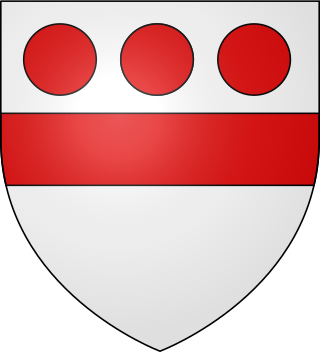
Sir Walter Devereux, 5th Viscount Hereford, 2nd Baronet of Castle Bromwich, was an English politician who sat in the House of Commons at various times, between 1614 and 1624, before succeeding to the family Viscountcy in the peerage of England.
William Devereux was an Anglo-Norman nobleman living during the reigns of kings William I, William II, and Henry I of England. The Devereux, along with the Baskervilles and Pichards, were prominent knightly families along the Welsh marches at the beginning of the twelfth century, and linked to the Braose and Lacy lordships of the region. William Devereux's descendants would later give rise to the Devereux family of Hereford, and the Devereux Viscounts of Hereford and Earls of Essex.
Stephen Devereux was a powerful Marcher Lord, and held Lyonshall Castle controlling an important approach to the border of Wales. As a key member of William Marshal, 1st Earl of Pembroke retinue, he played a significant role in the Earl's support of King John during the First Barons' War, and during the minority of Henry III.
Sir Walter Devereux of Bodenham and Weobley was a prominent knight in Herefordshire during the reigns of Richard II and Henry IV. He represented Hereford in Parliament, and gave rise to the Devereux Earls of Essex and Viscounts of Hereford.
Sir Walter Devereux of Bodenham was a prominent knight in Herefordshire during the reign of Edward III. He was a member of Parliament, sheriff, and Justice of the Peace for Hereford.
Sir William Devereux of Bodenham was a prominent knight in Herefordshire during the reign of Edward III, and an important member of the retinue of the Earls of Hereford. He is the ancestor of the Devereux Earls of Essex and Viscounts of Hereford.
Walter Devereux was an Anglo-Norman nobleman living during the reign of king Henry II of England and Richard I of England. The Devereux, along with the Baskervilles and Pichards, were prominent knightly families along the Welsh marches during the twelfth century, and linked to William Marshal, 1st Earl of Pembroke, and the Braose and Lacy lordships of the region. William Devereux's descendants would later give rise to the Devereux Viscounts of Hereford and Earls of Essex.
Sir Edward Devereux was an English politician who sat in the House of Commons, and was an English Baronet.
John Devereux of Bodenham and Decies was an Anglo-Norman nobleman living during the reigns of King John and Henry III of England. The Devereux were a prominent knightly family along the Welsh Marches during the thirteenth century, and John Devereux was a key member of the retinue of Richard Marshal, 3rd Earl of Pembroke, and companion of Walter III de Clifford, Baron of Clifford.
Walter Devereux of Bodenham and Bromwich was an Anglo-Norman knight and sheriff of Herefordshire living during the reigns of Henry III of England and Edward I of England. The Devereux were a prominent family along the Welsh Marches during the thirteenth century, and integral to the control of this region during the Second Barons' War.
Nicholas Devereux of Chanston (Vowchurch) was an Anglo-Norman nobleman living during the reigns of John and Henry III of England. The Devereux were a prominent knightly family along the Welsh Marches during the thirteenth century, and Nicholas Devereux was a key member of the retinue of Walter de Lacy, Lord of Meath.
