
Andrew Kippis was an English nonconformist clergyman and biographer.

St Dunstan's, Mayfield in Mayfield, East Sussex was founded in 960 CE by St Dunstan, who was then Archbishop of Canterbury. It is reported as being originally a log church which lasted until it was replaced by a stone structure in the 12th century by the Normans. In 1389 this church was virtually destroyed by fire. Only the tower, the lancet window in the west wall and the base of the north aisle survive to this day. The local congregation probably used the private chapel at the Archiepiscopal Palace nearby until the church was rebuilt between 1410 and 1420.

Arthur Christopher Benson, was an English essayist, poet and academic, and the 28th Master of Magdalene College, Cambridge. He wrote the lyrics of Edward Elgar’s Coronation Ode, including the words of the patriotic song "Land of Hope and Glory" (1902). His literary criticism, poems, and volumes of essays were highly regarded. He was also noted as an author of ghost stories.

William Hayley was an English writer, best known as the biographer of his friend William Cowper.

Selsey is a seaside town and civil parish, about eight miles (12 km) south of Chichester in West Sussex, England. Selsey lies at the southernmost point of the Manhood Peninsula, almost cut off from mainland Sussex by the sea. It is bounded to the west by Bracklesham Bay, to the north by Broad Rife, to the east by Pagham Harbour and terminates in the south at Selsey Bill. There are significant rock formations beneath the sea off both of its coasts, named the Owers rocks and Mixon rocks. Coastal erosion has been an ever-present problem for Selsey.
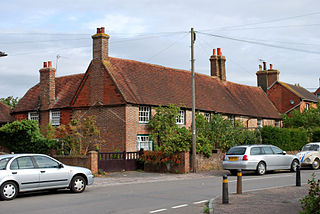
Thomas Turner was a shopkeeper in East Hoathly, Sussex, England. He is now most widely known for his diary.

Christopher Dock (c.1698—1771) was a Mennonite educator who worked primarily in South-East Pennsylvania. His teaching techniques stood in contrast to the norm of the day, and emphasized character building and discussion in lieu of physical punishment. His legacy lives on in the Christopher Dock Mennonite High School, which bears his name.
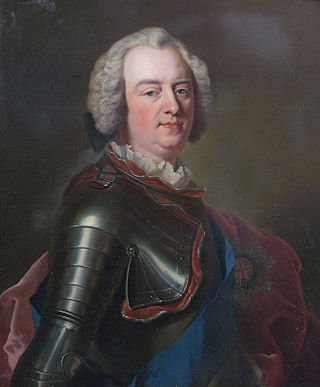
Charles Lennox, 2nd Duke of Richmond, 2nd Duke of Lennox, 2nd Duke of Aubigny, of Goodwood House near Chichester in Sussex, was a British nobleman and politician. He was the son of Charles Lennox, 1st Duke of Richmond, 1st Duke of Lennox, the youngest of the seven illegitimate sons of King Charles II. He was the most important of the early patrons of the game of cricket and did much to help its evolution from village cricket to first-class cricket.

Matthew Wren was an influential English clergyman, bishop and scholar.

James Woodforde (1740–1803) was an English clergyman, mainly in Somerset and Norfolk, remembered as the author of The Diary of a Country Parson. This vivid account of parish life remained unpublished until the 20th century.
Mayfield and Five Ashes is a civil parish in the High Weald of East Sussex, England. The two villages making up the principal part of the parish lie on the A267 road between Royal Tunbridge Wells and Eastbourne: Mayfield, the larger of the two villages is ten miles (16 km) south of Royal Tunbridge Wells; with Five Ashes being 2.5 miles (4 km) further south.

Nutley is a village in the Wealden District of East Sussex, England. It lies about 5 mi (8.0 km) north-west of Uckfield, the main road being the A22. Nutley, Fairwarp and Maresfield together form the Maresfield civil parish.
Younsmere Hundred was an administrative unit in the Rape of Lewes in the eastern division of the county of Sussex, England until the abolition of hundreds in the 19th century. The Rape was a county sub-division peculiar to Sussex. For most of the Younsmere hundred's existence it included the parishes of Rottingdean, Ovingdean and Falmer, i.e. the parishes covering a block of downland east of Brighton.
Nathan Daboll was an American teacher who wrote the mathematics textbook most commonly used in American schools in the first half of the 19th century. During the course of his career, he also operated a popular navigation school for merchant mariners, and published a variety of almanacs during the American Revolution period.

Mark Antony Lower F.S.A. M.A. (1813–1876) was a Sussex historian and schoolteacher who founded the Sussex Archaeological Society. An anti-Catholic propagandist Lower is believed to have started the "cult of the Sussex Martyrs", although he was against the excesses of the "Bonfire Boys".
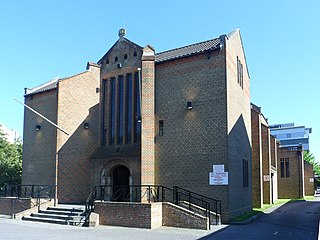
The Friary Church of St Francis and St Anthony is a Roman Catholic church in Crawley, a town and borough in West Sussex, England. The town's first permanent place of Roman Catholic worship was founded in 1861 next to a friary whose members, from the Order of Friars Minor Capuchin, had been invited to the area by a wealthy local family of Catholic converts. Crawley's transformation from a modest market town to a rapidly growing postwar New Town in the mid-20th century made a larger church necessary, and in the late 1950s the ecclesiastical architect Harry Stuart Goodhart-Rendel was commissioned to build a new church. The friary closed in 1980 and has been demolished, but the large brick church still stands in a commanding position facing the town centre. English Heritage has listed the building at Grade II for its architectural and historical importance.

Littlehampton Friends Meeting House is a Religious Society of Friends (Quaker) place of worship in the town of Littlehampton, part of the Arun district of West Sussex, England. A Quaker community has worshipped in the seaside town since the 1960s, when they acquired a former Penny School building constructed in the early 19th century. The L-shaped, flint-faced structure, consisting of schoolrooms and a schoolmaster's house, has been converted into a place of worship at which weekly meetings take place. The house is a Grade II Listed building.

Mayfield College is a defunct Roman Catholic boys' boarding school founded as the Holy Trinity Orphanage For Boys in 1865–1866 by the American-born Dowager Duchess of Leeds, Louisa Catherine Caton, one mile from Mayfield, East Sussex. The main building and attached chapel were built in the Gothic style, primarily of red brick and are Grade II listed, having been designed by E. W. Pugin. After closure in 1999 both the main building and chapel were converted into luxury apartments now called collectively Mayfield Grange. Officially opening in 1868 it was also known as the Xaverian Brothers School, St Xavier's College and Xaverian College at various times. Mayfield College was built as one of a pair of orphanages at the Duchess's expense, the other originally known as St. Michael's Orphanage for Girls in Bletchingley, East Sussex, also designed by Pugin.
Edward Burghall was an English ejected minister, a Puritan who supported the Parliamentary cause in the English Civil War. He is known for a diary called "Providence improved", which describes the state of Cheshire throughout the English Civil War. From this diary the main facts of Burghall's life can also be gathered.
Uckfield School, founded in 1718, later called Uckfield Grammar School, grew from a small local charity school at Uckfield into a grammar school with about 160 boys, including boarders. It closed in 1930.


