Related Research Articles

A ballad is a form of verse, often a narrative set to music. Ballads were particularly characteristic of the popular poetry and song of Great Britain and Ireland from the Late Middle Ages until the 19th century. They were widely used across Europe, and later in Australia, North Africa, North America and South America.

Porgy and Bess is an English-language opera by American composer George Gershwin, with a libretto written by author DuBose Heyward and lyricist Ira Gershwin. It was adapted from Dorothy Heyward and DuBose Heyward's play Porgy, itself an adaptation of DuBose Heyward's 1925 novel Porgy.

Germany claims some of the most renowned composers, singers, producers and performers of the world. Germany is the largest music market in Europe, and third largest in the world.
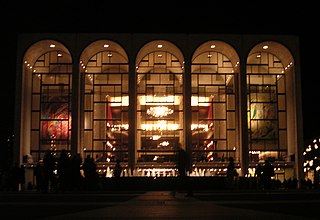
The music of New York City is a diverse and important field in the world of music. It has long been a thriving home for popular genres such as jazz, rock, soul music, R&B, funk, and the urban blues, as well as classical and art music. It is the birthplace of hip hop, garage house, boogaloo, doo wop, bebop, punk rock, disco, and new wave. It is also the birthplace of salsa music, born from a fusion of Cuban and Puerto Rican influences that came together in New York's Latino neighborhoods in the 1960s. The city's culture, a melting pot of nations from around the world, has produced vital folk music scenes such as Irish-American music and Jewish klezmer. Beginning with the rise of popular sheet music in the early 20th century, New York's Broadway musical theater, and Tin Pan Alley's songcraft, New York has been a major part of the American music industry.
Ukrainian music covers diverse and multiple component elements of the music that is found in the Western and Eastern musical civilization. It also has a very strong indigenous Slavic and Christian uniqueness whose elements were used among the areas that surround modern Ukraine.

Irish music is music that has been created in various genres on the island of Ireland.

In Italy, music has traditionally been one of the cultural markers of Italian national cultures and ethnic identity and holds an important position in society and in politics. Italian music innovation – in musical scale, harmony, notation, and theatre – enabled the development of opera and much of modern European classical music – such as the symphony and concerto – ranges across a broad spectrum of opera and instrumental classical music and popular music drawn from both native and imported sources. Instruments associated with classical music, including the piano and violin, were invented in Italy.
A lyricist is a writer who writes lyrics, as opposed to a composer, who writes the song's music which may include but not limited to the melody, harmony, arrangement and accompaniment.

Douglas Stuart Moore was an American composer, songwriter, organist, pianist, conductor, educator, actor, and author. A composer who mainly wrote works with an American subject, his music is generally characterized by lyricism in a popular or conservative style which generally eschewed the more experimental progressive trends of musical modernism. Composer Virgil Thomson described Moore as a neoromantic composer who was influenced by American folk music. While several of his works enjoyed popularity during his lifetime, only his folk opera The Ballad of Baby Doe (1956) has remained well known into the 21st century.

American classical music is music written in the United States in the Classical music tradition, which originated in Europe. In many cases, beginning in the 18th century, it has been influenced by American folk music styles; and from the 20th century to the present day it has often been influenced by American folk music and sometimes jazz.
The state of Maine is located in the New England region of the northeastern United States. Its musical traditions extend back thousands of years to the music of the first peoples of Maine, the Penobscot Passamaquoddy, Wabanaki and other related Indigenous cultures.

Jake Heggie is an American composer of opera, vocal, orchestral, and chamber music. He is best known for his operas and art songs as well as for his collaborations with internationally renowned performers and writers.

The ballad opera is a genre of English comic opera stage play that originated in the early 18th century, and continued to develop over the following century and later. Like the earlier comédie en vaudeville and the later Singspiel, its distinguishing characteristic is the use of tunes in a popular style with spoken dialogue. These English plays were 'operas' mainly insofar as they satirized the conventions of the imported opera seria. Music critic Peter Gammond describes the ballad opera as "an important step in the emancipation of both the musical stage and the popular song."

Walter Johannes Damrosch was a Prussian-born American conductor and composer. He was the director of the New York Symphony Orchestra and conducted the world premiere performances of various works, including Aaron Copland's Symphony for Organ and Orchestra, George Gershwin's Piano Concerto in F and An American in Paris, and Jean Sibelius' Tapiola. Damrosch was also instrumental in the founding of Carnegie Hall. He also conducted the first performance of Rachmaninoff's Piano Concerto No. 3 with the composer himself as soloist.

Earl Hawley Robinson was an American composer, arranger and folk music singer-songwriter from Seattle, Washington. Robinson is remembered for his music, including the cantata "Ballad for Americans" and songs such as "Joe Hill" and "Black and White", which expressed his left-leaning political views. He wrote many popular songs and music for Hollywood films, including his collaboration with Lewis Allan on the 1940s hit "The House I Live In" from the Academy Award winning film of the same name. He was a member of the Communist Party from the 1930s to the 1950s.
Musical nationalism refers to the use of musical ideas or motifs that are identified with a specific country, region, or ethnicity, such as folk tunes and melodies, rhythms, and harmonies inspired by them.

Rolf Liebermann, was a Swiss composer and music administrator. He served as the Artistic Director of the Hamburg State Opera from 1959 to 1973 and again from 1985 to 1988. He was also Artistic Director of the Paris Opera from 1973 to 1980.
Bright Sheng is a Chinese-born American composer, pianist and conductor. Sheng has earned many honors for his music and compositions, including a MacArthur Fellowship in 2001; he also was a two-time Pulitzer Prize finalist. His music has been commissioned and performed by virtually every major American symphony orchestra, in addition to the Orchestre de Paris, Royal Concertgebouw Orchestra, Toronto Symphony Orchestra, BBC Symphony Orchestra, London Sinfonietta, St. Petersburg Philharmonic Orchestra, Russian National Orchestra, Finnish Radio Symphony Orchestra, Sydney Symphony Orchestra, National Symphony Orchestra of Taiwan, Shanghai Philharmonic Orchestra, Tokyo Philharmonic Orchestra, and the Seoul Philharmonic Orchestra among numerous others. His music has been performed by such musicians as the conductors Leonard Bernstein, Kurt Masur, Christoph Eschenbach, Charles Dutoit, Michael Tilson Thomas, Leonard Slatkin, Gerard Schwarz, David Robertson, David Zinman, Neeme Järvi, Robert Spano, Hugh Wolff; the cellists Yo-Yo Ma, Lynn Harrell, and Alisa Weilerstein; the pianists Emanuel Ax, Yefim Bronfman, and Peter Serkin; the violinists Gil Shaham and Cho-Liang Lin; and the percussionist Evelyn Glennie.

"The Dowie Dens o Yarrow", also known as "The Braes of Yarrow" or simply "Yarrow", is a Scottish border ballad. It has many variants and it has been printed as a broadside, as well as published in song collections. It is considered to be a folk standard, and many different singers have performed and recorded it.
The Indianist movement was a movement in American classical music that flourished from the 1880s through the 1920s. It was based on attempts by classical composers to incorporate American Indian musical ideas with some of the basic principles of Western music, with the goal of creating a new, truly American national music.
References
- ↑ Budris, John (1992-03-24). "Songs of Slavery In Operatic Form". Christian Science Monitor . Retrieved 2018-02-21.
- ↑ Jess, Tyehimba (2003). African American Pride: Celebrating Our Achievements, Contributions, and Enduring Legacy . Citadel Press. ISBN 978-0806524986.
- ↑ Katz, Larry. "Interview with Walter Robinson, American Composer". Northeastern University Library Digital Repository Service. hdl:2047/D20428681 . Retrieved 10 January 2024.
   | This article about an American musician is a stub. You can help Wikipedia by expanding it. |