Related Research Articles

A puppeteer is a person who manipulates an inanimate object called a puppet to create the illusion that the puppet is alive. The puppet is often shaped like a human, animal, or legendary creature. The puppeteer may be visible to or hidden from the audience.

Puppetry is a form of theatre or performance that involves the manipulation of puppets – inanimate objects, often resembling some type of human or animal figure, that are animated or manipulated by a human called a puppeteer. Such a performance is also known as a puppet production. The script for a puppet production is called a puppet play. Puppeteers use movements from hands and arms to control devices such as rods or strings to move the body, head, limbs, and in some cases the mouth and eyes of the puppet. The puppeteer sometimes speaks in the voice of the character of the puppet, while at other times they perform to a recorded soundtrack.
Lili is a 1953 American film released by MGM. It stars Leslie Caron as a touchingly naïve French girl whose emotional relationship with a carnival puppeteer is conducted through the medium of four puppets. The film won the Academy Award for Best Original Score, and was also entered in the 1953 Cannes Film Festival. It was later adapted for the stage under the title Carnival! (1961).

A marionette is a puppet controlled from above using wires or strings depending on regional variations. A marionette's puppeteer is called a marionettist. Marionettes are operated with the puppeteer hidden or revealed to an audience by using a vertical or horizontal control bar in different forms of theatres or entertainment venues. They have also been used in films and on television. The attachment of the strings varies according to its character or purpose.

A sock puppet, sockpuppet, or sock poppet is a puppet made from a sock or a similar garment. The puppeteer wears the sock on a hand and lower arm as if it were a glove, with the puppet's mouth being formed by the region between the sock's heel and toe, and the puppeteer's thumb acting as the jaw. The arrangement of the fingers forms the shape of a mouth, which is sometimes padded with a hard piece of felt, often with a tongue glued inside.

Howdy Doody is an American children's television program that was created and produced by Victor F. Campbell and E. Roger Muir. It was broadcast on the NBC television network in the United States from December 27, 1947, until September 24, 1960. It was a pioneer of children's programming and set the pattern for many similar shows. One of the first television series produced at NBC in Rockefeller Center, in Studio 3A, it pioneered color production in 1956 and NBC used the show to promote color television sets in the late 1950s.
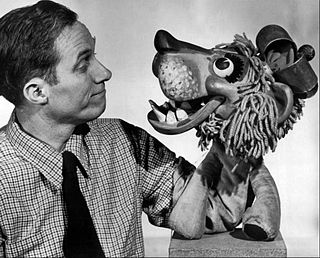
William Britton "Bil" Baird was an American puppeteer of the mid- and late 20th century. He and his puppets performed for millions of adults and children. One of his better known creations was Charlemane the lion. He and his wife Cora Eisenberg Baird (1912–1967) produced and performed the famous puppetry sequence for "The Lonely Goatherd" in the film version of The Sound of Music. His son Peter Baird was also a puppeteer, and he continued his family's legacy until his own death in July 2004.
A hand puppet is a type of puppet that is controlled by the hands that occupies the interior of the puppet. A glove puppet is a variation of hand puppets. Rod puppets require one of the puppeteer's hands inside the puppet glove holding a rod which controls the head, and the puppet's body then hangs over most or all of the forearm of the puppeteer, and possibly extends further. Other parts of the puppet may be controlled by different means, e.g., by rods operated by the puppeteer's free hand, or strings or levers pulled the head or body. A smaller variety, simple hand puppets often have no significant manipulable parts at all. Finger puppets are not hand puppets as they are used only on a finger.
Digital puppetry is the manipulation and performance of digitally animated 2D or 3D figures and objects in a virtual environment that are rendered in real-time by computers. It is most commonly used in filmmaking and television production but has also been used in interactive theme park attractions and live theatre.
Ronnie Burkett, OC is a Canadian puppeteer, best known for his original theatrical plays for adults, performed with marionettes. Burkett, who hails from Medicine Hat, was the puppeteer for Ralph on the TV Ontario series Harriet's Magic Hats during seasons three and four. He was also credited on two TV shows; Chicken Minute and Little Star.
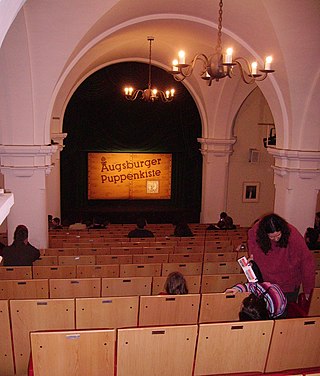
The Augsburger Puppenkiste is a marionette theater in Augsburg, Germany.
The Turnabout Theatre was a company of marionette puppeteers who performed in Hollywood from 1941 through 1956. The company's shows began with marionette performances, and concluded with a revue.

Mirsolav Trejtnar is a master puppeteer and teacher of puppetry.

Peter Scriven MBE was an Australian puppeteer, writer and theatre producer, and the founding artistic director of the Marionette Theatre of Australia. Scriven played a huge role in establishing puppetry as a serious artform in Australia.

A puppet is an object, often resembling a human, animal or mythical figure, that is animated or manipulated by a person called a puppeteer. Puppetry is an ancient form of theatre which dates back to the 5th century BC in Ancient Greece.

Yoke thé is the Burmese name for marionette puppetry. Although the term can be used for puppetry in general, its usage usually refers to the local form of string puppetry. Like most of Burmese refined art, yoke thé performances originated from royal patronage and were gradually adapted for the wider populace. Yoke thé are almost always performed in the form of Burmese operas.
Sue Hastings was an American puppeteer known for popularizing the ancient art of puppetry in the 1930s and 1940s. She was a protégé of famous advertising artist and master puppeteer Tony Sarg. She was known as a society hostess and for performing with her large collection of professionally made marionettes, which she created with the assistance of her large team of artisan puppeteers. Her many renowned performing companies were headquartered in New York City, New York, USA. During the height of her career, as owner and CEO of Sue Hastings Marionettes, Inc., she reputedly, in her inimitable "hands-on" style, was actively and very successfully directing over 50 performing companies, some of which performed worldwide for heads of Royalty, such as Queen Elizabeth I, and many other dignitaries and distinguished national and international diplomats and world leaders.

The Opera dei Pupi is a marionette theatrical representation of Frankish romantic poems traditionally performed in Sicily, Italy.
The Lanchester Marionettes, a professional puppet theatre, was co-founded in 1936 by Waldo and Muriel Lanchester. The 50-seat Lanchester Marionettes Theatre in Malvern, Worcestershire, England was “the only theatre in the country exclusively to be used for marionettes.” George Bernard Shaw’s final play, Shakes versus Shav, was written for the Lanchester Marionettes in 1949.
Margo Rose was an American puppeteer. She designed many puppets for films and the show Howdy Doody with her husband. The couple won a Peabody Award for ''The Blue Ferry" in 1958.
References
- puptcrit archive The team of Walton and O'Rourke and their puppets