Related Research Articles
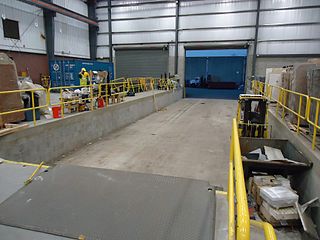
Logistics is a part of supply chain management that deals with the efficient forward and reverse flow of goods, services, and related information from the point of origin to the point of consumption according to the needs of customers. Logistics management is a component that holds the supply chain together. The resources managed in logistics may include tangible goods such as materials, equipment, and supplies, as well as food and other consumable items.

Inventory or stock refers to the goods and materials that a business holds for the ultimate goal of resale, production or utilisation.

Logistics automation is the application of computer software or automated machinery to improve the efficiency of logistics operations. Typically this refers to operations within a warehouse or distribution center, with broader tasks undertaken by supply chain engineering systems and enterprise resource planning systems.
A warehouse is a building for storing goods. Warehouses are used by manufacturers, importers, exporters, wholesalers, transport businesses, customs, etc. They are usually large plain buildings in industrial parks on the outskirts of cities, towns, or villages.
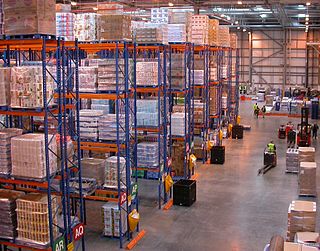
A distribution center for a set of products is a warehouse or other specialized building, often with refrigeration or air conditioning, which is stocked with products (goods) to be redistributed to retailers, to wholesalers, or directly to consumers. A distribution center is a principal part, the order processing element, of the entire order fulfillment process. Distribution centers are usually thought of as being demand driven. A distribution center can also be called a warehouse, a DC, a fulfillment center, a cross-dock facility, a bulk break center, and a package handling center. The name by which the distribution center is known is commonly based on the purpose of the operation. For example, a "retail distribution center" normally distributes goods to retail stores, an "order fulfillment center" commonly distributes goods directly to consumers, and a cross-dock facility stores little or no product but distributes goods to other destinations.

An automated storage and retrieval system consists of a variety of computer-controlled systems for automatically placing and retrieving loads from defined storage locations. Automated storage and retrieval systems (AS/RS) are typically used in applications where:
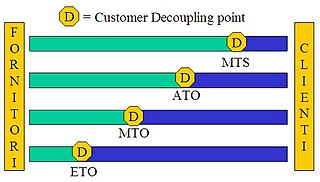
Order fulfillment is in the most general sense the complete process from point of sales inquiry to delivery of a product to the customer. Sometimes, it describes the more narrow act of distribution or the logistics function. In the broader sense, it refers to the way firms respond to customer orders.
A warehouse control system (WCS) is a software application that directs the real-time activities within warehouses and distribution centers (DC). As the “traffic cop” for the warehouse/distribution center, the WCS is responsible for keeping everything running smoothly, maximizing the efficiency of the material handling subsystems and often, the activities of the warehouse associates themselves. It provides a uniform interface to a broad range of material handling equipment such as AS/RS, carousels, conveyor systems, sorters, palletizers, etc. The primary functions of a WCS include:
Wave picking is used to support management and workers via a warehouse management system (WMS) in several ways, to support the planning and organizing of the daily flow of work of a warehouse or distribution center. Wave picking is an application of short-interval-scheduling. Managers, using a WMS, may assign groups of orders into short intervals called "waves", to initially simulate the flow for the day, consistent with the order departure plan and available labor. When the plan is satisfactory, it is accepted. The WMS will then release the waves to the warehouse sequentially throughout the day, to allow managers to coordinate the several parallel and sequential activities required to complete the daily work plan. One of the objectives of wave picking is to minimize the variation of workload in each work function by wave. The wave planning data includes the workload by order or function, providing management the information to calculate staff requirements to guide the assignment of staff by function, with the reasonable expectation that the work in each function, within each wave. Waves are often constructed to last between 1 and 4 hours, with resulting 8 to 2 waves in a shift.
Order processing is the process or work-flow associated with the picking, packing, and delivery of the packed items to a shipping carrier and is a key element of order fulfillment. Order processing operations or facilities are commonly called “distribution centers” or “DC 's”. There are wide variances in the level of automation associating to the “pick-pack-and-ship” process, ranging from completely manual and paper-driven to highly automated and completely mechanized; computer systems overseeing this process are generally referred to as Warehouse Management Systems or “WMS”.
Amazon Robotics, formerly Kiva Systems, is a Massachusetts-based company that manufactures mobile robotic fulfillment systems. It is a subsidiary company of Amazon.com. Its automated storage and retrieval systems were previously used by companies including The Gap, Walgreens, Staples, Gilt Groupe, Office Depot, Crate & Barrel, and Saks 5th Avenue. After those contracts ran out, Amazon did not renew them and Kiva's assets now work only for Amazon's warehouses.
Merge-in-transit (MIT) is a distribution method in which several shipments from suppliers originating at different locations are consolidated into one final customer delivery. This removes the need for distribution warehouses in the supply chain, allowing customers to receive complete deliveries for their orders. Under a merge-in-transit system, merge points replace distribution warehouse. In today's global market, merge-in-transit is progressively being used in telecommunications and electronic industries. These industries are usually dynamic and flexible, in which products have been developed and changed rapidly.
Distribution Center Management System (DCMS) is a user friendly Warehouse Management System (WMS), designed to track the activities performed in a distribution center (DC)/warehouse. It is created and owned by a private company called Eclipse Systems Pvt Ltd. It automates the entire process flow of receiving, managing and shipping goods to customers from the warehouse. DCMS solutions are designed for both large and small scale businesses. In January 2015, the product went open source.
SAP EWM is part of SAP AG's Supply Chain Management Suite of solutions. The Extended Warehouse Management product is an integrated software platform for inflexible, automated support for processing goods movements and for managing inventory in the warehouse.
The term dark store, dark shop, dark supermarket or dotcom centre refers to a retail outlet or distribution centre that exists exclusively for online shopping. A dark store is generally a large warehouse that can either be used to facilitate a "click-and-collect" service, where a customer collects an item they have ordered online, or as an order fulfillment platform for online sales. The format was initiated in the United Kingdom, and its popularity has also spread to France followed by the rest of the European Union and Russia, as well as to the United States.
Intelligrated, Inc. was a material handling automation and software engineering company based in Mason, Ohio. In 2016, it was acquired by Honeywell, who made it a subsidiary and renamed it to Honeywell Intelligrated. 2017, Honeywell Intelligrated reported revenue of $1 billion. Honeywell Intelligrated has production and service locations in the United States, Canada, India, Mexico, Brazil, and China.
Warehouse execution systems (WES) are computerized systems used in warehouses and distribution centers to manage and orchestrate the physical flow of products from receiving through shipping. Warehouses are storage facilities for raw materials and parts used in manufacturing operations; distribution centers (DCs) are facilities that store and distribute finished goods to retail locations, consumers, and other end customers.
Omnichannel order fulfillment is a material handling fulfillment strategy and process that treats inventory as fully available to all channels from one location. While the internal fulfillment process may diverge to optimize the operations, the outbound process only diverges at the point of pack out and shipping.
Attabotics is a robotics company based in Calgary, Alberta, Canada that specializes in Automated Storage and Retrieval System (AS/RS) inventory management systems. Founded in 2016, the company designs and manufactures intelligent robots that operate within a modular, three-dimensional storage structure that minimizes the traditional fulfillment center footprint.
A transportation and warehouse management system (TWMS) is a software application that supports eCommerce, distribution, and third-party logistics (3PL) companies within supply chain management.
References
- 1 2 Michel, Roberto (1 July 2016). "The catch in going waveless". Modern Materials Handling. Retrieved 21 September 2017.
- ↑ "5 Tips for Moving Beyond the Traditional Warehouse Management System". Supply Chain Brain. RIS News. 27 October 2016. Retrieved 21 September 2017.
- ↑ "What is batch picking?". Business Dictionary. Archived from the original on 3 June 2019. Retrieved 3 November 2017.
- ↑ "The 7 Wastes of Lean". KaiNexus. Retrieved 3 November 2017.
- ↑ "WHAT IS LEAN?". Lean Enterprise Institute. Retrieved 3 November 2017.
- ↑ Quackenbush, Jeff (18 July 2017). "WineDirect opening big high-tech Napa Valley fulfillment center". North Bay Business Journal. Archived from the original on 1 July 2018. Retrieved 21 September 2017.
- ↑ "The Waveless Warehouse: Why Wave Picking Might Not Be the Best for Your Distribution Center". Supply Chain 247. 22 March 2017. Retrieved 21 September 2017.
- ↑ Holste, Cliff (20 September 2017). "Sorting It Out: Customized Order Fulfillment Requirements Drives Adoption of Automation Technology". Supply Chain Digest. Retrieved 21 September 2017.
- ↑ Gallien, Jeremie; Weber, Theophane (26 May 2010). "To Wave or Not to Wave? Order Release Policies for Warehouses with an Automated Sorter" (PDF). Manufacturing & Service Operations Management. 12 (4): 642–662. doi:10.2139/ssrn.1266171. S2CID 901694 . Retrieved 20 September 2017.
- ↑ Michel, Roberto (1 January 2015). "Supply Chain Software: Waving bottleneck issues goodbye". Modern Materials Handling. Retrieved 21 September 2017.