
George Westinghouse Jr. was a prolific American inventor, engineer, and entrepreneurial industrialist based in Pittsburgh, Pennsylvania. He is best known for his creation of the railway air brake and for being a pioneer in the development and use of alternating current (AC) electrical power distribution. During his career, he received 362 patents for his inventions and established 61 companies, many of which still exist today.

The Westinghouse Electric Corporation was an American manufacturing company founded in 1886 by George Westinghouse and headquartered in Pittsburgh, Pennsylvania. It was originally named "Westinghouse Electric & Manufacturing Company" and was renamed "Westinghouse Electric Corporation" in 1945. Through the early and mid-20th century, Westinghouse Electric was a powerhouse in heavy industry, electrical production and distribution, consumer electronics, home appliances and a wide variety of other products. They were a major supplier of generators and steam turbines for most of their history, and was also a major player in the field of nuclear power, starting with the Westinghouse Atom Smasher in 1937.
Westinghouse Electric Company LLC is an American nuclear power company formed in 1999 from the nuclear power division of the original Westinghouse Electric Corporation. It offers nuclear products and services to utilities internationally, including nuclear fuel, service and maintenance, instrumentation, control and design of nuclear power plants. Westinghouse's world headquarters are located in the Pittsburgh suburb of Cranberry Township, Pennsylvania.
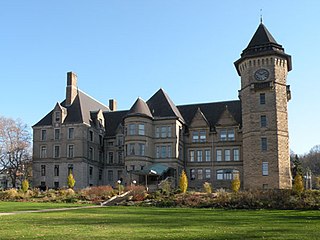
The Westinghouse Air Brake Technologies Corporation (WABCO) was an American company founded on September 28, 1869 by George Westinghouse in Pittsburgh, Pennsylvania. Earlier in the year he had invented the railway air brake in New York state.
The Westinghouse Astronuclear Laboratory (WANL) was a division of Westinghouse Electric Corporation. Established in 1959 to develop nuclear space propulsion technologies for the government, the lab was located, for most of its history, in the paradoxically small town of "Large" along Pa. Rte 51, about 13 miles (21 km) south of Pittsburgh in Allegheny County, Pennsylvania, USA. The site is not far from the Bettis Atomic Power Laboratory in West Mifflin, which Westinghouse operated during the same time and later.

Union Switch & Signal was an American company based in Pittsburgh, Pennsylvania, which focused on railway signaling equipment, systems and services. The company was acquired by Ansaldo STS in 1988, operating as a wholly-owned company until January 2009, when US&S was renamed "Ansaldo STS USA" to operate as a subsidiary of Ansaldo in the Americas and Asia.
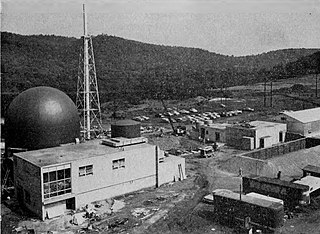
The Saxton Nuclear Experiment Station, also known as the Saxton Nuclear Generating Station or Saxton Nuclear Experimental Corporation Facility, was a small nuclear power plant located in Bedford County, near Saxton, Pennsylvania.

The Westinghouse Licensing Corporation was a Delaware General Corporation Law organized subsidiary that was founded in 1998 by Westinghouse-CBS in managing the intellectual property assets relating to the Westinghouse trademarks produced from 1886 until 1996. The Westinghouse name and trademarks were purchased from ViacomCBS in 2021 by a new company called Westinghouse Electric Corporation.

Heinrich Johann Welker was a German theoretical and applied physicist who invented the "transistron", a transistor made at Westinghouse independently of the first successful transistor made at Bell Laboratories. He did fundamental work in III-V compound semiconductors, and paved the way for microwave semiconductor elements and laser diodes.
The Westinghouse Combustion Turbine Systems Division (CTSD), part of Westinghouse Electric Corporation's Westinghouse Power Generation group, was originally located, along with the Steam Turbine Division (STD), in a major industrial manufacturing complex, referred to as the South Philadelphia Works, in Lester, Pennsylvania near to the Philadelphia International Airport.
Westinghouse Advanced Energy Systems Division (AESD) was a research and development facility for nonconventional renewable energy systems, in the small town of Large in Allegheny County, Pennsylvania [USA]. The site is on the east side of Pa. Rte. 51, about 13 miles (21 km) south of Pittsburgh. Formerly the site of the Westinghouse Astronuclear Laboratory (WANL), Westinghouse Electric Corporation changed the name of the facility, along with its charter, in 1977.
The Siemens Energy Sector was one of the four sectors of German industrial conglomerate Siemens. Founded on January 1, 2009, it generated and delivered power from numerous sources including the extraction, conversion and transport of oil and natural gas in addition to renewable and alternative energy sources. As of October 1, 2014, the sector level has been eliminated, including the Siemens Energy Sector.
Walter Guy Roman, was born in Aspen, Colorado and died in Gaithersburg, Maryland. Walter was a son of Erick Roman and Selma Coles.
Herbert Franz Mataré was a German physicist. The focus of his research was the field of semiconductor research. His best-known work is the first functional European transistor, which he developed and patented together with Heinrich Welker in the vicinity of Paris in 1948, independent from the Bell Labs engineers who had developed the first transistor shortly before. The final 20 years of his life Mataré split time between his homes in Hückelhoven, Germany and Malibu, California. He was born in Aachen.

Westinghouse Air Brake Technologies Corporation, commonly known as Wabtec, is an American company formed by the merger of the Westinghouse Air Brake Company (WABCO) and MotivePower Industries Corporation in 1999. It is headquartered in Pittsburgh, Pennsylvania.
The Westinghouse Air Brake Company General Office Building in Wilmerding, Pennsylvania is a building from 1890. It was listed on the Pittsburgh History and Landmarks Foundation in 1975, National Register of Historic Places in 1987. Originally built as an office building for the Westinghouse Air Brake Company, it housed the George Westinghouse Museum from 2006 to 2016. In 2016 it was sold to the Priory Hospitality Group with the intention of being developed into a boutique hotel. However, the 2020 global pandemic affected those plans and it was announced in November 2021 that the building will be used for an art academy and to house classrooms for the Westinghouse Arts Academy, a nearby high school.

The Westinghouse Memorial is a bronze monument located in the U.S. city of Pittsburgh, Pennsylvania. It commemorates George Westinghouse, an engineer, founder of the Westinghouse Electric Corporation, and inventor of the railway air brake. The memorial is located at the entrance to the Steven Faloon trail, a part of Schenley Park. The architects for the monument and the surrounding area were Henry Hornbostel and Eric Fisher Wood. Daniel Chester French was the sculptor for the statue and the main panel, and Paul Fjelde designed the side panels.

The Westinghouse Atom Smasher was a 5 million volt Van de Graaff electrostatic nuclear accelerator operated by the Westinghouse Electric Corporation at their Research Laboratories in Forest Hills, Pennsylvania. It was instrumental in the development in practical applications of nuclear science for energy production. In particular, it was used in 1940 to discover the photofission of uranium and thorium, and was most cited for certain nuclear physics measurements. The Westinghouse Atom Smasher was intended to make measurements of nuclear reactions for research in nuclear power. It was the first industrial Van de Graaff generator in the world, and marked the beginning of nuclear research for civilian applications. Built in 1937, it was a 65-foot-tall (20 m) pear-shaped tower. It was essentially unused after World War II, and the main structure was laid on its side in 2015. In 1985, it was named an Electrical Engineering Milestone by the Institute of Electrical and Electronics Engineers.
Petrol–electric transmission or gasoline–electric transmission or gas–electric transmission is a transmission system for vehicles powered by petrol engines. Petrol–electric transmission was used for a variety of applications in road, rail, and marine transport, in the early 20th century. After World War I, it was largely superseded by diesel–electric transmission, a similar transmission system used for diesel engines; but petrol–electric has become popular again in modern hybrid electric vehicles.
Gwilym Alexander Price was a lawyer, Pennsylvania state legislator, banker, and industrialist.
